Why the automation gap persists and how to close it in your organization.
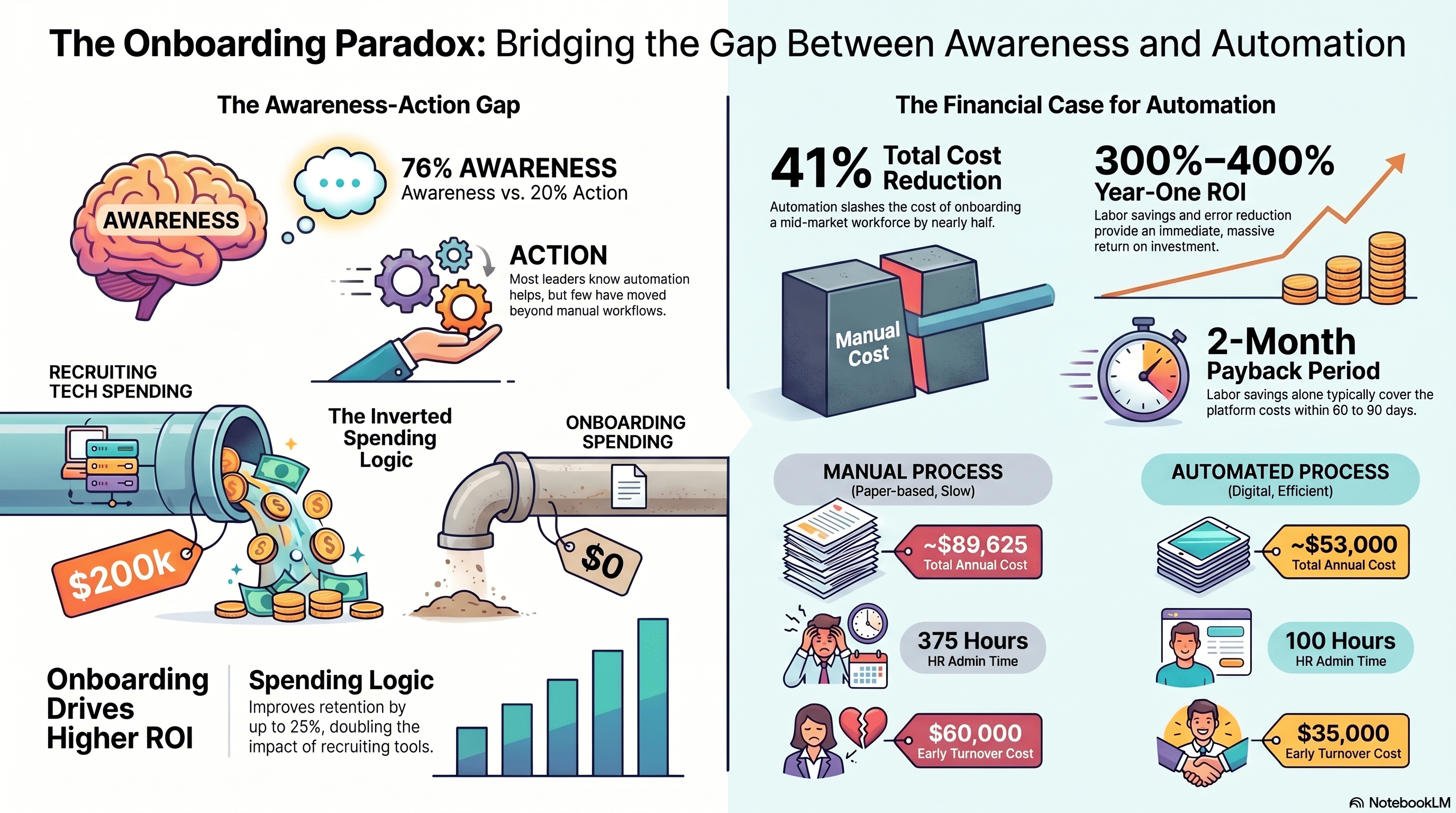
The Awareness-Action Gap in Onboarding Automation
A recent survey by the Business Management Association found that 76% of HR leaders say they understand that onboarding automation improves retention, reduces errors, and accelerates time-to-productivity. Yet only 20% of organizations have implemented systematic automation in their onboarding processes.
This gap—between awareness and action—is the most damaging inefficiency in talent operations. Organizations acknowledge the problem but fail to implement the solution. The costs compound annually: HR teams waste thousands of hours, new hires struggle with disorganized processes, and preventable turnover persists.
Why does this gap exist? It's not a technology problem. It's a change management, budget allocation, and business case clarity problem.
Barriers to Onboarding Automation Adoption
Perceived Complexity and Integration Overhead
Many organizations believe onboarding automation requires overhauling the entire HR tech stack. The reality: most modern ATS and HR platforms include onboarding modules. The barrier is often false perception that systems need rip-and-replace. Start by auditing what your current ATS can do; likely 60-70% of needed automation is already available, just not configured.
Budget Allocation Favors Recruiting Over Onboarding
ATS and sourcing tools get marketing budgets and board visibility. Onboarding sits in 'the back office.' A typical organization spends $50,000-200,000 annually on recruiting technology but $0-10,000 on onboarding automation. This inverted spending is illogical: better onboarding improves retention by 15-25%, but better recruiting tools improve hire quality by 5-10%. Dollar for dollar, onboarding ROI is higher.
'We've Always Done It This Way' Inertia
HR teams with paper-based onboarding develop ingrained processes. Changing workflows feels disruptive. The counterintuitive truth: automating onboarding reduces HR workload, freeing time for higher-value work. But persuading teams to try requires demonstrating short-term gains (less paper printing) and long-term gains (better retention).
Fear of Technology Failures and Compliance Risk
Some organizations worry automating compliance workflows introduces technology risk. What if the system fails? What if audit trails aren't preserved? These are legitimate concerns but misstated. Modern compliance platforms are more audit-proof than filing cabinets; they maintain immutable records. A single compliance gap costs more than years of platform fees.
The True ROI of Onboarding Automation
Let's quantify impact. A mid-market organization with 500 annual hires:
Current state (manual onboarding): HR admin time (45 minutes per hire = 375 hours annually at $35/hr = $13,125) + Document errors (10% rate = 50 errors = 150 hours remediation = $5,250) + Day-one productivity loss (1.5 hours × 500 = $11,250 value) + Early turnover 30-day rate of 12% (60 additional hires needed = $60,000 recruiting costs) + Total cost: ~$89,625
Automated onboarding: HR admin time (12 minutes = 100 hours = $3,500) + Document errors (2% rate = 10 errors = 20 hours = $700) + Day-one productivity preserved (30 min saved = $3,750 value) + Early turnover reduced to 7% (35 additional hires = $35,000) + Platform cost ($10,000) + Total cost: ~$53,000
Net savings: $36,625 annually, or 41% cost reduction. Plus intangible benefits (reduced compliance risk, improved hire experience, better retention). Return on investment: 300-400% in year one.
Why Organizations Underestimate Onboarding ROI
The ROI calculation above is conservative. Most organizations fail to account for:
Compliance risk: A single I-9 audit finding costs $100-500+ per violation. A single data breach (unsecured filing cabinet with SSNs) costs $10,000-100,000+.
Manager time: Managers spend 3-5 hours getting a new hire oriented (discussing paperwork, answering questions). Streamline administrative burden, managers focus on training and mentoring.
Turnover's ripple effects: When a hire leaves within 90 days, remaining team members often follow within 6 months (34% of departures happen in clusters). The productivity loss extends beyond the departing hire.
Brand damage: A poorly onboarded hire tells friends they had a bad experience. In tight labor markets (retail, hospitality, logistics), word-of-mouth hiring is critical. Poor onboarding experience spreads.
These intangible costs make the business case for automation even stronger.
Change Management: How to Build Internal Support
Implementing onboarding automation requires buy-in from HR, operations, compliance, and finance. Here's how to build that coalition:
Start with HR pain: Document how much time HR currently spends on manual onboarding. Interview team members; quantify frustration. Show that automation reduces their workload and eliminates tedious, error-prone work.
Pilot first: Don't automate all 500 hires at once. Pilot in 2-3 locations or for a single department. Capture metrics (time saved, errors prevented, hire feedback) to build confidence.
Involve operations: Show store managers that automated onboarding means hires arrive ready to work, not delayed by paperwork. Frame it as improving day-one execution.
Engage compliance: Work with legal/compliance to vet the platform and understand its audit capabilities. Demonstrate digital processes are more compliant than manual ones.
Build the business case: Present financial ROI to finance. Even if the numbers seem large, the payback period is 2-3 months of labor savings.
Key messaging: "This isn't about HR technology; it's about removing friction for new hires and letting our teams focus on what matters—getting people productive and engaged."
Selecting an Onboarding Automation Platform
Not all onboarding platforms are created equal. When evaluating, prioritize:
Mobile-first design: If 80%+ of hires access documents on phones, platform must be mobile-native, not desktop-optimized.
Pre-built templates: You shouldn't create forms from scratch. Look for industry-specific templates (retail, hospitality, logistics).
HRIS integration: Documents and candidate data must flow automatically into HRIS. Manual re-entry defeats the purpose.
e-Signature and E-Verify integration: These should be included, not add-ons requiring third-party tools.
Compliance vault: Automated storage, tagging, and retrieval of documents for audit purposes.
Multi-language support: If you hire internationally or serve diverse populations, multilingual forms are essential.
Analytics and reporting: Track completion rates, time-to-completion, error rates, and eventually, retention correlations.
Demand a free pilot with real data. Most platforms offer 30-60 day trials. Test with your next cohort of 50-100 hires; measure time saved and feedback.
The Cost of Waiting
Organizations often delay onboarding automation, waiting for 'the right moment' or 'a bigger budget.' But the cost of inaction compounds:
Every month without automation, 40-50 new hires have a suboptimal experience. Every month, HR staff waste 30+ hours on manual paperwork. Every month, 4-6 preventable early-departure hires create churn and morale impact.
Over a year, this inaction costs tens of thousands of dollars. The longer you wait, the more compelling the business case for action becomes.
Organizations at the forefront of onboarding automation—companies like Instacart, Amazon Logistics, and leading healthcare networks—made the decision three years ago. They're now harvesting the benefits: 40% faster onboarding, 25% better retention, HR teams focused on strategic work instead of form processing.
Your organization can be next.
Building a Roadmap for Implementation
A realistic 6-month implementation roadmap:
Month 1: Audit current onboarding process. Document time spent, errors, drop-off points. Build business case with data.
Month 2: Platform selection and pilot planning. Choose vendor, set up pilot cohort.
Month 3: Pilot execution. Run 50-100 hires through new automated process. Gather feedback from HR, managers, new hires.
Month 4: Refinement and training. Based on pilot feedback, adjust workflows. Train HR and managers on new process.
Month 5: Soft rollout to additional locations or departments. Scale gradually; monitor metrics.
Month 6: Full company-wide launch. Decommission paper processes. Celebrate wins with team.
Key milestone: By end of month 6, paper onboarding should be gone.
How Cadient Talent SmartSuite Helps
SmartSuite's onboarding automation module handles entire pre-boarding and day-one process: templated digital forms, e-signature, E-Verify integration, HRIS sync, and compliance vault. Mobile-optimized for frontline users. Multi-language support. Pre-built workflows for retail, hospitality, and logistics. Piloting is free for your next 100 hires, with transparent ROI measurement.
References and Further Reading
- Business Management Association, 'The Onboarding Automation Gap' (2024)
- Mercer, 'Global Talent Trends 2024' (2024)
- SHRM, 'Onboarding and Retention' (2023)
- Deloitte, 'The Cost of Talent Turnover' (2024)
How Cadient Talent SmartSuite™ Helps
Cadient Talent’s SmartSuite™ platform automates compliance workflows, embeds regulatory guardrails directly into your hiring process, and maintains audit-ready documentation at every stage—so your team can focus on finding great talent while staying protected from costly violations.
