LinkedIn learning data, career development for hourly workers, upskilling programs, and internal mobility paths.
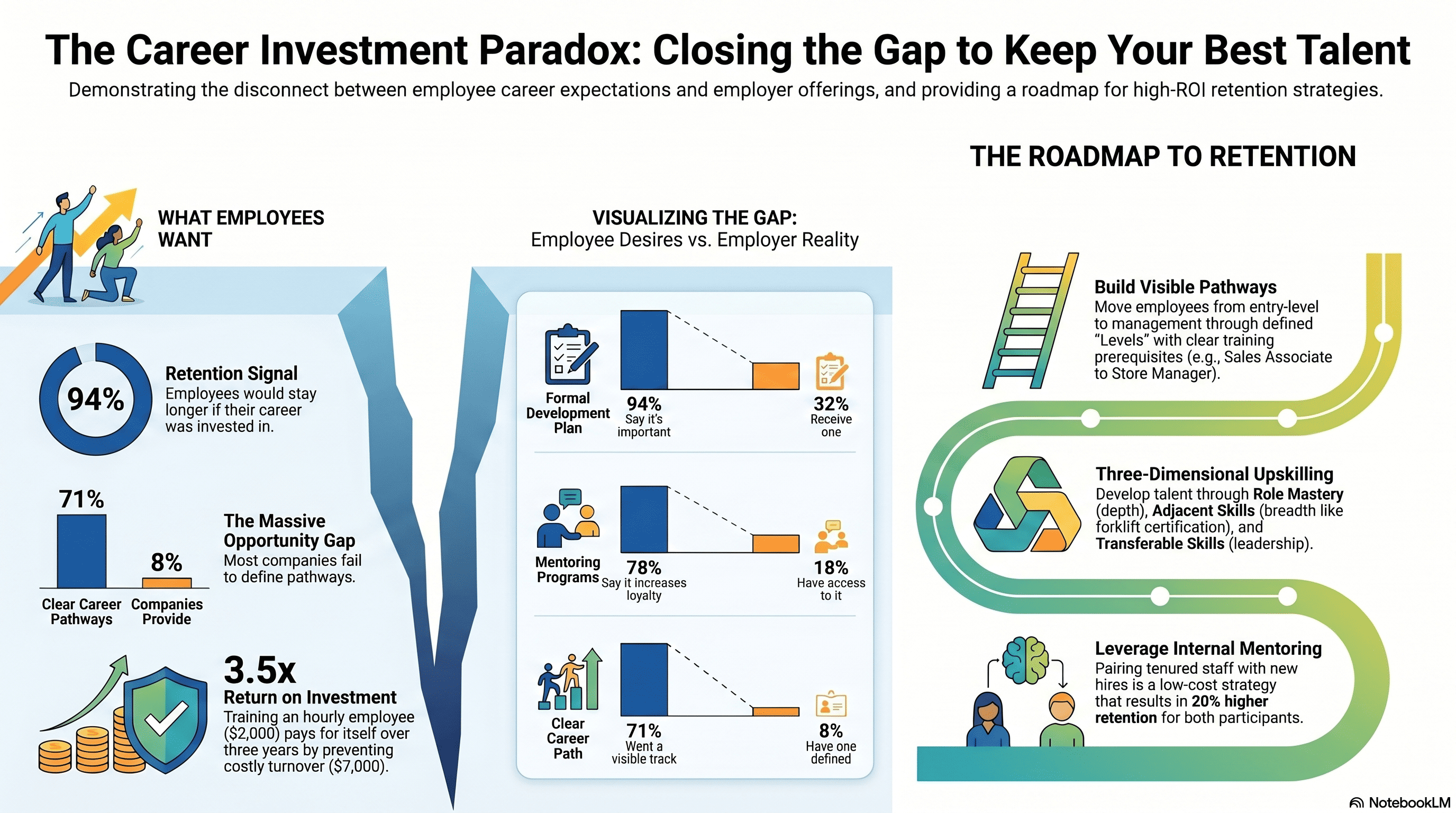
The Career Investment Paradox: What Employees Want vs. What Companies Provide
LinkedIn's 2023 Workplace Learning Report surveyed 5,000 employees on career development priorities.
What employees want: 94% say career development is important for staying long-term, 78% say company investment in their skills would increase loyalty, 82% would take lateral moves to develop new skills, 71% want clear career pathways, 58% report inadequate development opportunities.
What companies provide: 32% of hourly workers receive annual development plan from manager, 18% have formal mentoring, 8% have clear career progression path defined, 12% receive development budget allocation.
The gap is massive. 94% of employees want career investment. Yet 68% don't receive any formal development plan. For companies, this is leaving retention on the table.
Why the gap exists: (1) Sunk cost mentality: companies fear developing people makes them leave. False. Not developing them means they definitely leave. (2) Hourly staff viewed as transient: Why invest if they turn over anyway? Investment actually reduces turnover. (3) Budget constraints: Development is expensive. Wrong. Microlearning and internal mentoring are low-cost. (4) Lack of clear paths: Salaried staff have management track. Hourly staff don't. Without paths, development is directionless. (5) Manager burden: My manager is too busy. Career development conversations are 30 minutes monthly.
The financial argument: Company invests 2,000 in training an hourly employee. If employee leaves in 3 months, ROI is negative. If employee stays 3 years, that is 2,000 investment on 30,000 per year salary = 6.7% of annual cost = trivial. If training reduces turnover (employee stays 2 more years beyond baseline), ROI on reduced turnover cost (7,000) exceeds training cost (2,000) 3.5x. Investment pays for itself through retention alone.
Career Development for Hourly Workers: Creating Pathways
Most hourly workers see no path: I am a cashier. I will be a cashier. There is nothing else. This perception drives departure.
Creating visible pathways enables employees to see progression. Retail example: Level 1 Sales Associate, Level 2 Lead Associate (train new staff, handle difficult customers), Level 3 Senior Lead (assist manager), Level 4 Assistant Manager (full operational responsibility), Level 5 Store Manager.
Each level has prerequisites: Level 2 requires customer service + team leadership training (12 hours), Level 3 requires inventory management + scheduling fundamentals (20 hours), Level 4 requires P&L training + hiring (40 hours), Level 5 requires management certification (60 hours).
Employee sees this: If I learn customer service skills and complete training, I become Lead. If I do that well and complete inventory training, I become Senior Lead. Pathway is visible and achievable.
Warehouse example: Level 1 Warehouse Associate, Level 2 Lead Associate (quality inspection, mentoring), Level 3 Area Lead (oversee section, manage small team), Level 4 Shift Supervisor (manage shift, 20-40 people), Level 5 Warehouse Manager.
Compensation progression is also clear: Level 1 is 14-15 per hour, Level 2 is 15-16.50, Level 3 is 16.50-18, Level 4 is 18-21, Level 5 is 21-28. Employee understands: Learn skills, move up, make more money. Progression is tied to actual development, not tenure alone.
Key principles: (1) Visibility: Poster in break room, included in onboarding, discussed in reviews. (2) Achievability: Each level reachable with 12-24 months work plus training. (3) Clear prerequisites: To get here, you need this training. No mystery. (4) Internal promotion assumption: Good performers move up. This is the norm. (5) Multiple paths: Some want management; others want specialized skills. Offer both.
Implementation: Map current roles, define prerequisites for each level, create training requirements, communicate pathway, measure awareness and progression.
Upskilling Programs: Three Types of Development
Career development is not just vertical (move up). It is also horizontal (broaden skills) and diagonal (develop adjacent skills).
Three types: (1) Role mastery (depth): Retail cashier becomes POS expert becomes payment processing expert becomes trainer. (2) Adjacent skills (breadth): Warehouse packer becomes forklift certified becomes equipment operator. (3) Transferable skills (portability): Communication, leadership, problem-solving, digital literacy that apply across roles.
Upskilling program design involves identifying skill gaps, creating training paths, coaching on application, and enabling applied learning. For example, what skills does high-performing employee at Level 2 need for Level 3? Create targeted training: Module 1 Inventory management systems (12 hours), Module 2 Scheduling fundamentals (8 hours), Module 3 Coaching and training (10 hours). Total 30 hours over 3-4 months.
Offer upskilling as menu of options. Technical track for deeper expertise (advanced POS, inventory management, equipment operation, quality control). Leadership track for management path (coaching, delegation, conflict resolution, team dynamics, hiring, scheduling). Specialized track for expertise (customer experience specialist, product knowledge expert, safety specialist, process improvement specialist, technology specialist).
Budget for 200 hourly staff: Training content 10,000-20,000, microlearning platform 2,000-3,000, manager training 5,000-8,000, certifications 3,000-5,000 annually. Total 20,000-36,000 annually, or 100-180 per employee. ROI: Easily 10x through retention plus productivity.
Internal Mobility: Career Paths Across Departments
Vertical pathways (move up in current department) are important. Horizontal movement (transfer to different department) is equally valuable. Why? Employees want change without leaving company, discover new interests, broaden skills, company retains institutional knowledge, reduces dead-end perception.
Internal mobility program structure: (1) Create transfer framework: Employees eligible to transfer after 12+ months in current role. No restrictions. Manager approves transition. (2) Internal job posting: Post internally first, 5 days before external posting. Internal candidates interviewed first. Internal hire gets priority if equally qualified. (3) Career conversation framework: Manager and employee have annual conversation about learning, future interests, openness to transfer, career excitement. (4) Development for mobility: If interested in different department, create development path with training plan and cross-training (30% of time in target department while still in current role).
Example: Sarah is retail associate, 2 years tenure. Interest: warehouse operations. Development plan: Month 1-2 cross-training 1 day per week (observe), Month 3-4 training on systems, safety, inventory (16 hours), Month 5-6 cross-training 2 days per week (hands-on), Month 7-8 available for transfer. When role opens, Sarah applies and is ready.
Measuring internal mobility: Track number of transfers, percentage of roles filled internally, retention of transferred employees, satisfaction with transfer. Target benchmarks: 20-30% of annual open roles filled internally, 80%+ of transferred employees employed 12 months after transfer, 85%+ satisfaction with transfer decision.
Companies achieving these benchmarks show 35-40% higher overall retention. Employees value ability to move around and grow.
Mentoring: Leveraging Tenured Employees
Formal mentoring pairs tenured employee (mentor) with newer or less-experienced employee (mentee) through regular conversation and guidance. Benefits: Low cost (uses existing payroll), high engagement (mentors feel valued, mentees feel invested in), knowledge transfer (tenured employees share institutional knowledge), leadership development (mentors develop coaching skills), retention (both mentors and mentees show higher retention).
Program structure: Identify mentors with 5+ years tenure, high performance, willing to mentor, demographic diversity. Provide mentor training on listening, asking questions, providing feedback, balancing support and challenge (4 hours). Match mentors to mentees based on preferences, capacity (1 mentor to 2-3 mentees max), diversity, same or cross-department.
Structured framework: Biweekly 30-minute conversations. Month 1-2: Relationship building, mentee goals (Where do you want to be in 2 years?). Month 3-4: Skill development, feedback on performance (How can you improve X?). Month 5-6: Problem-solving, overcoming challenges (I faced similar thing. Here is how I approached that). Month 7-12: Growth planning, next steps (You are ready for lead role. Here is what is next).
Recognize and incentivize: Annual recognition and small gift/bonus for mentors, valuable for advancement records, public celebration in team meetings, career opportunity (mentors often get management fast-track as mentoring demonstrates leadership readiness).
Expected outcomes: Mentees showing 15-20% higher promotion rate, mentors showing 20-25% higher promotion rate, both groups showing 18-22% higher retention, mentees reporting 35% higher engagement.
Low-cost, high-impact program.
Education Support: Tuition Assistance and Certifications
Some career development requires formal education: college degrees, professional certifications, trade certifications. Company-supported education signals: We will invest in your future even beyond what our company needs. This is ultimate retention signal.
Tuition reimbursement program: Eligible employees with 1+ year tenure. Eligible education is job-related (not hobby degrees). Coverage up to 5,000 per year, 15,000 lifetime. Conditions: Maintain grade B or higher, job-related field, stay 1 year after completion. Job-related examples: Warehouse worker to supply chain management degree, retail associate to business administration degree (for management path), healthcare worker to nursing degree, logistics to supply chain certification.
Certification programs: Company pays for industry-standard certifications (CNA, LPN, nursing for healthcare; Forklift, OSHA, Six Sigma for logistics; retail management certification; food safety manager certification). Cost 300-2,000 per certification. Benefit: Employee becomes more valuable, employee stays.
Structured training programs: For roles requiring progression, offer in-house training pathway. Example sales leadership track: Month 1-3 sales fundamentals (20 hours), Month 4-6 customer relationship management (16 hours), Month 7-9 sales management workshop (24 hours), Month 10-12 coaching and development workshop (16 hours). Total 76 hours over 12 months. Employees completing program move into sales lead or manager roles. Cost 5,000-8,000 per employee. Benefit: Clear advancement path plus trained leaders.
Budget for 500-person company: Tuition reimbursement pool 50,000 annually (10 employees x 5,000 average), certification programs 15,000, in-house training 20,000. Total 85,000 annually, or 170 per employee.
Measurement: Track number of employees using tuition reimbursement, receiving certifications, promotions from education investment, retention (98%+ vs. baseline 65%), wage progression. Companies offering education support average 35-40% better retention for participant employees. Employee thinking: They are investing in my future. I want to stay.
Implementation: Making Career Development Real
Research shows 94% of employees want career development, but most companies don't provide it. Implementation is the gap.
Step 1: Leadership commitment. CEO and leadership must believe career development drives retention and is worth investment. Board-level discussion: Career development is retention strategy. Budget allocation: We are investing X in career development programs. Accountability: Manager bonuses are 30% tied to employee development and retention.
Step 2: Create pathways. Define career progression for each role, identify prerequisites for each level, create training plans for progression, communicate pathways (break room poster, onboarding, annual review). Target: 100% of staff aware of career pathway within 3 months.
Step 3: Manager training. Train managers on career development conversations, coaching employees, identifying development opportunities. Accountability: Manager scorecard includes development metrics. Target: 100% of managers trained within 6 months.
Step 4: Launch programs (phased rollout). Month 1-2 implement stay interviews. Month 3-4 launch career pathway communication plus upskilling program. Month 5-6 launch mentoring program. Month 7-8 launch education support program. Month 9-12 optimize based on early feedback.
Step 5: Create accountability. Manager scorecard: 20% of bonus tied to team development metrics including percentage of team with career development plan (target 80%), percentage completing training (target 60%), internal promotion rate (target 15%), team engagement score (target 40%+), retention rate (target 65%+).
Executive dashboard: Monthly visibility on number of employees with career development plan, number receiving training, promotion rate (internal vs. external), retention rate, engagement score, program ROI.
Step 6: Communicate and celebrate. Announce programs via email, meeting, break room signage. Share success stories. Public recognition of achievers. Monthly or quarterly updates. Celebrate milestones.
Common pitfalls: Career development without manager buy-in fails. Pathways without transparency do not exist. Training without application fades. Promises without follow-through erode trust. Promotion criteria not defined cause frustration. Development budget only for high performers misses mid-performers. Annual review as only development conversation is too infrequent.
References and Further Reading
- LinkedIn Learning Report, "Workplace Learning and Skills Development 2023", 2023
- Bureau of Labor Statistics, "Employee Development and Career Progression", 2023
- Society for Human Resource Management, "Training and Development as Retention Tool", 2023
- Harvard Business Review, "Career Development ROI", 2023
- Cadient Talent SmartSuite Case Study, "Internal Mobility Program Impact", 2024
- Gallup, "Manager Investment in Development and Engagement", 2023
- Journal of Applied Psychology, "Mentoring Effects on Career Development", 2022
How Cadient Talent SmartSuite™ Helps
Cadient Talent’s SmartSuite™ platform automates compliance workflows, embeds regulatory guardrails directly into your hiring process, and maintains audit-ready documentation at every stage—so your team can focus on finding great talent while staying protected from costly violations.
