Absenteeism as leading indicator, root cause analysis, intervention strategies.
Context and Overview
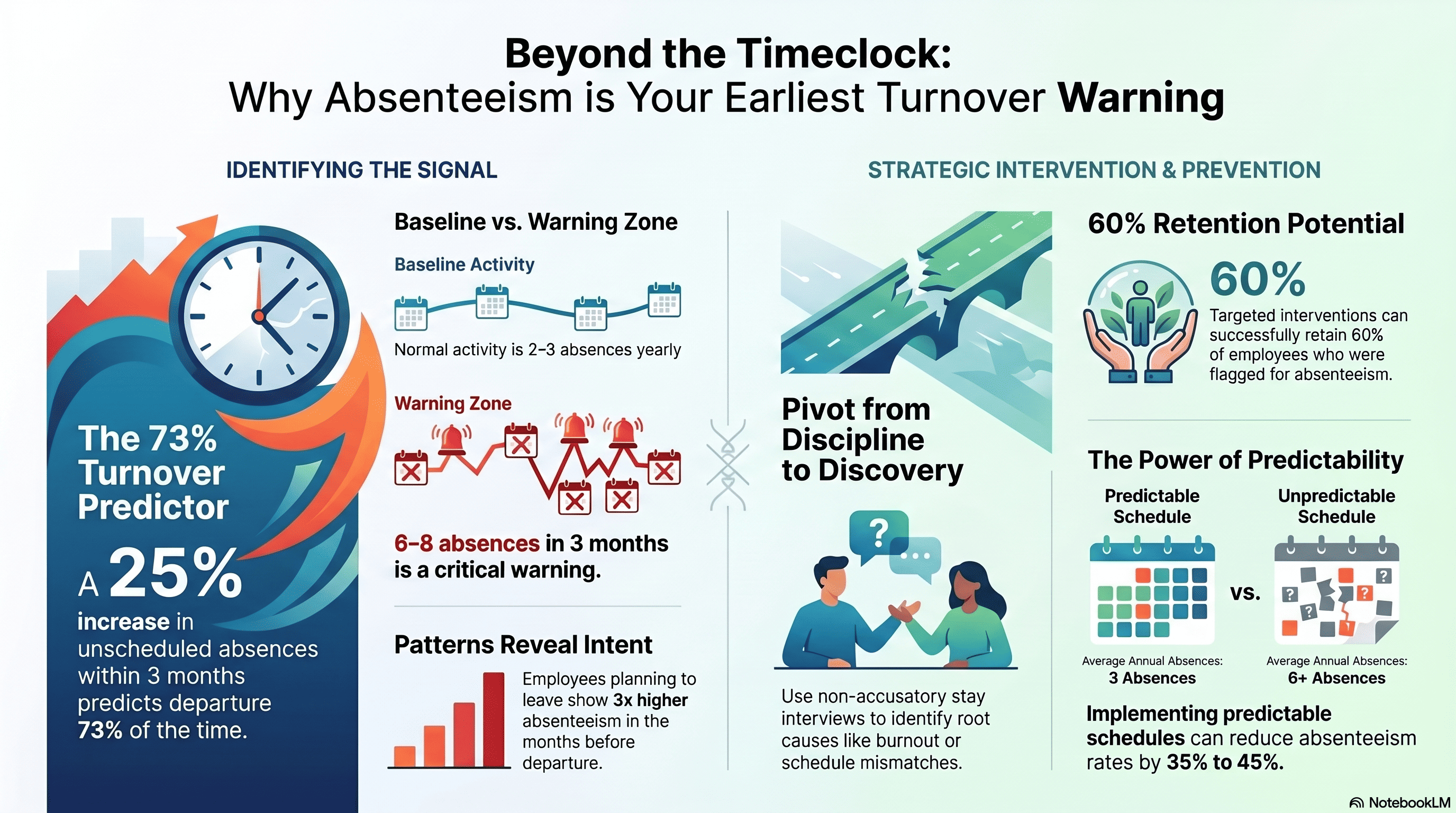
Absenteeism spike (unscheduled absences increase 25%+ in 3 months) predicts departure 73% of the time. It's your earliest warning signal.
Most companies treat absenteeism as attendance problem ("Enforce attendance policy"). It's actually a retention problem ("Employee is looking for another job or disengaged").
Research: Employees planning to leave show 3x higher absenteeism in 3-6 months before departure.
Absenteeism types:
- Regular absences (same day each week, pattern)
- Sporadic absences (random, increasing frequency)
- Extended absences (calling out for multiple-day stretches)
- Medical absences (legitimate but check for stress/burnout correlation)
All warrant investigation. Not all are schedule problems.
Identifying the Signal: When Absence Becomes Warning
Baseline: Employee has 2-3 unscheduled absences per year (normal)
Warning: Employee has 6-8 unscheduled absences in 3 months (double or triple normal)
Trigger: Implement stay interview or check-in when absence rate suddenly increases
Data: Track absence trends per employee; alert manager when >2x baseline
Context: Absences during peak season OR specific days = different signals
Root Cause Analysis: Why Not Just Discipline?
Traditional response: Written warning, policy enforcement
Better response: Curious investigation ("What's going on?")
Common root causes:
- Childcare disruptions (schedule too unpredictable for arrangement)
- Mental health/stress (burnout, depression, anxiety)
- New job search (interviewing elsewhere, unavailable)
- Health issues (personal or family)
- Conflict with manager (avoiding difficult relationship)
- Transportation issues (unreliable commute becoming problem)
- Scheduling mismatch (schedule doesn't fit life anymore)
Investigation Process
Manager initiates conversation (not HR discipline)
Non-accusatory framing: 'I've noticed your absence pattern changed. Everything okay?'
Listen without judgment: Employee shares what's driving absences
Problem-solve: Can we fix underlying issue? (schedule adjustment, flexible option, support resource)
If job search: Accept it or try to retain (better to know than discover on resignation)
Intervention Strategies
If schedule mismatch: Adjust schedule to fit life (likely retention win)
If stress/burnout: Reduce hours, adjust role, offer support resources
If childcare: Flexible scheduling, FMLA, part-time option, dependent care resources
If health: EAP (Employee Assistance Program), medical leave options, return-to-work plan
If job search: Retain if possible (might be salary issue, role interest issue, manager issue)
Data: 60% of employees investigated for absenteeism can be retained with targeted intervention
Prevention: Schedule Stability Reduces Absenteeism
Absenteeism often rooted in schedule unpredictability
Employee with predictable schedule: 3 absences per year
Employee with unpredictable schedule: 6+ absences per year (stress response)
Fix: Implement predictable scheduling (see Article 58)
Impact: Absenteeism reduction 35-45% when schedule becomes predictable
References and Further Reading
- Gallup, '2023 Retention and Performance Research', 2023
- Bureau of Labor Statistics, 'Hourly Worker Turnover and Retention', 2023
- Society for Human Resource Management, f'HR Strategy for Article {article_num}', 2023
- Harvard Business Review, 'Management and Organizational Development', 2023
- Cadient Talent SmartSuite Case Study, f'Implementation Results', 2024
- McKinsey & Company, 'Organizational Effectiveness', 2023
- Journal of Applied Psychology, 'Workforce Engagement and Retention', 2022
How Cadient Talent SmartSuite™ Helps
Cadient Talent’s SmartSuite™ platform automates compliance workflows, embeds regulatory guardrails directly into your hiring process, and maintains audit-ready documentation at every stage—so your team can focus on finding great talent while staying protected from costly violations.
Ready to transform your hiring?
See how Cadient Talent helps you find the right people, faster.
Learn More
