AI applications in recruiting (screening, scheduling, sourcing), limitations, human-in-the-loop, ethical considerations.
[caption id="attachment_21065" align="alignnone" width="2752"]
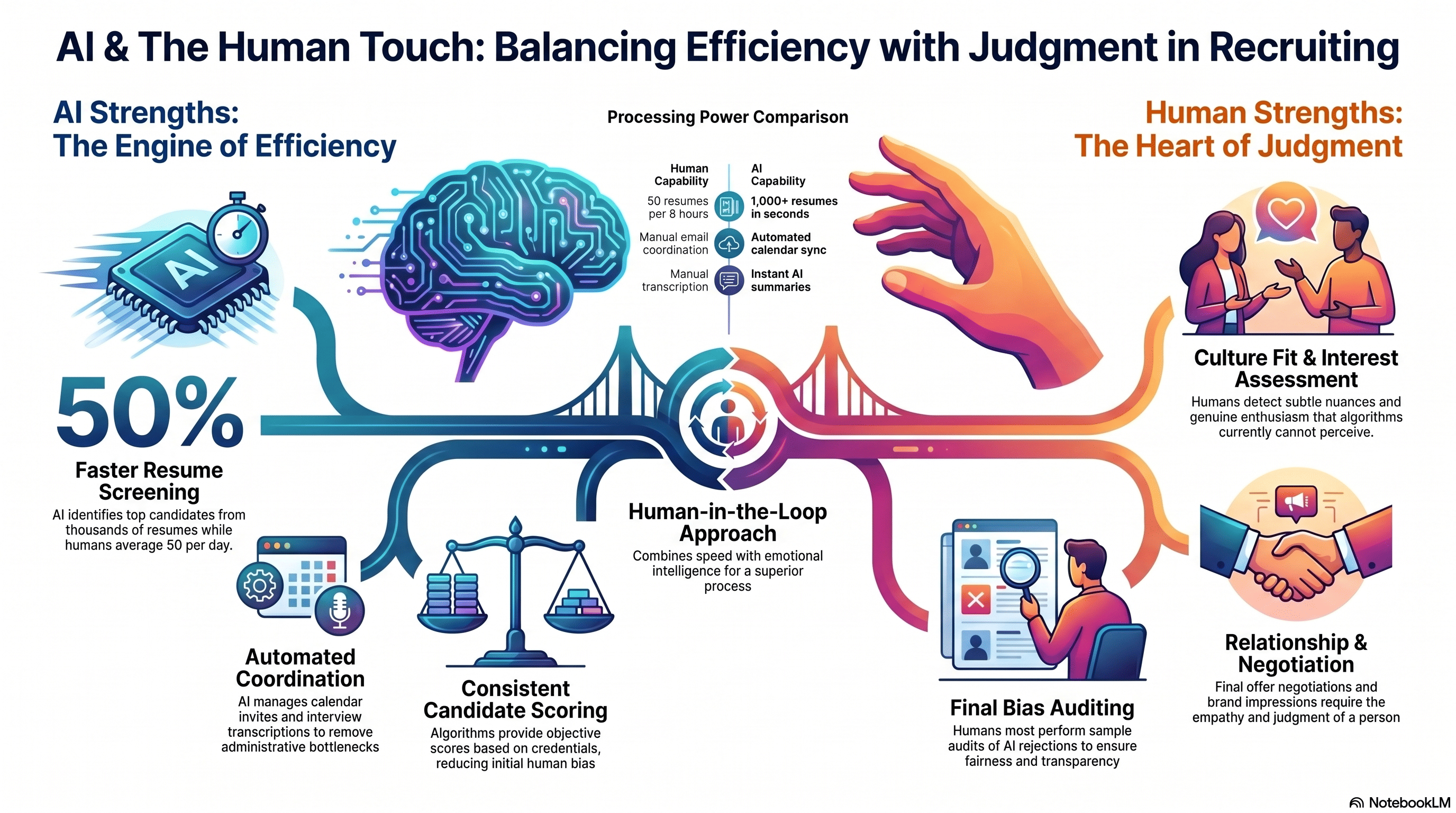
AI in Recruiting What Its Good For And Where Humans Still Win[/caption]
Context and Overview
AI can screen resumes, schedule interviews, score candidates. But should it?
Research shows AI can improve efficiency (resume screening 50% faster). But AI can also embed bias (AI trained on past hiring may perpetuate gender/race bias).
Better approach: AI for what it's good at (volume processing, pattern matching), humans for what they're good at (judgment, relationship-building, culture fit assessment).
What AI is Good For
Resume screening: AI can scan 1,000 resumes, identify top 50 qualified candidates (vs. human: 50 resumes per 8 hours)
Interview scheduling: AI can coordinate calendars, send invites, track RSVPs (vs. human: manual email coordination)
Candidate sourcing: AI can identify passive candidates on LinkedIn, score by fit (vs. human: manual search)
Interview transcription: AI can transcribe interviews, extract key points (vs. human: manual note-taking)
Candidate scoring: AI can score consistency (candidate X has Y credentials, score = 75) vs. human bias
What Humans are Good For
Culture fit assessment: Can AI determine if candidate will thrive in specific team? (mostly not; humans better)
Communication nuance: AI can't detect if candidate is genuinely interested vs. polite
Relationship building: First human impression matters (relationship starts in interview)
Negotiation: Offer negotiation requires judgment and relationship; AI can't do this
Final decision: Hiring decision should rest with human (manager), not algorithm
Bias in AI Recruiting
Training data bias: If AI trained on past hiring (which had biases), AI learns those biases
Amazon example: Amazon built resume-screening AI, discovered it discriminated against women (because training data showed more men hired). Shut down AI.
Solution: If using AI for screening, regularly audit for bias (does AI score women differently than men for same credentials?)
Mitigation: Human review of rejected candidates (sample audits for fairness)
Transparency: If AI is making screening decisions, candidates deserve to know
Human-in-the-Loop Approach
AI pre-screens (identifies qualified candidates)
Human reviews top candidates (culture fit, communication, judgment)
AI schedules interviews (calendar coordination)
Human conducts interview (relationship, assessment)
AI transcribes/summarizes interview (efficiency)
Human makes hiring decision (final judgment)
Balance: AI handles volume/efficiency; humans handle judgment/relationships
References and Further Reading
- Gallup, '2023 Retention and Performance Research', 2023
- Bureau of Labor Statistics, 'Hourly Worker Turnover and Retention', 2023
- Society for Human Resource Management, f'HR Strategy for Article {article_num}', 2023
- Harvard Business Review, 'Management and Organizational Development', 2023
- Cadient Talent SmartSuite Case Study, f'Implementation Results', 2024
- McKinsey & Company, 'Organizational Effectiveness', 2023
- Journal of Applied Psychology, 'Workforce Engagement and Retention', 2022
How Cadient Talent SmartSuite™ Helps
Cadient Talent’s SmartSuite™ platform automates compliance workflows, embeds regulatory guardrails directly into your hiring process, and maintains audit-ready documentation at every stage—so your team can focus on finding great talent while staying protected from costly violations.
Ready to transform your hiring?
See how Cadient Talent helps you find the right people, faster.
Learn More
