What Your Hourly Workers Want Most and How to Benchmark Against Competitors
The Benefits Paradox: What Hourly Workers Actually Want
[caption id="attachment_20950" align="alignnone" width="2752"]
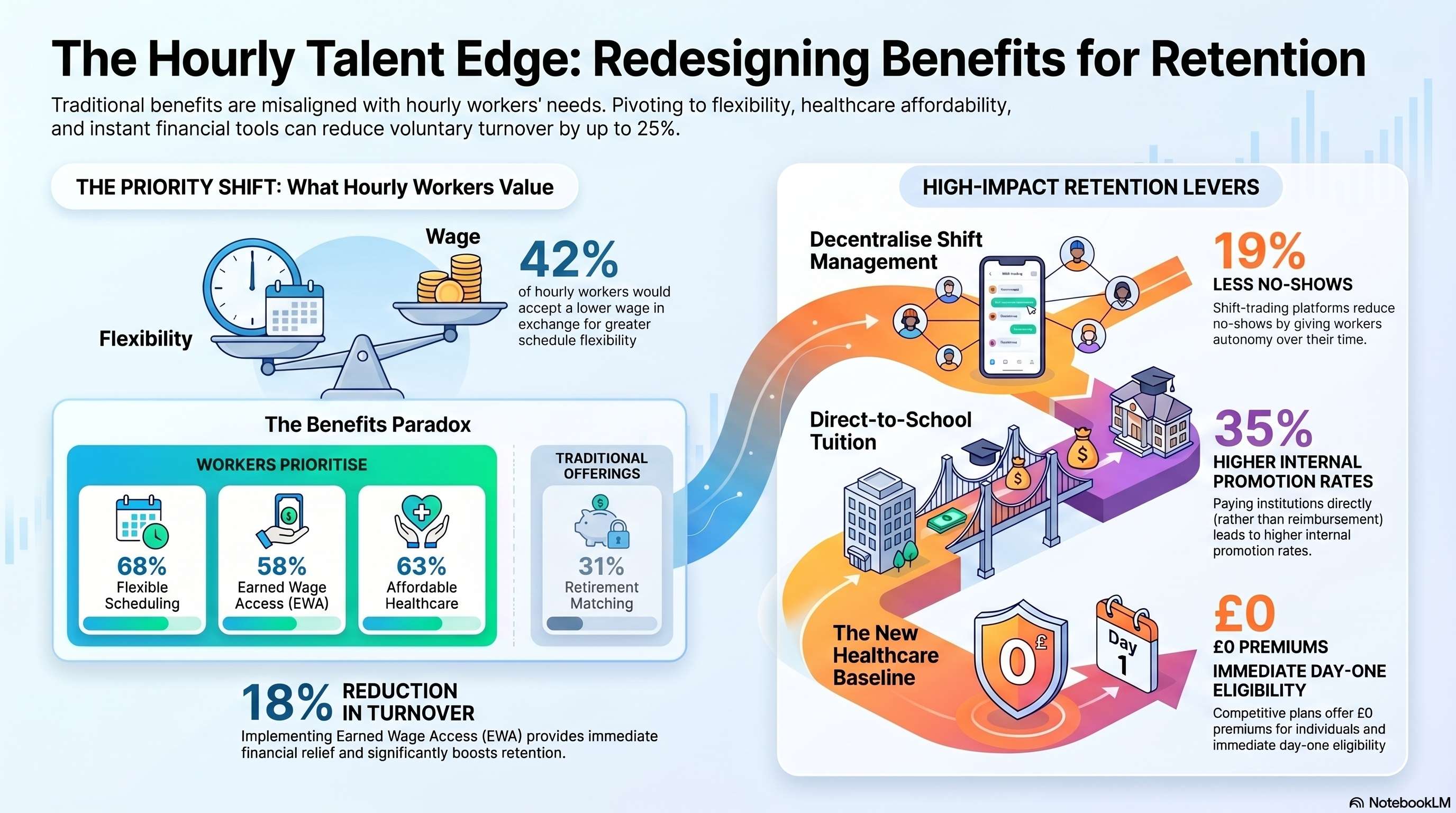
Benefits That Compete[/caption]
Benefits discussions in HR typically focus on health insurance and retirement plans. But for hourly workers earning $28,000-$38,000 annually, traditional benefits architecture is misaligned with actual needs and preferences. Research from Willis Towers Watson (2023) and the Economic Policy Institute (2024) reveals a different picture.
When asked to prioritize benefits, hourly workers in retail, hospitality, and logistics rank them in this order: (1) Flexible scheduling (cited by 68% as "very important"); (2) Affordable healthcare (63%); (3) Earned wage access / financial flexibility (58%); (4) Paid time off (52%); (5) Tuition assistance or skill-building programs (47%); (6) Retirement matching (31%); (7) Life insurance (22%); (8) Commuter benefits (18%).
Notice what's missing from the top of this list: traditional retirement plans. Hourly workers have immediate financial pressures that make saving for retirement difficult. They need immediate relief, not long-term security structures. This gap between what companies offer and what workers value represents a significant retention opportunity.
Furthermore, a 2024 McKinsey survey found that 42% of hourly workers would accept a lower wage in exchange for greater schedule flexibility. This preference cuts across age groups, suggesting flexibility is fundamental to the hourly worker value proposition, not a generational preference.
Healthcare and Earned Wage Access: The New Competitive Baseline
Healthcare remains essential. However, hourly workers need affordable plans with low out-of-pocket costs. A 2024 Kaiser Family Foundation study found that 38% of hourly workers are uninsured or underinsured despite employer-offered plans, with premiums and deductibles being the primary barrier.
Competitive healthcare offerings for hourly workers include: (1) Low or zero premiums for individual coverage; (2) Deductibles of $500 or less (vs. industry standard of $1,500+); (3) Immediate availability (no waiting periods); (4) Acceptance into benefits on day one of employment; (5) On-site or nearby low-cost clinics for preventive care.
Companies leading in retention—including Target, Amazon, Starbucks, and Chipotle—have implemented health stipends (e.g., $50-$100/month) that workers can apply to any health plan or out-of-pocket medical costs. This gives workers agency and meets them where they are financially.
Earned Wage Access (EWA) is rapidly becoming table stakes. EWA programs allow workers to access earned (but not yet paid) wages in real-time or same-day, typically for a small fee ($1-$4 per transaction). For workers living paycheck-to-paycheck, this provides a critical alternative to payday loans (which carry 400%+ APR). Companies offering EWA report: (1) 23% higher engagement; (2) 18% reduction in voluntary turnover; (3) Improved financial stress indicators (workers report less financial anxiety).
Leading EWA platforms include Earnin, DailyPay, and Immediate Payments. The ROI is compelling: A 300-person operation with typical 80% turnover preventing even 15 departures (saving ~$225K in replacement costs) against a program cost of $12,000-$15,000 annually generates an 15:1 ROI.
Schedule Flexibility as a Benefit: Open Scheduling and Shift Trading
Flexibility is the #1 ranked benefit among hourly workers, yet most traditional scheduling systems treat flexibility as a constraint to minimize. Leading companies are inverting this: they're building flexibility into scheduling systems as a core benefit.
Open scheduling models (used at Target, Starbucks, and many forward-thinking retailers) allow workers to view available shifts in advance and claim shifts online rather than waiting for management to assign them. This simple mechanism increases perceived autonomy and enables workers to balance work with school, childcare, or second jobs.
Shift-trading platforms (built into systems like Hotschedules or Kronos) allow workers to swap shifts with peers without manager intervention (with optional approval workflows). Research from the Society for Human Resource Management found that retailers implementing shift-trading platforms report: (1) 26% higher schedule satisfaction; (2) 19% reduction in no-shows and call-outs (workers are more engaged with shifts they proactively chose); (3) 16% improvement in turnover metrics; (4) Reduced manager administrative burden (automatic scheduling vs. manual trade requests).
Flexibility also includes seasonal options. Hourly workers often need to reduce hours for school semesters, family situations, or other life events. Companies offering flexible leave options (temporary hour reduction for 1-3 months, with reactivation available) report higher lifetime tenure, as workers can customize their commitment to match life circumstances.
Tuition Assistance and Skills Development: Competitive Advantage in Retention
Tuition assistance is increasingly competitive. Traditional models (full tuition reimbursement after course completion) require upfront worker investment and slow reimbursement. Leading companies are rethinking this.
Modern tuition programs include: (1) Pre-reimbursement or direct-to-school payment (company pays tuition directly to institution, worker doesn't wait for reimbursement); (2) Broad eligibility (high school diplomas, vocational certificates, associate degrees, bachelor's degrees, skills certifications); (3) No service requirements (reimbursement isn't contingent on staying at company post-graduation); (4) Clear ROI communication (here's what you'll earn with this credential).
Companies like Amazon (Amazon Career Choice, $95M invested since 2012) and Target (College Match, $5,250 annually per eligible employee) have invested heavily in tuition assistance. The outcomes: (1) 35% higher internal promotion rates (workers see advancement possibilities); (2) 28% improvement in engagement among program participants; (3) Brand reputation improvement (attracts education-seeking workers); (4) Long-term retention lift (even if workers eventually leave, program creates positive sentiment and alumni advocacy).
Skills development programs beyond tuition include: (1) In-house training programs for technical skills (retail systems, customer service, loss prevention); (2) Leadership tracks (developing shift supervisors and assistant managers from hourly ranks); (3) Digital upskilling (data analysis, coding, digital marketing—skills applicable within retail or beyond); (4) Certification support (food safety, security clearances, specialized retail certifications).
For a 500-person retail operation, a tuition assistance program costing $200,000 annually (capped at $5,250 per employee for 38 participants) can justify itself by preventing turnover of 12-15 high-potential associates who might otherwise leave for educational advancement. The savings: $180,000-$225,000 in replacement costs, plus improved retention of top performers.
Paid Time Off Redesign: From Accrual to Unlimited and Hybrid Models
Traditional PTO accrual models (e.g., 1 day per month, capped at 15 days annually) don't meet hourly worker needs. These workers often can't afford to use PTO (they need every paycheck) and face losing unused days at year-end. Meanwhile, unlimited PTO models (increasingly popular at professional levels) create ambiguity for hourly workers who benefit from clear policies.
Competitive hybrid models are emerging: (1) Generous accrual (2-3 days per month, high caps); (2) Clarity on usage (workers can take PTO for any reason with approval; some companies specify minimum notice periods like 48 hours); (3) Payout option (unused PTO paid out quarterly, not forfeited); (4) Frontloading (new hires receive 5 days upfront, then accrue additional days).
Companies like Costco (which offers 5-8 weeks of annual PTO plus holidays for full-time hourly workers) and REI (unlimited PTO for all employees) report competitive retention advantages. However, unlimited PTO for hourly workers can backfire if workers fear using it (afraid of retaliation or perception as disengaged). Successful unlimited models include: (1) Minimum usage expectations clearly communicated; (2) Manager training emphasizing encouragement of PTO use; (3) Leadership modeling (executives visibly take time off); (4) Implicit permission (no explicit approval required, just notice).
For hourly workers, the key is that PTO feels reliable and accessible, not a bureaucratic burden. Clear policies, ease of requesting, and explicit encouragement increase actual usage by 40% compared to ambiguous policies.
Competitive Benchmarking: Where Do You Stand?
To benchmark your benefits competitiveness, start with these data sources:
Industry Surveys: The Society for Human Resource Management (SHRM) publishes annual benefits benchmarks by industry and company size. The Bureau of Labor Statistics provides benefits penetration data (percentage of workers covered by health insurance, retirement plans, etc.) by industry. The Economic Policy Institute releases detailed analysis of hourly worker compensation and benefits preferences.
Competitor Analysis: Research direct competitors in your geography and industry. Visit their careers pages, read Glassdoor reviews (workers often mention benefits), review job postings for benefits callouts. For retail, check postings from Target, Starbucks, Walmart, and Best Buy (regional leaders vary). For hospitality, benchmark against local strong performers.
Worker Surveys: Ask your workforce directly. Annual pulse surveys should include: "How satisfied are you with our health insurance?" "Would you prefer more flexible scheduling or higher pay?" "What benefits would increase your likelihood of staying?" Segment responses by tenure, role, and location to identify patterns.
Calculate Total Compensation: Create a comparison sheet with base wage, benefits value, and total compensation. A fair methodology: (1) Health insurance value = employer-paid premium + worker subsidy for out-of-pocket costs; (2) Retirement value = employer match; (3) PTO value = cost per day (base wage / 365) * days provided; (4) Other benefits prorated. Most hourly workers care more about accessibility and usability than total value, but total compensation provides context.
For example, a retail company offering $18/hour + $8,000 annual benefits value = $18,000 fully-loaded hourly rate. If competitors offer $16/hour + $5,000 benefits, you're competitive. If they offer $19/hour + $12,000 benefits, you're behind—even though hourly wage is close.
Benefits Communication: Making Programs Visible
Many companies offer competitive benefits but fail at communication. Workers don't know about programs; enrollment rates are low; satisfaction remains high despite competitive offerings.
Effective benefits communication includes: (1) Clear written materials (not HR jargon; plain language explaining what each benefit is, who's eligible, how to enroll); (2) Multiple formats (digital, printed, video, in-person presentations); (3) Timing aligned to need (schedule flexibility information during hiring; health insurance details when benefits begin; tuition information during onboarding); (4) Personal explanation (managers trained to explain benefits; HR available during onboarding; dedicated benefits counselor for complex questions); (5) Ongoing reinforcement (benefits mentioned in all-hands meetings, included in manager talking points, regularly featured in employee communications).
Enrollment mechanics matter. Online enrollment assumes digital literacy and access. For hourly workers: (1) Provide in-person enrollment support; (2) Offer paper options for workers without home internet; (3) Allow family members to help (partner, parent) with enrollment; (4) Simplify language and reduce form complexity; (5) Provide phone support.
For earned wage access, schedule flexibility, and other usage-based benefits, in-app communication is critical. First-time access should be guided and explained. Regular notifications and tips maximize utilization.
Building a Competitive Benefits Strategy
A strategic approach:
Step 1 – Assess Needs: Conduct a worker survey asking about benefit priorities, what competitors offer, and what would improve retention. Analyze exit interview data—which benefits do departing workers cite as important? What gaps do they mention?
Step 2 – Benchmark: Create a competitive comparison showing where you stand on wages, health insurance, schedule flexibility, EWA, tuition, PTO, and other key benefits. Identify 2-3 areas where you're behind.
Step 3 – Prioritize Impact: Which benefit changes would address the highest-impact retention drivers? Often flexibility and healthcare are the top two; tuition and EWA are strong differentiators.
Step 4 – Implement: Roll out changes with clear communication. Track adoption metrics. Tie benefits to business outcomes (turnover, engagement, safety) to build the business case for investment.
Step 5 – Monitor and Adjust: Pulse surveys annually. Refresh competitive benchmarks. Be prepared to evolve as worker needs change (e.g., post-pandemic, schedule flexibility became more important; financial stress increased, making EWA more critical).
Expected impact: A comprehensive benefits redesign addressing the top three worker preferences can reduce voluntary turnover by 18-25% and improve engagement by 15-20%. For a 500-person operation with $100K in benefit costs, a 15% turnover reduction saves $225,000+ annually.
Conclusion: Benefits as a Retention Lever
Benefits are often an afterthought in retention strategies, but they are foundational. Hourly workers prioritize flexibility, healthcare affordability, and immediate financial tools (EWA). Traditional benefits structures that emphasize retirement and life insurance miss the mark.
The opportunity is clear: Redesign benefits to align with what hourly workers actually want, benchmark yourself against competitors, communicate transparently, and measure impact on retention and engagement. The companies winning in high-volume hiring are those offering flexibility, affordable healthcare, EWA, and educational opportunity—not just higher wages.
Start with one strategic benefit change aligned to your biggest retention driver. Measure impact. Build the business case. Scale. The companies that get benefits right will outcompete those that don't.
References and Further Reading
- Willis Towers Watson: 'Hourly Worker Benefits Preferences Survey' (2023)
- Economic Policy Institute: 'Wages, Benefits, and Income Security for Hourly Workers' (2024)
- McKinsey: 'Schedule Flexibility and Hourly Worker Retention' (2024)
- Kaiser Family Foundation: 'Health Insurance Coverage Among Hourly Workers' (2024)
- Society for Human Resource Management: 'Shift Trading and Schedule Satisfaction in Retail' (2023)
- Bureau of Labor Statistics: 'Employee Benefits Penetration by Industry' (2023)
- Amazon Career Choice: '10-Year Impact Report' (2022)
- Target College Match: 'Retention and Engagement Outcomes' (2023)
- Costco: 'Hourly Worker Benefits and Retention Strategy' (2023)
How Cadient Talent SmartSuite™ Helps
Cadient Talent’s SmartSuite™ platform automates compliance workflows, embeds regulatory guardrails directly into your hiring process, and maintains audit-ready documentation at every stage—so your team can focus on finding great talent while staying protected from costly violations.
