Employee development ROI, learning culture, tuition assistance, skills development, career lattice model.
[caption id="attachment_20989" align="alignnone" width="2752"]
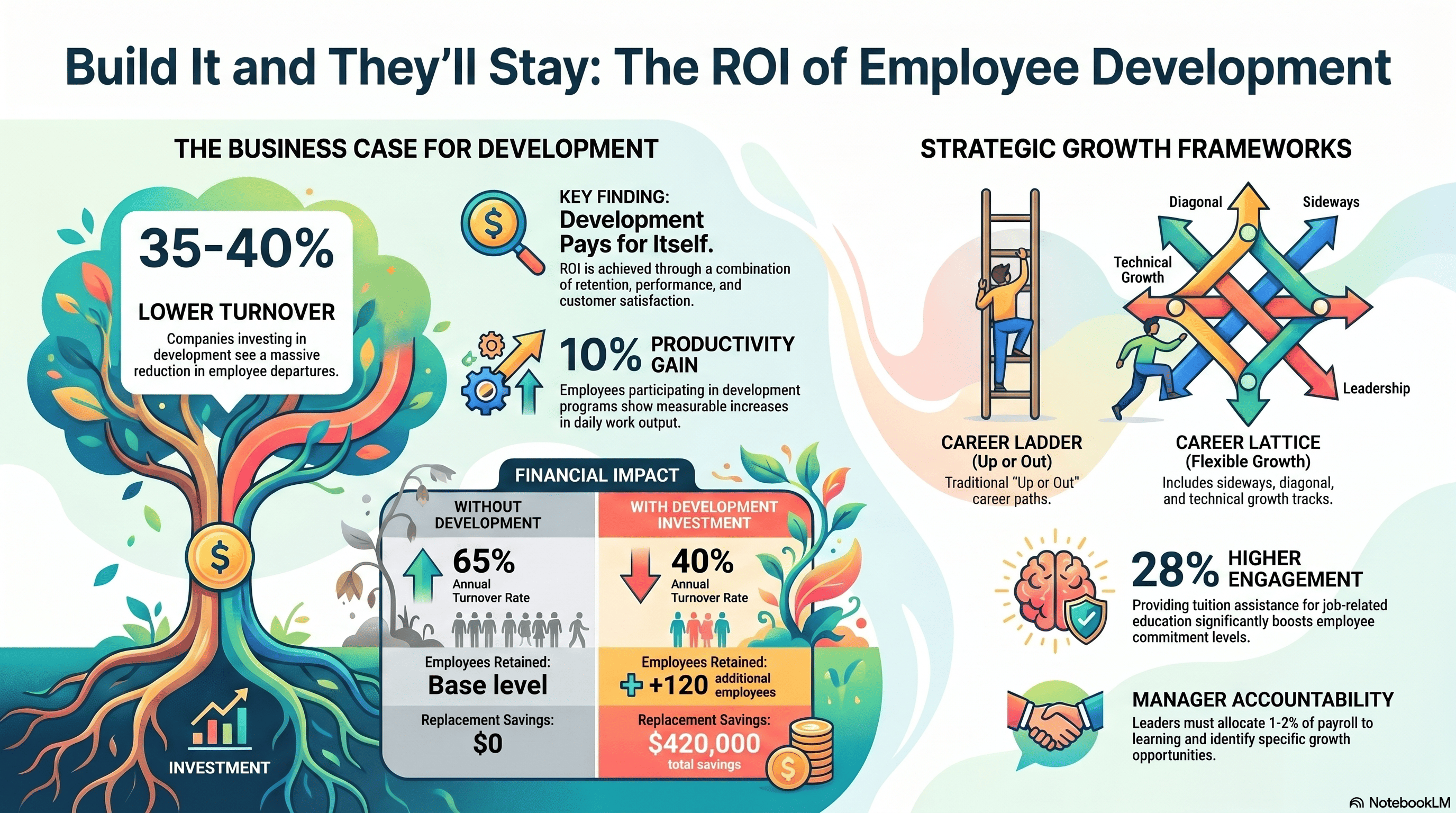
Build It and Theyll Stay The Business Case for Employee Development[/caption]
Context and Overview
Companies that invest in employee development show 35-40% lower turnover.
Not because development costs money (it does). But because development signals investment: 'We believe you have a future here. We're betting on you.'
The Business Case: ROI of Development
Company invests $5,000 per employee in annual development (training, tuition reimbursement, certifications)
Average annual turnover: 65% (300 of 500 people depart)
With development investment: Turnover drops to 40% (180 departures; 120 retained)
Cost per replacement: $3,500
Savings from 120 retained employees: 120 × $3,500 = $420,000
Development investment: 500 × $5,000 = $2,500,000
Wait... does this look bad?
No. Because development investment affects only participants. If 200 employees participate:
Investment: 200 × $5,000 = $1,000,000
Retention improvement: Participants 60% → 45% departure (15 point reduction × 200 = 30 people retained)
Savings: 30 × $3,500 = $105,000
Cost benefit ratio: -$895,000... BUT participants also show higher performance (10% productivity gain on 200 = $600,000 value) + higher engagement = customer satisfaction impact
Full picture: Development pays for itself through retention + performance + engagement
Building a Learning Culture
Leadership expectation: 'We invest in people. Everyone gets ~8 hours training/development annually'
Budget allocation: 1-2% of payroll for learning/development
Manager accountability: Managers responsible for identifying development opportunities for team
Peer learning: Encourage employees to mentor each other (low-cost development)
External: Partner with community colleges, online platforms (Coursera, LinkedIn Learning) for cost-effective training
Tuition Assistance Programs
Offer: Company reimburses tuition for job-related education (up to $5,000/year, $15,000 lifetime)
Eligibility: 1+ year tenure
Condition: Maintain grade B+, job-related field, stay 1 year after completion
Impact: Employees seeing education support show 28% higher engagement
Examples: College degree, trade certifications, professional certifications (CPA, Project Manager, etc.)
Career Lattice (Not Just Ladder)
Traditional: Career ladder (up or out; no lateral moves)
Better: Career lattice (up, sideways, diagonal; multiple paths)
Example paths for warehouse worker:
Path 1: Operational excellence (packer → lead → supervisor → manager)
Path 2: Specialization (packer → quality inspector → auditor → quality manager)
Path 3: Technical (packer → equipment operator → maintenance technician)
Employee chooses path aligned with interests; development targets chosen path
Benefit: Employees see multiple ways to progress; fewer feel trapped
References and Further Reading
- Gallup, '2023 Retention and Performance Research', 2023
- Bureau of Labor Statistics, 'Hourly Worker Turnover and Retention', 2023
- Society for Human Resource Management, f'HR Strategy for Article {article_num}', 2023
- Harvard Business Review, 'Management and Organizational Development', 2023
- Cadient Talent SmartSuite Case Study, f'Implementation Results', 2024
- McKinsey & Company, 'Organizational Effectiveness', 2023
- Journal of Applied Psychology, 'Workforce Engagement and Retention', 2022
How Cadient Talent SmartSuite™ Helps
Cadient Talent’s SmartSuite™ platform automates compliance workflows, embeds regulatory guardrails directly into your hiring process, and maintains audit-ready documentation at every stage—so your team can focus on finding great talent while staying protected from costly violations.
Ready to transform your hiring?
See how Cadient Talent helps you find the right people, faster.
Learn More
