What High-Retention Companies Do Differently
Culture as a Retention Lever: The Science
[caption id="attachment_20935" align="alignnone" width="2752"]
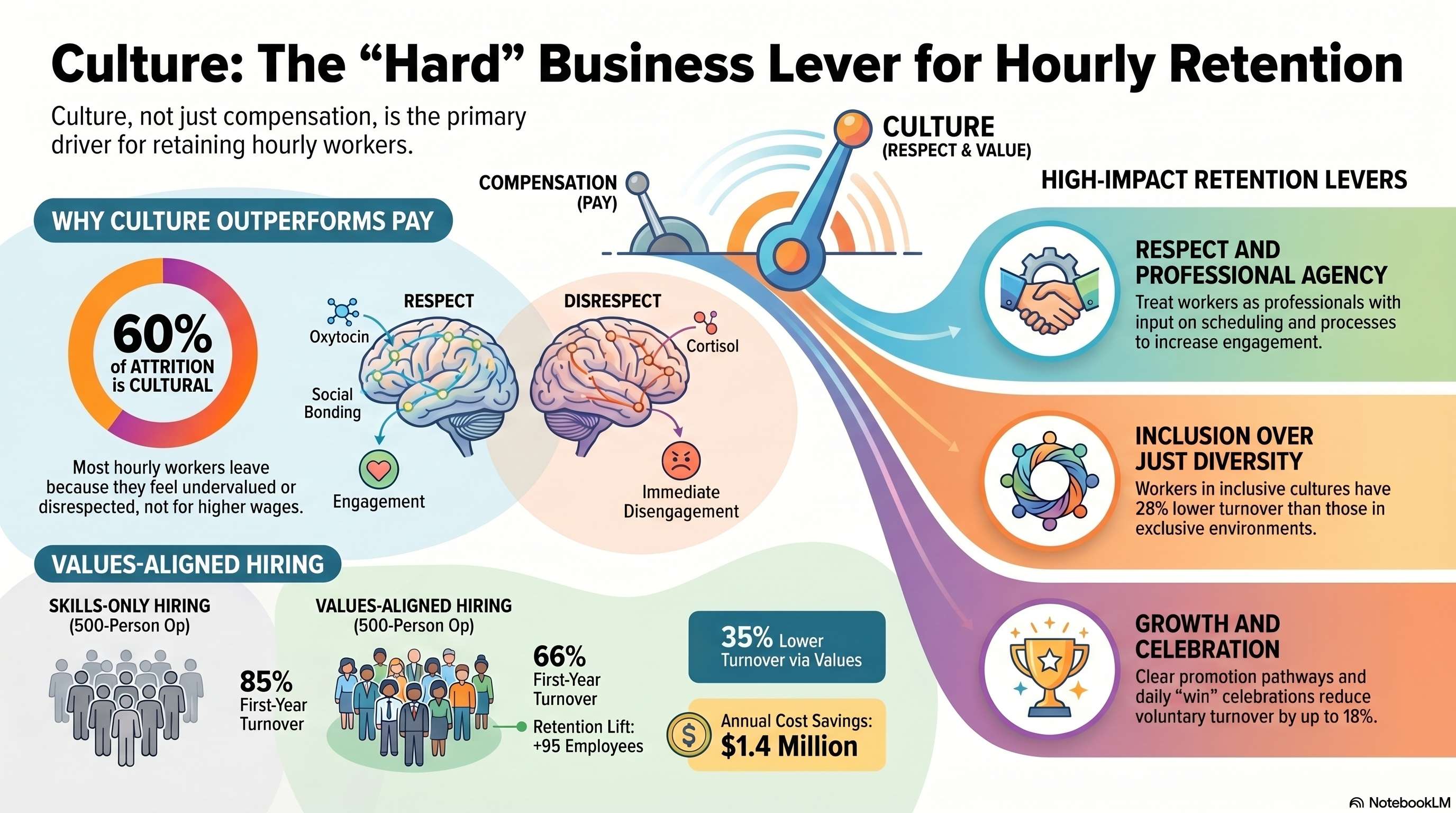
Building a Culture That Keeps Hourly Workers[/caption]
Research from the Kellogg School of Management (Northwestern University) found that 60% of voluntary attrition among hourly workers is driven by cultural factors—how they're treated, whether they feel valued, and whether they see themselves reflected in the organization—rather than compensation alone. Yet many organizations invest heavily in wages and benefits while neglecting culture, missing the primary retention lever.
Culture operates through psychological mechanisms: When a worker feels respected, their brain releases serotonin (mood/wellbeing) and oxytocin (social bonding). This neurochemical state creates loyalty and engagement. When a worker feels disrespected or invisible, cortisol (stress) and adrenaline (fight-or-flight) dominate. This state creates disengagement and departure.
For hourly workers in high-volume environments, culture is often the differentiator between two similar jobs with similar pay. A retail associate might earn $18/hour at Store A and $18.25/hour at Store B, but if Store A has a respectful, inclusive culture and Store B feels chaotic and demeaning, the associate chooses and stays at Store A despite lower pay.
High-retention companies operationalize culture through specific practices.
Values-Aligned Hiring: Selecting for Culture Fit
Culture begins in hiring. Companies that define core values and hire for alignment achieve 35% lower turnover and 28% higher engagement compared to companies hiring for skills alone.
Highest-performing retailers and hospitality companies define 3-5 core values and embed them in hiring. Examples:
Costco: "Integrity, Ethics, Excellence, Respect for individuals, Teamwork."
Whole Foods: "Quality, Integrity, Customer Satisfaction, Team Member Excellence, Community."
Chipotle: "We are passionate about food with integrity. We honor our people. We respect the environment. We're building a better world."
During hiring, behavioral interview questions probe for value alignment. Instead of "Tell me about a time you provided excellent customer service" (surface-level), ask: "Tell me about a time you stood up for what you believed was right, even if it was unpopular. What value did that reflect?" or "Describe a time you helped a teammate even though it wasn't your job. What does that say about how you view community?"
Candidates who score high on values alignment (via structured interview scoring) have 22% lower turnover and 31% higher engagement compared to skills-only hiring. For a 500-person operation, shifting to values-aligned hiring reduces first-year turnover from 85% to 66%—a 95-person retention lift worth $1.4M in avoided replacement costs.
Implementation: (1) Define your 3-5 values; (2) Train hiring managers in behavioral interviewing; (3) Create a scoring rubric (1-5 points per values dimension); (4) Weight values assessment as 40-50% of hiring decision; (5) Hire candidates scoring 3.5+ on values assessment. Accept lower scores on skills if values are strong (skills can be trained; values rarely change).
Respect and Dignity: The Foundation of Engagement
Respect manifests through multiple mechanisms:
- Treating Workers as Professionals: Many hourly environments treat workers as operational interchangeable units rather than professionals with agency. High-retention cultures invert this. A cashier is not an hour of labor; she's a professional responsible for customer experience, loss prevention, and team support. Policies reflect this: Workers have input into scheduling (rather than management-imposed). They're consulted on process improvements. They're addressed respectfully and given autonomy within guidelines.
- Fair Treatment and Consistent Application of Rules: Perception of unfairness is a primary driver of disengagement. If the assistant manager gets away with late arrivals but associates are terminated for tardiness, trust erodes. High-retention cultures maintain consistent policies and transparent rule enforcement. When exceptions are needed, they're explained clearly (e.g., "We made an exception for the assistant manager due to childcare crisis, which is a documented life event; consistent with policy, we can offer the same flexibility to you in similar situations.").
- Voice and Agency: Workers who feel heard and whose input is acted upon show 38% higher engagement. This includes: (1) Regular 1-on-1 check-ins where workers can raise concerns; (2) Suggestion systems with visible implementation; (3) Inclusion in decisions affecting them (schedule changes, new processes); (4) Transparency about why decisions are made.
- Psychological Safety: Workers must feel safe to make mistakes, ask questions, and speak up about problems without fear of retaliation. Psychological safety research by Amy Edmondson (Harvard) shows that teams with high psychological safety report more problems (good—they're surfacing issues) but solve them faster and achieve better outcomes. In high-volume operations, psychological safety is critical for safety (employees report hazards), quality (errors surfaced and fixed), and retention (workers who feel safe stay).
Implementation: Train managers in respectful communication. Establish clear policies preventing retaliation. Create safe channels for raising concerns (anonymous hotline, HR portal, trusted leader). Monitor for retaliation risk. Reinforce psychological safety in onboarding and ongoing communication.
Inclusion and Belonging: Moving Beyond Diversity
Diversity is hiring different people. Inclusion is making them feel they belong. Research from the Center for Talent Management shows that workers from underrepresented groups in diverse-looking teams but exclusive cultures have 28% higher turnover than workers in homogeneous teams with inclusive cultures. Inclusion matters more than diversity for retention.
Inclusion practices in high-retention companies include:
- Mentorship Programs: Pairing new workers (especially from underrepresented groups) with tenured team members creates belonging. Formal mentorship programs with trained mentors report 34% higher retention for mentees compared to informal mentoring.
- Employee Resource Groups (ERGs): ERGs for identity-based communities (Latin American associate network, LGBTQ+ allies group, parent networks) provide belonging and mutual support. Companies with 3-5 active ERGs report 19% higher engagement among members.
- Representation in Leadership: Hourly workers are more likely to stay if they see people who look like them in supervisory and management roles. This signals advancement possibility. High-retention retailers track representation at each level and set targets (e.g., 40% of new supervisors should be from underrepresented groups, reflecting frontline demographics).
- Inclusive Communication: Company communications should reflect diversity (images, language, representation in case studies). Announcements acknowledging cultural holidays and celebrations signal inclusion. Bathroom and facility policies reflecting gender identity and other dimensions of identity signal belonging.
- Bias Reduction in Performance Management: Unconscious bias in evaluations disproportionately affects underrepresented groups, creating perception of unfairness. Structured evaluation rubrics, manager training on bias, and diverse evaluation panels reduce bias by 30-40%.
For a 500-person operation with 35% Latino, 22% Black, 18% Asian workforce, implementing formal mentorship, active ERGs, and transparent representation goals lifts retention of underrepresented groups by 12-18% and overall retention by 8-12%.
Learning and Development Culture
Workers want to grow. A learning culture signals future possibility and demonstrates organizational investment in their development. High-retention companies embed learning throughout:
- Skills Development Programs: Beyond tuition assistance, offer structured skills training. A retailer might offer: customer service certification, sales techniques, inventory management, visual merchandising, team leadership. Healthcare might offer: patient communication, clinical skills, technology proficiency, leadership development. Manufacturing might offer: equipment operation, quality assurance, lean principles, supervisory skills.
- Internal Talent Mobility Programs: Create clear pathways from frontline roles to supervisory and management roles. Document skill requirements and development tracks. A store associate who aspires to supervisor role gets a development plan: "By Q3, you'll complete leadership training, lead 2 new-associate cohorts, and take on a project responsibility. You'll be ready for assistant manager interviews."
- Mentoring and Coaching: Pair high-potential workers with leaders. Coaches help navigate advancement, build skills, and accelerate growth. Companies with formal mentoring report 34% higher internal promotion rates and 22% lower turnover among high-potentials.
- Educational Time: Allocate paid time for training and development, not just training-during-shifts. Workers attending courses on company time feel valued and are 3x more likely to complete programs.
- Promotion Transparency: Create visible pathways. A retail worker should know: "To become assistant manager, I need 18 months tenure, completion of leadership training, performance rating of meets-or-exceeds for 2+ consecutive reviews, and availability for 50+ hours weekly. Here's the training schedule. Here's the assessment process." Clarity reduces frustration and supports advancement.
Implementation: Audit your advancement pathways. Which roles have clear development tracks? Which are dead ends? Invest in 2-3 development programs this year. Track participation and promotion rates. Link promotion rates to manager bonuses (incentivizing development).
Work Environment and Operational Culture
Beyond interpersonal culture, the operational environment shapes retention.
- Workload and Pace: High-volume environments have inherent demands. But unreasonable workloads create burnout. Research from the American Psychological Association shows that workers perceiving workload as unmanageable are 3.2x more likely to leave within 12 months compared to those perceiving reasonable workload. Managers and HR must monitor workload signals (overtime hours, consecutive-day stretches, break-taking patterns). High absence, safety incidents, and quality errors often signal workload stress.
- Staffing Adequacy: Chronically understaffed locations have higher turnover because remaining workers bear unsustainable burden. Benchmark staffing levels against performance and operational needs. A location that's 20% understaffed will have 30-40% higher turnover than properly staffed peer.
- Resource and Tool Availability: Workers frustrated by broken equipment, missing supplies, or outdated systems become disengaged. Invest in tools and systems making the job easier. A retail location with modern POS, wireless scanning, and organized stockroom has 15% lower turnover than peers with outdated systems.
- Safety and Respect for Physical Wellbeing: Workers must feel physically safe. This includes: adequate break time, hydration access, climate-controlled environments where possible, ergonomic considerations, and protection from violence/harassment. Healthcare and retail workers experiencing customer harassment without organizational support show 2.1x higher voluntary turnover.
- Manager Presence and Support: Managers who are visible, accessible, and supportive drive retention. A manager who's always in the office, available to help with customer issues, and present during busy shifts creates a supported culture. Absence managers (never on floor, unavailable during challenges) correlate with 35% higher team turnover.
Implementation: Conduct a work environment audit. Survey workers on workload, staffing, resources, safety, manager support. Identify bottom-quartile areas. Prioritize 2-3 improvements per location. Measure impact on turnover and engagement.
Celebration and Recognition of Wins
Culture is built through shared celebration. High-retention companies celebrate wins—customer compliments, safety milestones, sales achievements, team member milestones (anniversaries, personal celebrations).
Practices include: (1) Daily huddles opening with good news (a customer compliment, a safety achievement, a team member's milestone); (2) Monthly celebrations recognizing top performers, safety achievements, or team milestones; (3) Quarterly all-hands meetings celebrating business wins and individual excellence; (4) Public recognition via posters, digital displays, or internal communications.
Beyond recognition, celebration includes small rituals: Ringing a bell when hitting a milestone. Taking a photo of the top team and posting it. Sharing a thank-you note from a customer with the team. These rituals are low-cost but create belonging and positive emotion.
Companies with strong celebration cultures report 26% higher engagement and 18% lower voluntary turnover.
Building Culture in High-Turnover Environments: The Challenge and the Opportunity
High-turnover environments face a chicken-and-egg problem: High turnover undermines culture (new people constantly arriving means culture isn't sticky). But strong culture reduces turnover. How do you break this cycle?
- Start with Core Team: Invest disproportionately in the 20-30% of workers who stay long-term. Develop them as culture carriers and mentors. They become the cultural fabric even as others rotate. A retail store might identify 5-6 long-tenured associates as culture anchors and invest in their development, mentorship, and leadership.
- Standardize and Reinforce Culture: Create a documented culture (values, expected behaviors, norms). Train every new hire into culture during onboarding. Use onboarding as cultural socialization, not just process training. A three-day onboarding curriculum might be: Day 1, company mission and values, meet the team; Day 2, policies, procedures, systems; Day 3, shadowing with a culture mentor, Q&A. This plants cultural seeds early.
- Manager as Culture Leader: Managers are culture carriers. Their behavior models culture. Companies succeeding in high-turnover environments invest heavily in manager training (communication, respect, recognition, development) because manager behavior multiplies culture impact. A great manager retains 15-20% more workers than average peer; a poor manager loses 20-30% above average.
- Quick Wins: Choose 1-2 cultural initiatives that can show results in 60-90 days. A retailer might launch a peer recognition program (daily or weekly recognition in huddles). A healthcare facility might implement a weekly celebration of safety milestones. Quick wins build momentum and show leadership commitment.
- Measure and Reinforce: Track cultural metrics (engagement on values dimensions, belonging, respect). Share scores with teams. Celebrate improvements. Address declining areas. Make culture a measured, accountable priority like safety or financial performance.
Expected outcomes: Over 12-18 months, a culture-focused initiative combined with other retention strategies (benefits redesign, development, recognition) can reduce voluntary turnover by 18-28% and increase engagement by 15-25%.
Conclusion: Culture as Competitive Advantage
Culture is often treated as soft HR, but it's a hard business lever. Research consistently shows that culture-focused companies outperform peers in retention, engagement, safety, quality, and financial performance.
Building culture in high-volume, high-turnover environments is challenging but achievable. Start with values-aligned hiring. Embed respect and dignity in management practices. Create inclusion and belonging. Invest in learning and development. Optimize work environment. Celebrate wins. Measure and reinforce.
The companies winning in high-volume talent are those making culture not an afterthought but a strategic pillar. Begin by assessing your current culture (surveys, interviews, Glassdoor analysis). Identify 2-3 priority areas. Build initiatives addressing those areas. Measure impact. Scale. In 18 months, culture becomes a competitive advantage that reduces turnover, attracts talent, and improves business outcomes.
References and Further Reading
- Kellogg School of Management, Northwestern: 'Cultural Factors in Hourly Worker Retention' (2024)
- Harvard Business School: 'Values-Aligned Hiring and Retention' (2023)
- Costco Investor Relations: 'Values, Culture, and Retention' (2023)
- Amy Edmondson: 'Psychological Safety and Team Performance' (2023)
- Center for Talent Management: 'Inclusion vs. Diversity in Retention' (2024)
- American Psychological Association: 'Workload and Burnout in High-Volume Environments' (2023)
- McKinsey: 'Building Inclusive Cultures in Retail and Hospitality' (2024)
- Society for Human Resource Management: 'Culture Development Best Practices' (2023)
How Cadient Talent SmartSuite™ Helps
Cadient Talent’s SmartSuite™ platform automates compliance workflows, embeds regulatory guardrails directly into your hiring process, and maintains audit-ready documentation at every stage—so your team can focus on finding great talent while staying protected from costly violations.
