HR tech stack integration, data silos, API-driven architecture, single source of truth, efficiency gains.
[caption id="attachment_21078" align="alignnone" width="2752"]
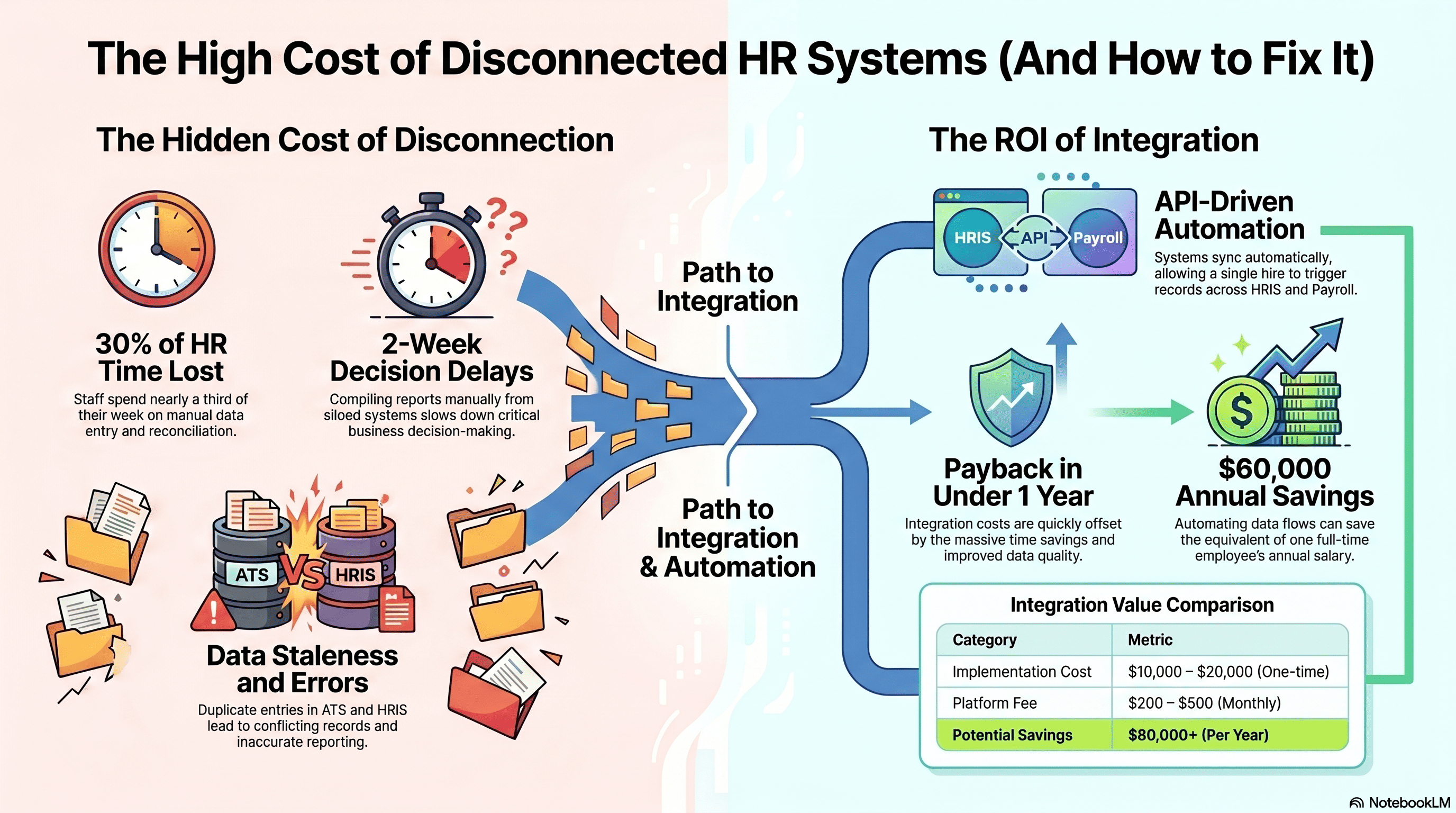
Disconnected HR Systems Are Slowing You Down The Case for Integration[/caption]
Context and Overview
Company uses 7 different systems: ATS (recruiting), HRIS (HR records), LMS (training), payroll, scheduling, POS (for retail), and survey tool.
Data in each system is disconnected. Recruiting data doesn't flow to HRIS. Training data doesn't connect to performance data. Survey data is siloed in separate tool.
Result: Manual data entry, duplicate data, conflicting data, slow reporting.
The Cost of Disconnected Systems
Manual entry: HR imports hired candidates from ATS to HRIS manually (error-prone, slow)
Duplicate data: Candidate in ATS, then in HRIS, then in payroll (if updates in one place, others are stale)
Reporting friction: Recruiting report pulls from ATS; retention report pulls from HRIS; they don't align
Time cost: HR spends 30% of time on data management (pulling, aligning, reconciling) instead of strategic work
Decision delay: Report needed takes 2 weeks because data must be manually compiled
Integration Strategy
API-driven architecture: Systems talk to each other via APIs (application programming interfaces)
Example: Candidate hired in ATS → automatically creates HRIS record → sends offer letter → initiates training module → triggers first payroll entry
Single source of truth: One system as master (e.g., HRIS is master for employee data; all other systems reference it)
Data flow: Define how data flows (ATS → HRIS → Payroll → LMS → Survey)
Automation: Replace manual entry with automated data sync
Implementation Steps
Step 1: Audit systems and data flows (what data is where, how does it move)
Step 2: Map desired integrations (ATS → HRIS, HRIS → Payroll, etc.)
Step 3: Prioritize (integrate highest-impact flows first)
Step 4: Select integration platform (Zapier, MuleSoft, custom APIs)
Step 5: Build integrations (can be simple like Zapier, or complex like custom APIs)
Step 6: Test thoroughly (ensure data accuracy)
Step 7: Monitor (ensure integrations run smoothly)
ROI of Integration
Time saved: 30% of HR time spent on data management → 1 FTE saved (annual cost $60,000)
Accuracy improved: Duplicate data eliminated; data quality improves
Speed improved: Reports generate automatically instead of manual compilation (days → hours)
Cost: Integration platform ($200-500/month) + IT implementation ($10,000-20,000 one-time)
Payback: <1 year through time savings
References and Further Reading
- Gallup, '2023 Retention and Performance Research', 2023
- Bureau of Labor Statistics, 'Hourly Worker Turnover and Retention', 2023
- Society for Human Resource Management, f'HR Strategy for Article {article_num}', 2023
- Harvard Business Review, 'Management and Organizational Development', 2023
- Cadient Talent SmartSuite Case Study, f'Implementation Results', 2024
- McKinsey & Company, 'Organizational Effectiveness', 2023
- Journal of Applied Psychology, 'Workforce Engagement and Retention', 2022
How Cadient Talent SmartSuite™ Helps
Cadient Talent’s SmartSuite™ platform automates compliance workflows, embeds regulatory guardrails directly into your hiring process, and maintains audit-ready documentation at every stage—so your team can focus on finding great talent while staying protected from costly violations.
Ready to transform your hiring?
See how Cadient Talent helps you find the right people, faster.
Learn More
