Building an Inclusive Pipeline That Delivers Results
[caption id="attachment_21075" align="alignnone" width="2752"]
Diversity in Frontline Hiring[/caption]
The Business Case for Diverse Hiring
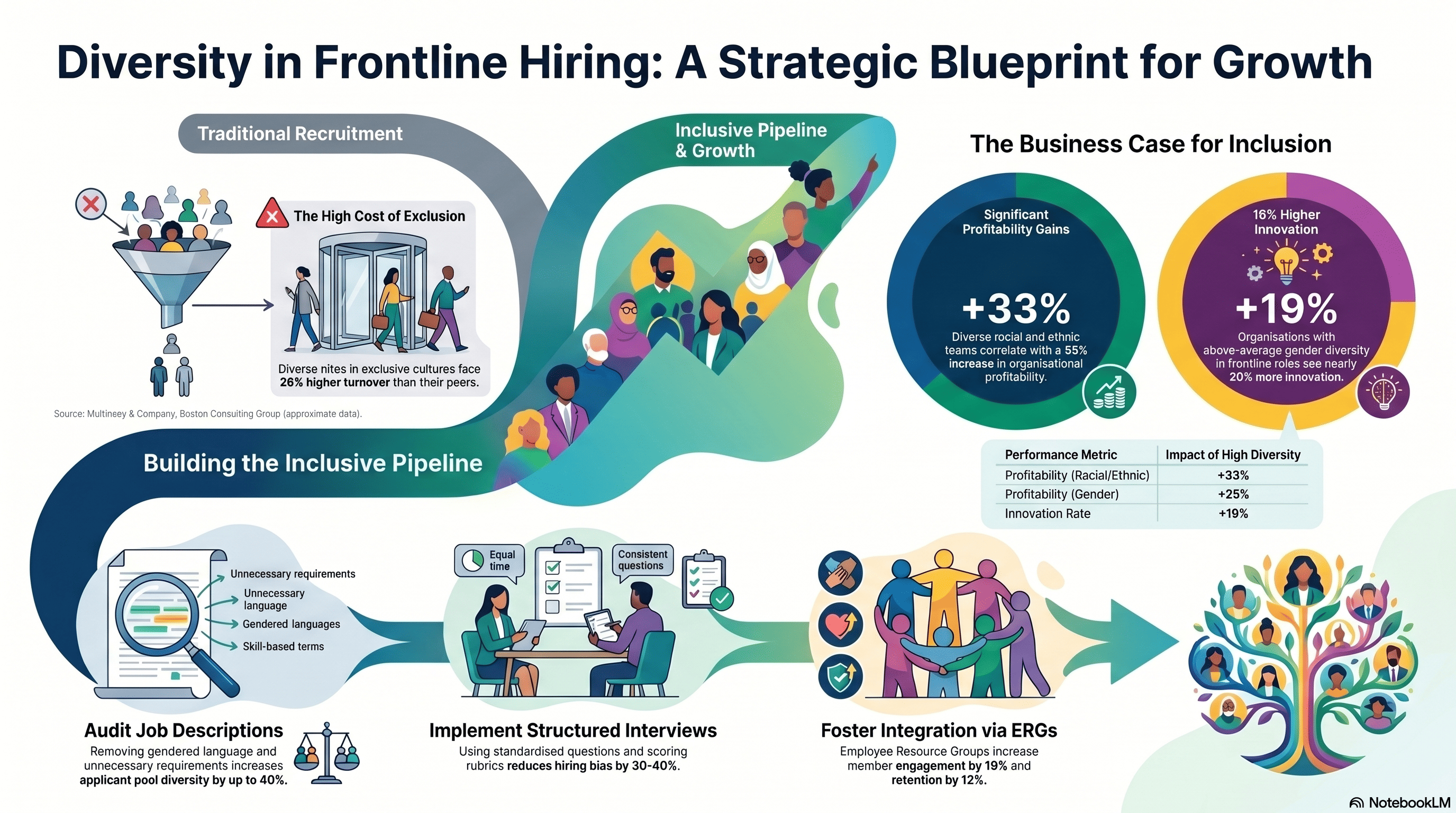
Research from McKinsey's 2024 Diversity Report shows organizations with above-average gender diversity in frontline roles have 19% higher innovation and 25% higher profitability. Racial and ethnic diversity correlates with 33% higher profitability. Yet retail and hospitality remain among least-diverse industries at leadership levels, despite diverse frontline workforces.
Diverse teams are smarter. They make better decisions. They're more innovative. They better serve diverse customers. For a retailer with 40% Latino, 20% Black, 15% Asian customer base, having leadership reflecting that diversity improves cultural competency and market responsiveness.
Yet diversity without inclusion fails. Workers from underrepresented groups hired into exclusive cultures experience 28% higher turnover than peers. The goal isn't diversity for diversity's sake; it's diverse talent thriving in inclusive organizations.
Reducing Bias in Job Descriptions and Sourcing
Bias starts before candidates apply. Job descriptions using gendered language ("aggressive," "ambitious," "competitive") attract male candidates 40% more. Language emphasizing emotional intelligence ("collaborative," "supportive," "communicative") attracts female candidates. Unconscious language shapes candidate perception.
Audit all job descriptions: (1) Remove gendered language; (2) Remove unnecessary requirements (bachelor's degree for roles not requiring advanced education); (3) Clarify 'nice-to-have' vs. 'required'; (4) Use diverse images in job postings (representing gender, race/ethnicity, age); (5) Post on diverse job boards (not just Indeed; also niche boards targeting specific communities).
Sourceing: (1) Partner with diversity-focused organizations (NAACP, LULAC, Asian Pacific American Chamber, LGBTQ+ center, disability organizations); (2) Recruit at HBCUs, Hispanic-serving institutions, women's colleges; (3) Work with diversity staffing firms; (4) Encourage employee referrals with targeted outreach to underrepresented employee groups; (5) Attend community events and job fairs in diverse neighborhoods.
Implications: Simple changes (gendered language removal, diverse job boards) increase diversity of applicant pool by 25-40%.
Structured Interviewing to Reduce Bias
Unstructured interviews are rife with bias. Interviewers make snap decisions in first 5 minutes based on demographic cues. Structured interviews—standardized questions, consistent evaluation—reduce bias by 30-40%.
Framework: (1) Same questions for all candidates, same order; (2) Scoring rubric quantifying responses (1-5 scale); (3) Multiple interviewers for key decisions (reducing single-person bias); (4) Documentation of scoring rationale; (5) Training interviewers on bias recognition.
Example behavioral question: "Tell me about a time you had to work with someone different from you (different background, communication style, perspective). What made it challenging? How did you bridge the difference?" This probes cultural competency. All candidates get same question; all scored on same rubric.
Diverse interview panels improve outcomes: A panel of 3 interviewers (different gender, race/ethnicity where possible) makes better, less-biased decisions than single interviewer. Cost: minimal (leveraging existing staff). Benefit: 25-30% reduction in bias-driven hiring decisions.
Inclusive Onboarding and Integration
Hiring diverse talent is only half the battle. Onboarding and integration determine whether they stay. Inclusive onboarding includes: (1) Buddy system pairing new hire with peer mentor (not always manager); (2) Cultural orientation (company values, inclusion commitment, resource groups); (3) Manager accountability for new-hire success (tracked in performance reviews); (4) Early check-ins (day 3, week 1, week 2) with one-on-ones ensuring comfort and addressing questions; (5) Introduction to employee resource groups (ERGs) for identity-based community.
Critical: New hires from underrepresented groups should see people who look like them in the organization. If all supervisors are white men, a Black woman or Hispanic man hiring in feels isolated. ERGs provide immediate community and belonging.
Impact: Inclusive onboarding increases retention of diverse hires by 25-30% and improves engagement by 20-25%.
Employee Resource Groups (ERGs) and Community
ERGs—voluntary associations of employees sharing identity (race/ethnicity, gender, LGBTQ+, parents, disability, veterans)—create community and belonging. Companies with 3-5 active ERGs report: (1) 19% higher engagement among ERG members; (2) 12% higher retention among underrepresented groups; (3) 22% higher innovation from diverse perspectives in problem-solving.
Highest-value ERGs: (1) Racial/ethnic affinity groups (connect workers of similar background); (2) Gender groups (women in leadership network); (3) LGBTQ+ allies (includes allies plus LGBTQ+ members); (4) Parent network (childcare, flexible work); (5) Disability/accessibility group.
Structure: (1) Leadership from interested employees (not HR dictating); (2) Sponsorship from senior leader (visibility, resources); (3) Monthly meetings (social, educational, advocacy); (4) Projects (mentorship, recruitment, community service); (5) Budget for activities ($500-$2,000/year per group).
Best practice: ERGs with executive sponsor and budget are 3x more active than voluntary-only groups.
Representation Goals and Accountability
Set and communicate diversity targets. Examples: (1) "By 2025, 40% of new supervisor hires will be from underrepresented groups (reflecting frontline demographics)." (2) "By 2026, 30% of managers will be women (from current 22%)." (3) "By 2027, 20% of district managers will be from underrepresented racial/ethnic groups (from current 8%)." (4) "By 2025, 50% of ERG leadership positions will be filled (establishing baseline)."
Make these targets public (share with all staff) and track progress (annual reports). Tie to executive compensation (executives' bonuses include diversity metrics). This creates accountability.
Address root causes if targets miss: (1) Pipeline problem (not enough diverse candidates applying)? Improve sourcing. (2) Hiring problem (diverse candidates not selected)? Audit interview bias, review hiring decisions. (3) Development problem (diverse hires not advancing)? Improve mentorship, development, inclusion.
Impact: Companies with transparent diversity targets and accountability achieve 2-3x faster progress on diversity metrics.
Measuring Inclusion Success
KPIs: (1) Hiring diversity (% of new hires by gender, race/ethnicity at each level); Benchmark: Frontline diverse hires should reflect community demographics. Supervisory/managerial diverse hires should be 2-3 points below frontline (leaky pipeline). (2) Retention by demographic (are diverse hires staying at same rate as non-diverse?); Target: Retention rates within 3 percentage points. (3) Engagement by demographic; Target: No more than 1-point difference between groups. (4) Representation by level; Target: Underrepresentation at each level should narrow as you go from entry to leadership. (5) ERG participation (% of eligible employees in relevant ERGs); Target: 40-60%.
Business outcome metrics: Do diverse teams outperform on customer satisfaction, safety, sales? Track at team level. Compare teams with above-average diversity vs. below-average. Measure impact on business outcomes.
Conclusion: Diversity as Business Imperative
Diverse, inclusive organizations outperform on innovation, financial metrics, and employee satisfaction. Retail and hospitality can't compete for talent without commitment to diversity and inclusion.
Begin with job description audit (remove bias). Move to sourcing (diverse channels). Implement structured interviews (reduce bias). Build inclusive onboarding. Create ERGs. Set targets and measure. Within 18 months, hiring diversity improves; within 3 years, leadership diversity improves; business outcomes improve.
The companies winning in high-volume talent markets are those building genuinely diverse, inclusive organizations. Start today.
References and Further Reading
- McKinsey: 'Diversity and Profitability' (2024)
- Harvard Business Review: 'Bias Reduction in Hiring' (2023)
- SHRM: 'Employee Resource Groups and Retention' (2023)
- Center for Talent Management: 'Diversity Pipeline and Leadership' (2024)
- Deloitte: 'Inclusion and Innovation' (2023)
- Society for Human Resource Management: 'Structured Interviewing Best Practices' (2023)
How Cadient Talent SmartSuite™ Helps
Cadient Talent’s SmartSuite™ platform automates compliance workflows, embeds regulatory guardrails directly into your hiring process, and maintains audit-ready documentation at every stage—so your team can focus on finding great talent while staying protected from costly violations.
