How to design a referral program that turns your workforce into your best recruiter
Why Referrals Beat Every Other Sourcing Channel
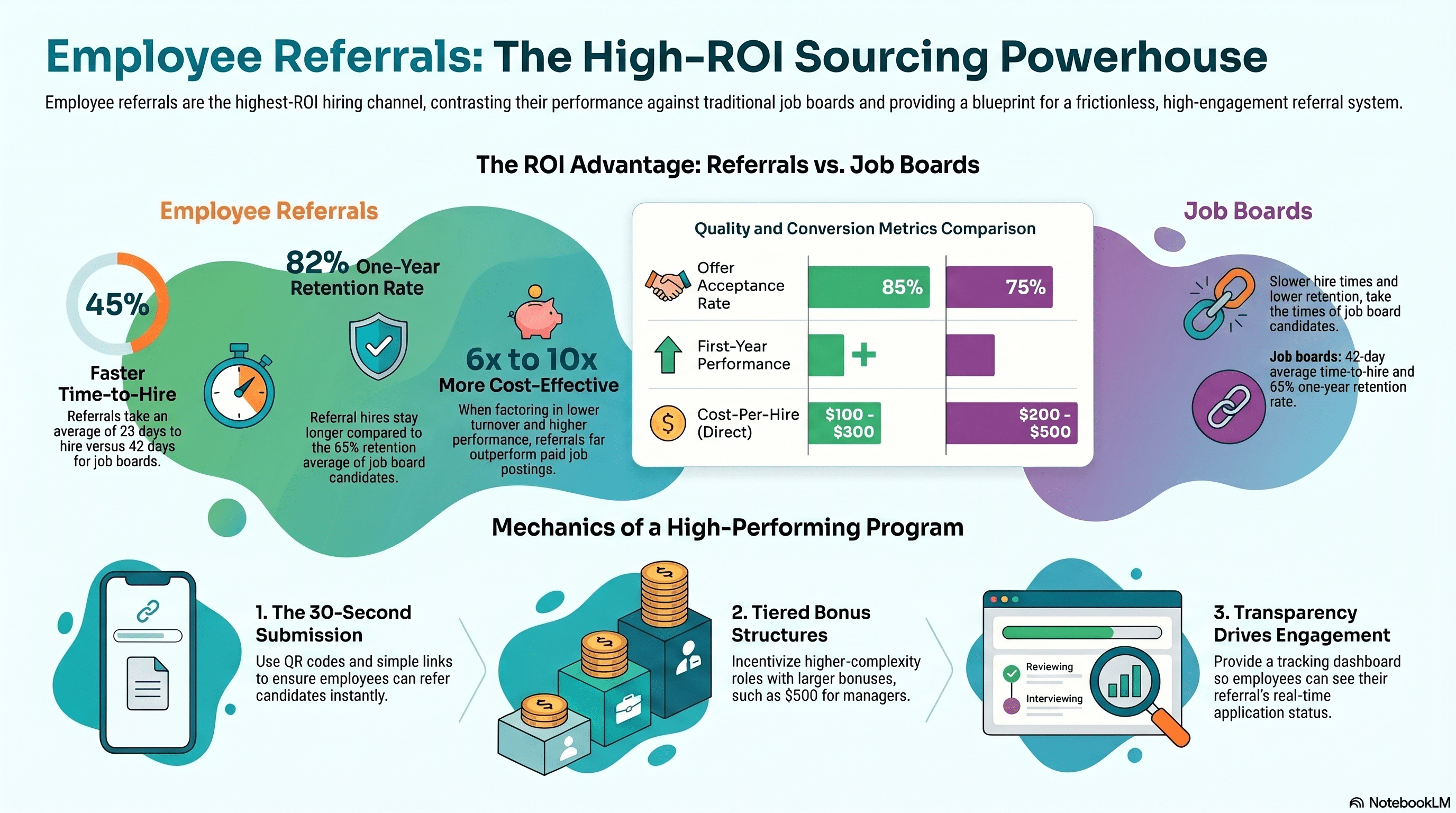
If you had to pick one recruiting channel to maximize, it would be employee referrals. The data is overwhelming:
LinkedIn Talent Solutions (2024) analyzed hiring outcomes across all channels. Employee referrals outperformed every other source on four critical metrics simultaneously:
- Time-to-hire: 23 days (vs 42 days for job board average)
- Offer-acceptance rate: 85% (vs 75% for job boards)
- One-year retention: 82% (vs 65% for job boards)
- Cost-per-hire: $100-300 (vs $200-500 for job boards, depending on paid spend)
Glassdoor research (2023) found that referral hires have 40% lower turnover in the first year. They perform 15% better in the first year. They're more likely to be promoted.
Why? Because referrals come pre-vetted by someone who knows your culture. They've heard the real story about what it's like to work there, not the marketing version. They know what they're signing up for. They're more likely to be genuine fits. And they have a built-in onboarding buddy (the employee who referred them).
Yet most companies treat referrals as an afterthought. They have a referral program that exists but isn't promoted. They don't track referral source in their ATS. They underpay referral bonuses. They don't make it easy to refer.
The companies winning at high-volume hiring do the opposite. They obsess over referrals. They treat employees as recruiters. They make referring as easy as sharing a link. They pay competitively. They measure it religiously.
Referral Program Economics: Why High Bonuses Make Sense
Many companies hesitate to offer large referral bonuses. 'If we pay $300 to refer someone, that's expensive.' But this comparison is wrong.
Let's compare:
Indeed sponsored job posting:
- Cost per click: $0.50
- Conversion rate (click to hire): 25-to-1
- Cost per hire: $12.50
- Plus: recruiting time to screen and interview (recruiter salary ~$30/hour × 5 hours average = $150)
- Total cost per hire: ~$160
Employee referral:
- Cost per successful hire: $300 (assuming 1 employee successfully refers 1 hire)
- Plus: recruiter time (usually less, because referral candidates are pre-vetted, 2 hours instead of 5)
- Total cost per hire: ~$360
At face value, referrals seem more expensive. But this ignores the quality difference.
Referral hire (cost $360):
- 82% one-year retention
- 15% higher performance rating
- 40% lower turnover
- If one-year cost of turnover is 50% of salary (~$9,000 for a $18/hour retail role), retention benefit = $3,600
- Adjusted cost per hire: $360 - (0.18 × $3,600 reduced turnover burden) = ~$10/hire
Jobboardhire (cost $160):
- 65% one-year retention
- Average performance
- 40% higher turnover
- Turnover cost benefit: $0 (baseline)
- Adjusted cost per hire: ~$160
When you account for retention and performance differences, referral hires are 6-10x more cost-effective than job board hires.
This economics justifies paying $300-500 per successful referral, especially if quality differences are real. Some companies even pay higher for specialized roles or management positions.
The question isn't 'Can we afford to pay $300 per referral?' It's 'Can we afford not to?'
Referral Program Design: Mechanics That Work for Frontline Workers
A referral program that works has five components:
- Easy submission process: Employees should be able to refer someone in 30 seconds. Provide a link (e.g., 'refer.companyname.com'), email template, or even a QR code. When an employee clicks, they enter referrer name, candidate name, candidate phone/email, and a note about why they'd be great. That's it. No 10-field form.
- Clear eligibility criteria: Who can receive the bonus? Current employees only? Contractors? Families of employees? (Most companies exclude spouses/family to avoid conflicts.) What roles are eligible for referral bonuses? (Usually all, but some exclude family/friends for fairness.) Clearly state the rules upfront.
- Bonus structure: Simple is better. Examples:
Option A (Single tier): Every successful referral = $200 bonus
Option B (Role-based tiering): Entry-level = $100, shift lead = $250, manager = $500
Option C (Time-based): $100 upon hire, $100 after 90 days, $100 after one year (incentivizes longer tenure)
Option D (Seasonal): Higher bonus during busy season (Q4 retail, summer hospitality)
Most effective for frontline: Option B (tiered by role complexity) or Option C (paid out over time). This incentivizes quality and retention.
- Transparent tracking: Employees should be able to see the status of their referral. 'Referred John Smith on 3/10. Status: In interview scheduled for 3/24. Bonus if hired: $200.' This transparency keeps employees engaged and accountable.
- Timely bonus payment: Pay the referral bonus quickly. Within 30 days of the referred employee's start date is ideal. Some companies pay at hire, others at 90-day mark. The sooner, the better (incentivizes participation). Delay payment 6 months and employees forget they referred anyone.
Best practice program for a 200-person retail/logistics company:
- Referral link on Slack, email signature, and company intranet
- Submission form takes 1 minute
- Entry-level hire: $150 bonus
- Shift lead hire: $300 bonus
- Manager hire: $500 bonus
- First $150 paid upon hire, second $150 paid after 90 days (for applicable roles)
- Employees can refer unlimited people
- Anyone can be referred (past applicants, friends, family—your call, but be clear)
- Tracking dashboard visible to all employees
Digital Tools and Incentive Structures
Technology makes referrals scalable. Without it, referral programs work fine for 20-person companies but break down at 100+.
Basic tools (free or low-cost):
- ATS with referral tracking: Most modern ATS (Workable, Lever, SmartSuite, Recruitee) have native referral features. Set them up.
- Email template: Create a standard email employees can forward to friends: 'Hey, my company is hiring [role]. [Link]. If you get hired, I get a $200 bonus!'
- Slack bot integration: Some ATS integrate with Slack. Employees can submit referrals directly from Slack.
- QR codes: Print QR codes linking to your referral form and post in break rooms, on uniforms, on invoices. 'Know someone great? Scan to refer!'
Advanced tools ($500-2,000/month):
- Dedicated referral platform: Tools like Workable, Referral Rock, or built-in ATS referral modules gamify the process. Leaderboards ('Who referred the most hires this month?'), badges, milestones, etc. These increase participation.
- Mobile app: A simple mobile app for referrals increases submission because employees can refer while on their phone, at home, anywhere.
- Automated tracking: ATS integration with automations—when a referral is submitted, Slack notification goes to hiring manager, candidates receive auto-acknowledgment, bonus tracking is automatic.
Incentive structures beyond cash:
- Team-based incentives: If the team collectively meets a hiring goal through referrals, bonus everyone. 'If we hire 10 people via referrals this quarter, everyone on the team gets $100 bonus.' This incentivizes the team to promote the program.
- Non-monetary rewards: gift cards, extra PTO day, raffle entry. Some employees value these as much as cash.
- Recognition: Public recognition in company all-hands or internal newsletter. 'Sarah referred 3 great hires this year!' Pride and social recognition are powerful.
- Special events: Monthly raffle where referring employees can win prizes (smaller than referral bonus, but frequent).
Best practice: Combine cash bonus + team incentives + recognition. Cash motivates action, team incentives motivate engagement, recognition motivates culture.
Measuring Referral Program Success
Track five key metrics quarterly:
- Referral rate: (Hires from referrals ÷ total hires) × 100. Target: 30-40% of hires from referrals.
- Referral participation: (Employees who submitted a referral ÷ total employees) × 100. Target: 15-25% of workforce participates in a quarter.
- Conversion rate: (Referrals hired ÷ referrals submitted) × 100. Target: 40-50%. (This is higher than general application-to-hire because referrals are pre-vetted.)
- Cost per referral hire: (Total referral bonuses paid ÷ hires from referrals). This should be $150-400 depending on role and bonus structure.
- Referral retention: (Referral hires still employed after 12 months ÷ referral hires) × 100. Target: 80%+. Compare to non-referral retention (should be 60-70% for hourly roles).
Example quarterly report:
- Total hires: 50
- Referral hires: 18 (36%)
- Referral submissions: 35 (conversion rate: 51%)
- Employees who referred: 22 out of 200 (11% participation)
- Referral bonuses paid: $3,600 ($200 per hire average)
- Cost per referral hire: $200
- 12-month retention (referral vs. non-referral): 81% vs. 64%
- Performance rating (referral vs. non-referral): 3.8/5 vs. 3.5/5
When you see these metrics improving quarter-over-quarter, you know the program is working. When participation drops, you know you need to re-promote it (send email reminder, highlight success stories, increase bonus).
Promotion and Engagement: Making Sure Your Program Isn't Invisible
The biggest failure mode of referral programs is that employees don't know they exist.
A company launches a referral program. HR sends one email about it. 2% of employees notice. The program exists but generates minimal referrals. A year later, HR concludes 'referrals don't work for us.' They're wrong. They didn't promote it.
Promotion strategy:
Monthly reminders:
- Email: Every month, send a reminder highlighting recent referral hires and bonuses paid. 'This month, 3 employees earned $600 in referral bonuses.'
- Slack/Teams post: If you use Slack, post a monthly referral roundup and success story. 'Sarah referred Marcus, who's now a top performer on the team. Sarah earned $200!'
- All-hands mention: In monthly all-hands, ask: 'Who has a friend or family member looking for work? Refer them and earn a bonus.'
Quarterly highlights:
- Leaderboard: Post who referred the most hires. 'Q2 Referral Champions: Sarah (3), Tom (2), Maya (2).' Recognition drives participation.
- Success stories: Feature a referral hire. 'Meet James! Referred by his neighbor Tom, James has been a shift lead for 3 months and just got promoted. Tom earned a $300 bonus.'
- Bonus celebration: When a team member earns a referral bonus, celebrate it. 'Congrats Tom on your $300 referral bonus!'
Ongoi campaigns:
- Career day: Invite employees to bring friends to a company 'career open house.' Casual, informal, friends get to see the workplace and meet hiring managers.
- Referral contest: 'Refer someone in May and be entered to win a raffle prize (Apple Watch, $500 gift card, etc.). Top 3 referrers get extra bonus.'
- Merchandise: Give employees referral t-shirts or hats with a QR code linking to the referral form. 'Wear this and spread the word!'
- Integration into orientation: New hires get told about the referral program and given referral bonuses if they successfully refer someone in their first 90 days. New employees are often in networks of job seekers and are great referral sources.
The engagement strategy is as important as the program mechanics. A great program that's invisible produces nothing. A decent program that's visible and promoted produces results.
Common Referral Program Mistakes
Three mistakes derail referral programs:
Mistake 1: Underpaying the bonus. A $25 referral bonus signals 'this doesn't matter to us.' Employees feel the company doesn't value the help. Pay fairly ($150+). If the bonus is real, employees will promote the program to friends.
Mistake 2: Slow or unclear bonus payout. 'You'll get the bonus if they work here 6 months' is a broken promise. Pay within 30 days of hire. If you want to incentivize retention, use a tiered structure ($150 at hire, $150 at 6 months, $100 at one year). But be clear upfront.
Mistake 3: No tracking or visibility. If employees don't know the status of their referral, they stop caring. Set up a dashboard or regular email updates: 'Your referral of James is in final interviews, scheduled for 3/15.' Visibility keeps people engaged.
Additional mistakes:
- Only promoting the program once. Set a recurring schedule. Monthly at minimum.
- Not celebrating wins. When someone earns a referral bonus, celebrate it publicly. This reminds everyone the program exists and works.
- Excluding certain roles. If you exclude 'hard to fill' roles from referral bonuses, you've misunderstood the program. Refer more for hard-to-fill roles, not less.
- Not comparing to benchmarks. If your referral rate is 10% of hires and industry average is 30%, something's broken. Fix it.
Scaling Referrals: From 50 Employees to 500
A referral program works at any size, but scaling requires different tactics:
Stage 1 (Small company, 20-50 employees):
- Simple structure: Fixed bonus ($200) for all roles
- Manual tracking: Spreadsheet or simple ATS field
- Promotion: Monthly email, word-of-mouth
- Investment: 5 hours/month HR time
Stage 2 (Growing, 50-150 employees):
- Tiered bonus structure: Entry-level $150, lead $300, manager $500
- ATS referral module: Automate tracking, send status updates to referrer
- Promotion: Monthly email, Slack reminders, all-hands mentions, leaderboard
- Investment: 10-15 hours/month HR time
Stage 3 (Scaling, 150-500 employees):
- Dedicated referral platform or ATS with robust referral tools
- Multi-channel promotion: Email, Slack, Teams, intranet, career site
- Quarterly contests and campaigns
- Manager incentives: Managers who participate in referral recruitment get credit/bonus
- Investment: 20-30 hours/month, or dedicated 0.5 FTE if very large
Stage 4 (Enterprise, 500+ employees):
- Dedicated referral program manager or team
- Sophisticated tools with mobile apps, gamification, leaderboards
- Integrated into broader talent strategy
- Regular ROI reporting to leadership
- Investment: 1+ FTE dedicated to referral program
At each stage, the investment is proportional to the ROI. An extra $20k/year in HR time to drive referral hires that save $40k/year in cost per hire is a 2:1 return. This pays for itself.
Tying It All Together: Referrals as Your Primary Channel
The highest-performing recruiting operations treat referrals as their primary channel, not a secondary one. Here's how to get there:
Year 1: Set up a referral program (Months 1-2), launch it (Month 3), promote it actively (Months 3-12). Target: Get referrals to 15-20% of hires.
Year 2: Refine the program based on participation data. Increase bonus if participation is low. Promote more aggressively. Build referral into manager performance reviews ('Did you drive referrals?'). Target: 25-30% of hires from referrals.
Year 3: Referrals are now 35%+ of your pipeline. Your cost per hire has dropped due to higher-quality referral hires. Your retention has improved. Your employer brand is stronger (because referral hires have better experience and stay longer). You're now competing on recruiting efficiency, not just recruiting speed. Referral program is self-sustaining because it's part of company culture.
The companies that win at high-volume hiring all have this in common: they've built a referral program that's so effective and well-promoted that it's their primary sourcing channel. Employees see it as normal. 'Hey, my company is hiring, know anyone?' is a question they ask friends regularly because they know the bonus and the process.
This is your 3-year goal. Start building it today.
References and Further Reading
- LinkedIn Talent Solutions. (2024). 'Employee Referral Program Benchmarks: Quality and Cost Data.' Analysis of referral source performance across industries.
- Glassdoor Economic Research. (2023). 'Referral Hire Retention and Performance: A Longitudinal Study.' Data on referral quality and tenure.
- Society for Human Resource Management (SHRM). (2023). 'Employee Referral Programs: Design and Best Practices.' Survey of 1,000+ HR leaders on referral program effectiveness.
- Work Institute. (2023). 'Retention Report: Reasons Employees Stay and Leave.' Data on referral employee tenure vs. other sources.
- ERE Media. (2023). 'Building and Scaling Referral Programs for High-Volume Hiring.' Case studies of referral program scaling.
- LinkedIn Learning. (2023). 'Employee Advocacy and Referral Programs.' Research on employee participation and engagement.
- CareerBuilder Insights. (2023). 'Word of Mouth Hiring: The Referral Advantage.' Study of how employee networks affect hiring outcomes.
How Cadient Talent SmartSuite™ Helps
Cadient Talent’s SmartSuite™ platform automates compliance workflows, embeds regulatory guardrails directly into your hiring process, and maintains audit-ready documentation at every stage—so your team can focus on finding great talent while staying protected from costly violations.
