The Science of Employee Recognition and Its Impact on Retention
The Recognition Neuroscience Behind Retention
[caption id="attachment_20971" align="alignnone" width="2752"]
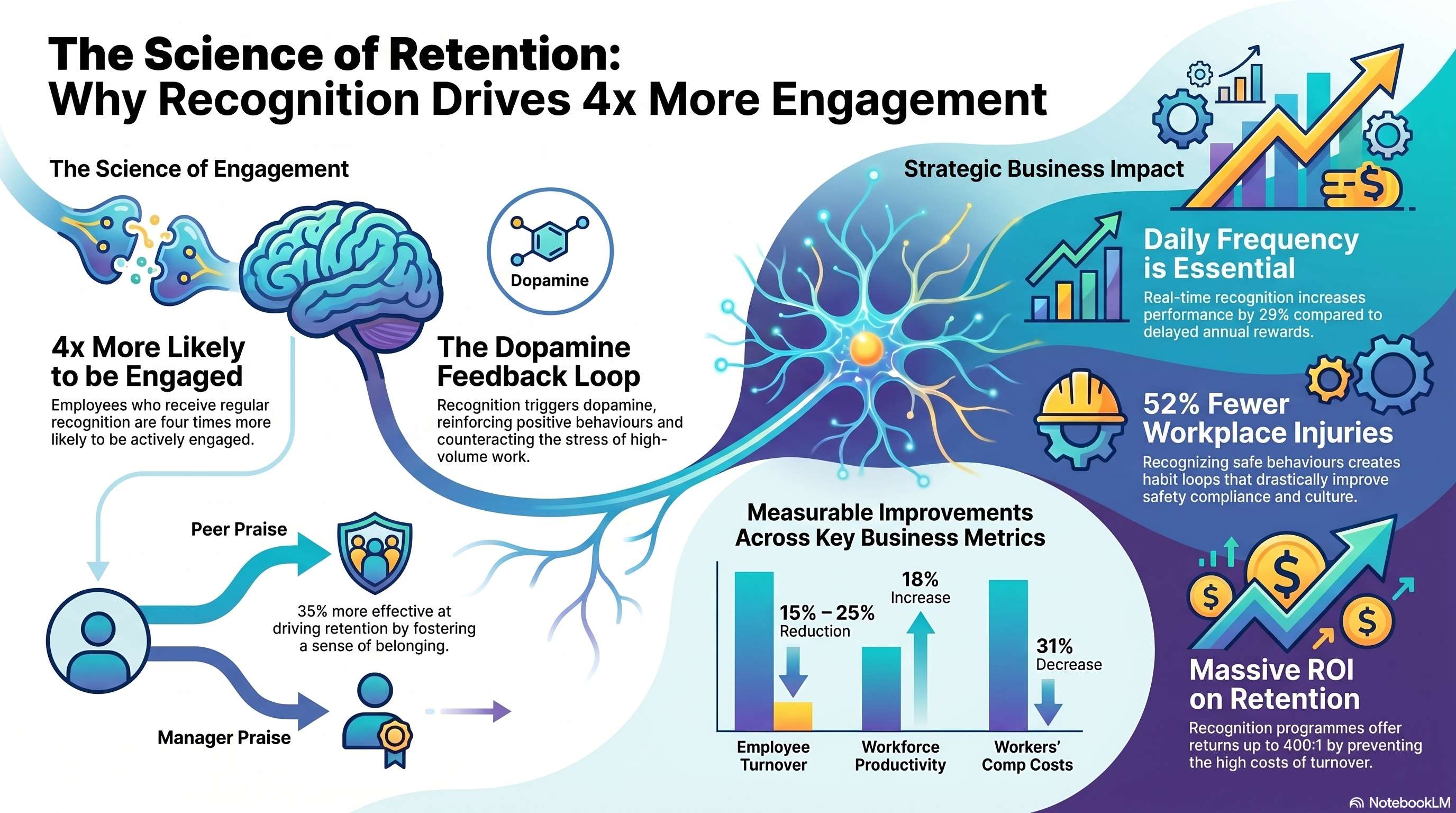
Four Times More Engaged[/caption]
Research from Gallup shows that employees who are recognized for their work are four times more likely to be engaged than those who are not. But why? The answer lies in neuroscience. When an employee receives genuine recognition, their brain releases dopamine—the same neurochemical associated with motivation, reward, and pleasure. This dopamine release creates a positive feedback loop: recognition triggers dopamine release, which reinforces the behavior, which increases the likelihood of that behavior recurring. For frontline workers in retail, hospitality, and logistics, this mechanism is particularly powerful because recognition directly counteracts the psychological toll of high-volume, high-stress work environments.
The anterior cingulate cortex, the region of the brain responsible for processing social pain and rejection, also processes recognition and praise. When an employee is publicly recognized, they experience a reduction in social pain and an increase in social connection—two factors directly correlated with engagement and tenure. In high-turnover industries where workers often feel invisible and undervalued, recognition becomes a powerful antidote to the sense of anonymity that drives departures. Companies that systematize recognition don't just improve engagement; they fundamentally alter the neurochemistry of their workforce.
Recognition Frequency: Daily vs. Annual
Traditional annual recognition programs—bonuses, employee-of-the-month awards, annual reviews—fail to maintain dopamine elevation over time. Research from the Society for Human Resource Management (SHRM) found that 68% of hourly workers report feeling underappreciated, despite many organizations having formal recognition programs in place. The problem is timing and frequency.
Neuroscience shows that dopamine spikes are temporary. To maintain sustained engagement, recognition must be frequent. A study by Workplaces Insights revealed that real-time recognition (recognition delivered within hours of the achievement) increased performance by 29% compared to delayed recognition. For frontline workers, this means daily or weekly micro-recognitions are far more effective than annual accolades. A retail shift supervisor who acknowledges a cashier's exceptional customer service during that shift triggers an immediate dopamine response and reinforces the behavior in real-time. Companies implementing daily recognition systems report 35% lower turnover compared to those relying on traditional annual programs.
The frequency sweet spot appears to be multiple times per week to daily. However, this must be balanced against authenticity—hollow or generic recognition produces the opposite effect, triggering cortisol (stress hormone) instead of dopamine. Quality matters more than quantity.
Peer Recognition vs. Manager Recognition: Which Matters More?
A 2024 Harvard Business Review analysis found that peer-to-peer recognition is 35% more effective at driving retention than manager-only recognition. This counterintuitive finding challenges the traditional top-down recognition model. The reason: peer recognition signals social inclusion and belonging, which activates additional brain regions beyond those activated by managerial praise alone.
When a coworker recognizes a peer, it triggers the ventromedial prefrontal cortex—the region associated with social connection and self-worth within a group. Managerial recognition primarily activates reward centers but may not activate belonging centers. For hourly workers who spend 8-10 hours daily with their peers, peer recognition becomes the primary signal of inclusion. Organizations that facilitate peer recognition (through digital platforms, team huddles, or public channels) report 45% higher engagement scores among frontline staff.
However, manager recognition retains unique power: it signals career progression potential and advancement opportunity. The optimal model combines both. A retail location where associate-to-associate peer recognition is encouraged on a daily basis, AND where supervisors deliver quarterly strategic recognition tied to skill development and advancement, creates a dual-channel recognition ecosystem that maximizes retention. Research from Gallup shows this hybrid approach increases retention by 27% compared to manager-only programs.
Digital Recognition Platforms: Scaling Recognition Across Multi-Location Operations
High-volume employers operating 50, 100, or 500 locations face a recognition scaling challenge: How do you ensure consistent, frequent recognition across geographically dispersed teams? Digital recognition platforms solve this by embedding recognition into the workflow.
Platforms like Bonusly, Achievers, or Karma enable peer-to-peer recognition with micropoint systems where employees earn real or symbolic rewards. These platforms integrate with timekeeping, ATS, and HCM systems, making recognition data transparent and tied to actual performance. A 2023 Society for Human Resource Management study found that companies using digital recognition platforms report 39% higher engagement and 18% lower turnover in hourly roles.
The most effective digital platforms include: (1) Mobile-first design for shift workers without desk access; (2) Real-time notifications (recognition delivered and visible instantly); (3) Integration with business outcomes (tracking which recognized behaviors correlate with sales, customer satisfaction, or safety metrics); (4) Gamification elements (badges, streaks, leaderboards); (5) Conversion to tangible rewards (points redeemable for gift cards, paid time off, or merchandise).
Critically, the platform must be configured to prevent gaming. A meta-analysis of 47 studies on recognition programs found that when workers perceive recognition as manipulative or insincere, engagement actually decreases 22%. The platform must enforce authenticity through requirements like written comments, minimum word counts, and prevention of anonymous mass recognition.
Recognition and Safety Performance: The Compliance Advantage
In high-risk industries like healthcare, manufacturing, and logistics, recognition programs tied to safety metrics drive measurable compliance improvements. The National Safety Council reports that organizations with strong recognition cultures for safety behaviors experience 52% fewer lost-time injuries compared to industry averages.
This works because safety is often invisible work. A healthcare worker who follows proper infection control protocols 50 times per shift makes no headlines; an accident gets immediate attention. Recognition systems flip this equation by making safe behavior visible. When a warehouse associate is recognized for using proper lifting technique or a retail worker for following security protocols, it creates a culture where safety is celebrated—not just mandated.
The neurological mechanism: Recognition of safe behavior triggers dopamine, reinforcing those actions. Over time, workers develop habit loops around safety. Combined with peer recognition (where coworkers call out safety-conscious behavior), this creates a self-reinforcing safety culture. Organizations implementing recognition-based safety programs report not only fewer incidents but also 31% lower workers' compensation costs and 26% fewer regulatory citations.
Designing Your Recognition Program: The 5-Point Framework
Building an effective recognition program requires more than launching a software platform. Here's the framework:
- Clarity on Values and Behaviors: Define which behaviors you're recognizing. Don't recognize tenure alone; recognize specific behaviors aligned to company values. For example, instead of "Employee of the Month," recognize "Goes Beyond to Help a Customer" or "Models Our Safety Commitments."
- Frequency at Scale: Implement daily or near-daily recognition opportunities. A retail chain might run daily recognition in each location's end-of-shift huddle. A logistics company might include peer recognition in its weekly safety briefing.
- Dual-Channel System: Ensure both peer-to-peer AND manager-to-employee recognition pathways. Peer recognition should be easiest and most frequent; manager recognition should be strategic and tied to development.
- Real-Time Visibility: Make recognition visible in real-time. Public huddles, digital platforms with instant notifications, and team channels (Slack, Teams) create immediate social proof of recognition.
- Measurement and Linkage: Track participation rates, tie recognition data to business outcomes (turnover, engagement scores, safety metrics, customer satisfaction), and adjust the program based on data.
Companies implementing all five elements report 38% higher engagement and 22% lower turnover in hourly populations compared to organizations with fragmented recognition approaches.
The Cost of Underrecognition: Turnover Math
The absence of recognition is costly. Gallup estimates that a single lost employee costs $15,000 to $240,000 in direct and indirect expenses depending on role. But the recognition benefit math is compelling: Implementing a recognition program costs approximately $2-$5 per employee per month (platform fees, management time) and reduces turnover by 15-25%. For a 500-person retail or hospitality operation with typical 100% annual turnover, preventing even 50 departures saves $750,000 to $12 million annually against a program cost of $12,000-$30,000. The ROI is 25:1 to 400:1.
Beyond direct savings, recognition improves productivity. Engaged employees (those who feel recognized) are 18% more productive and generate 23% higher profitability. For retailers, a 15% engagement lift correlates to 1-2 percentage point increases in same-store sales. For call centers, recognition programs improve average handle time by 12% and customer satisfaction scores by 8%.
The data is unambiguous: Recognition is not a "nice to have" HR initiative; it's a core financial driver for high-volume, high-turnover operations.
Avoiding Common Recognition Program Failures
Many organizations launch recognition programs that fail within 6-12 months. Common failure patterns include:
Lack of Leadership Participation: If managers don't actively recognize, the program stalls. Programs fail when leadership doesn't model the behavior. Successful programs make manager recognition a tracked accountability metric, with peer evaluations of manager recognition effectiveness built in.
Insincere or Generic Recognition: Saying "Great job today!" repeatedly produces recognition fatigue and cynicism. Recognition must be specific, tied to observable behavior, and genuine. Program guidelines should require descriptions like: "On March 15, Sarah resolved a complex customer issue by listening carefully, offering three alternative solutions, and following up the next day—exactly what our 'Customer First' value means."
Missing Peer Recognition: Programs that focus solely on top-down manager recognition miss the engagement opportunity of peer connection. Programs need structured pathways for peers to recognize peers, sometimes with light gatekeeping (e.g., manager approval of points but not suppression of recognition).
Decoupling from Outcomes: If the program isn't tied to measurable business outcomes, it becomes a cost center rather than a strategic investment. Successful programs measure: (1) Recognition participation rates; (2) Correlation with engagement scores; (3) Impact on voluntary turnover; (4) Connection to safety, quality, or sales metrics where relevant.
Low Accessibility: If the platform is difficult to access (requires a desktop, is not mobile-optimized, has a complex approval workflow), adoption stalls. For shift workers, mobile-first, push-button recognition is critical.
Conclusion: Recognition as a Strategic Retention Lever
Employee recognition is not a soft HR program; it is a neuroscience-grounded, measurably impactful retention and performance strategy. The science is clear: recognition triggers dopamine, creates positive feedback loops, signals social inclusion, and reinforces desired behaviors. At scale, recognition programs reduce turnover by 18-25% and improve productivity by 12-23%.
For high-volume employers in retail, hospitality, healthcare, and logistics—industries where turnover rates exceed 100% annually—recognition becomes a critical competitive advantage. Organizations that systematize recognition through daily opportunities, digital platforms, peer-to-peer channels, and clear behavior frameworks achieve substantially higher engagement, lower turnover, and improved business outcomes.
The time to implement is now. Quarterly or annual recognition is insufficient. Daily, frequent, authentic recognition embedded in operational workflows is the standard that high-retention organizations use to outcompete their peers.
References and Further Reading
- Gallup: 'Recognition and Engagement: Understanding the Dopamine Effect' (2023)
- Harvard Business Review: 'Peer Recognition Outpaces Manager Recognition in Driving Retention' (2024)
- SHRM: 'Employee Appreciation and Retention in Hourly Workforces' (2023)
- Society for Human Resource Management: 'Digital Recognition Platforms: ROI and Adoption Metrics' (2023)
- National Safety Council: 'Safety Recognition Programs and Lost-Time Injury Reduction' (2023)
- Bonusly: 'Recognition and Turnover: A 3-Year Longitudinal Study' (2023)
- Society for Occupational Health Psychology: 'Neuroscience of Recognition and Workplace Belonging' (2024)
- Workplace Insights: 'Real-Time vs. Delayed Recognition and Performance Impact' (2023)
How Cadient Talent SmartSuite™ Helps
Cadient Talent’s SmartSuite™ platform automates compliance workflows, embeds regulatory guardrails directly into your hiring process, and maintains audit-ready documentation at every stage—so your team can focus on finding great talent while staying protected from costly violations.
