Building Internal Career Pathways That Retain Talent
The Internal Promotion Opportunity
[caption id="attachment_20927" align="alignnone" width="2752"]
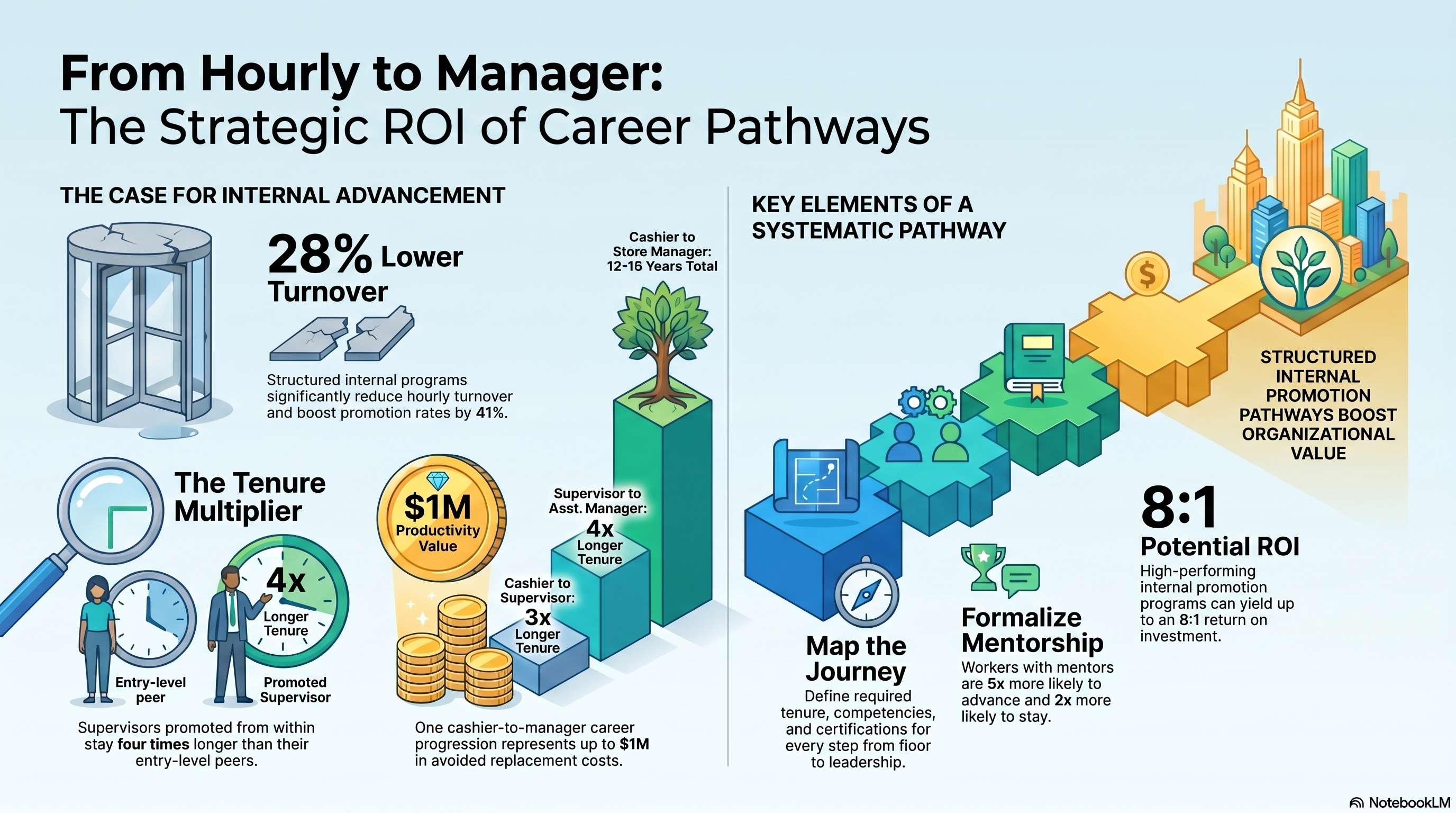
From Hourly to Manager[/caption]
Retail and hospitality have massive untapped potential for internal advancement. A typical regional manager started as a cashier. A Store Manager likely started in a warehouse or on a sales floor. Yet most companies treat these pathways as accidental rather than systematic. The result: High-potential hourly workers see no advancement path and leave. Research from Harvard Business School found that companies with structured internal advancement programs report 28% lower turnover among hourly workers and 41% higher internal promotion rates.
The math is compelling: A cashier who becomes a supervisor has 3x longer tenure than peers. A supervisor who becomes assistant manager has 4x longer tenure. A single career progression from cashier to Store Manager represents 12-15 years of tenure at full engagement—worth $500K-$1M in productivity and avoided replacement cost. Yet most cashiers never consider advancing because they don't see the path.
Building systematic career pathways requires five elements: (1) Clear advancement maps; (2) Skills development; (3) Mentorship; (4) Proven success stories; (5) Accessible entry points to advancement.
Mapping Career Pathways: From Hourly to Leadership
Document every position in your organization and the skills required to advance from one to the next. A typical retail progression: Cashier → Floor Associate → Team Lead → Assistant Manager → Store Manager → District Manager → Regional Manager.
For each step, define: (1) Required tenure in current role; (2) Required competencies and skills; (3) Required performance/behavioral standards; (4) Education or certifications required; (5) Development activities needed before promotion.
Example progression (Cashier to Team Lead): Minimum 1 year tenure as cashier. Competencies required: Customer service excellence (rating 4+/5 on evaluations), reliability (attendance 95%+), cash handling accuracy (error rate <1%), teamwork (peer/manager feedback positive), communication skills (able to explain procedures clearly). Development: (1) Complete POS system certification (2 weeks); (2) Complete customer service training program (1 week); (3) Lead one new-cashier cohort (1 month); (4) Complete supervisory basics course (6 hours).
Share this map with all hourly workers. A cashier should understand: "Here's what I need to develop to become a Team Lead. Here's the timeline. Here's who can help." Clarity creates aspiration and engagement. Research shows workers with clear advancement maps have 32% higher engagement and 24% lower turnover.
Skills Development and Training Programs
Advancement requires building skills beyond current role. Establish structured development programs for each role level.
For Team Lead pathway: (1) Systems training (POS, inventory, labor management systems); (2) Customer service excellence (handling difficult customers, service recovery); (3) Team management basics (delegating, feedback, conflict resolution); (4) Loss prevention and cash handling; (5) Hiring and onboarding fundamentals; (6) Safety and compliance.
Delivery: Mix of classroom training (1-2 days per topic), online modules (self-paced), on-the-job learning (shadowing experienced Team Leads), and coaching (manager support). Total time: 60-80 hours over 3-4 months for someone ready for promotion.
Investment: A structured development program costs $2,000-$3,000 per employee (instructor time, materials, systems, coaching). For a company promoting 50 hourly workers to leadership annually, cost is $100K-$150K. But each promoted employee staying 3+ years longer than replacement hires (average promotion-level tenure: 3 years; external hire tenure: 1.5 years) generates $200K-$300K additional productivity value. ROI: 1.5:1 to 2:1.
Best practice companies: Target, Amazon, Starbucks, Whole Foods all have documented development programs for hourly advancement. These programs are part of company brand ("grow your career here") and are competitive advantage.
Mentorship and Sponsorship
Development programs teach skills. Mentorship teaches how to succeed in your organization. A mentor—a more experienced manager—guides a potential leader through unwritten rules, cultural expectations, and advancement strategy.
Structured mentorship includes: (1) Monthly one-on-ones (30-60 min); (2) Specific skill coaching (practicing difficult conversations, reviewing performance feedback); (3) Visibility (mentor invites mentee to meetings, presentations, leadership discussions); (4) Network building (introducing mentee to other leaders); (5) Sponsorship (mentor advocates for mentee's advancement when opportunities arise).
Mentor selection: Match mentor and mentee by: (1) Desired advancement path (if mentee wants Store Manager role, mentor should be current or former Store Manager); (2) Personality/rapport (they should naturally get along); (3) Mentor availability (someone actually willing to invest time); (4) Mentee readiness (someone demonstrating commitment to development).
Formalization: Establish a mentorship program with: (1) Application/nomination process; (2) Training for mentors on coaching skills; (3) Structured meeting schedule and agenda; (4) Progress tracking (mentor documents mentee development); (5) Success metrics (percentage of mentees advancing within 18 months).
Impact: Workers with mentors are 5x more likely to advance and 2x more likely to stay long-term. Companies with formal mentorship programs report 34% higher internal promotion rates.
Visibility and Opportunity Creation
Advancement depends on visibility. A talented hourly worker who doesn't surface won't be considered for leadership roles. Create mechanisms for visibility: (1) Leadership committees and projects; (2) Cross-functional exposure; (3) Internal talent reviews; (4) 360-degree feedback; (5) Training and conference attendance; (6) Stretch assignments.
Leadership projects: Identify high-potential hourly workers and assign them to projects outside their normal work. Examples: Process improvement team (redesigning new-hire onboarding), store opening team (opening a new location), technology piloting (testing new POS system across 5 stores). These projects expose workers to broader organizational challenges and visibility with leaders.
Internal talent reviews: Quarterly or biannual discussions where managers identify and discuss high-potential workers. Executives hear about emerging talent and can coach on development. This surfaces talent that might otherwise be invisible.
360-degree feedback: High-potential workers receive structured feedback from peers, managers, and direct reports (if applicable). This reveals blind spots and developmental needs. It also signals to the individual that the organization is investing in their development.
Stretch assignments: Assign a high-potential Team Lead to temporarily cover for a vacationing Assistant Manager or lead a complex project. Success in stretch roles proves readiness and builds confidence.
Impact: Workers with visibility and stretch opportunities are 3.5x more likely to be promoted within 2 years compared to peers without these exposures.
Communicating Success Stories
Proof is powerful. A cashier who advanced to Store Manager is living proof that advancement is possible. Feature these stories in: (1) Company communications; (2) Recruiting materials; (3) Onboarding; (4) All-hands meetings; (5) Manager training; (6) Internal job postings.
Success story structure: (1) Their starting role and background; (2) Challenges they faced; (3) Development journey (what skills they built, who helped them, how long it took); (4) Current role and accomplishments; (5) Advice for aspiring leaders; (6) Career milestones and timeline.
Example: "Maria started as a Retail Cashier in 2015 earning $15/hour. She was curious, reliable, and had strong customer service instincts. Her manager noticed her potential and invited her into our Team Lead development program. Over 18 months, Maria completed training, led multiple new-hire cohorts, and proved her ability to handle complexity. In 2017, she became Team Lead. In 2019, she became Assistant Manager. In 2021, she became Store Manager of our flagship location. Today, Maria is District Manager overseeing 12 stores. She credits her mentors (particularly Store Manager Janet) and her own commitment to learning. Her advice: 'Show up reliably, ask questions, seek feedback, and say yes to stretch opportunities.'"
Impact: Companies featuring internal advancement stories report 22% higher engagement among hourly workers and 18% higher conversion rate from hourly to supervisory roles (percentage of supervisor positions filled internally).
Removing Barriers to Advancement
Even with clear pathways and development, barriers can prevent advancement. Address these: (1) Perception barriers ("That's not for people like me"); (2) Structural barriers (Team Lead roles all require full-time availability; part-time workers can't advance); (3) Financial barriers (development courses cost workers money); (4) Geographic barriers (only promotions available in other cities); (5) Credential barriers (requiring certain degrees/certifications that workers can't access).
Solutions: (1) Proactively recruit from underrepresented groups for advancement programs; (2) Create part-time supervisory roles for workers preferring flexible schedules; (3) Pay for development courses; (4) Offer transfer opportunities (workers can move to other locations for promotion); (5) Partner with schools/online programs to make credentials accessible; (6) Value experience equivalent to credentials ("5 years in role = degree requirement").
Impact: Removing barriers is low-cost but high-impact. Companies removing barriers report 25-30% improvement in diversity in leadership and 18% improvement in internal promotion rates.
Measuring Career Pathway Success
KPIs to track: (1) Internal promotion rate (% of promotions filled internally); Benchmark: Retail average is 25-30%; high performers: 40-50%. (2) Tenure of promoted workers (tenure of workers advanced from hourly to supervisory); Benchmark: Promoted workers should stay 3+ years in supervisory role (vs. external hire tenure of 1.5-2 years). (3) Engagement of high-potential workers (track engagement scores for workers identified as advancement candidates); Target: 7.5+/10. (4) Development program completion rate (% of participants completing program); Target: 85%+. (5) Advancement rate (% of development program participants advancing within 18 months); Target: 60-70%. (6) Manager satisfaction with new leaders (did promoted workers succeed or struggle?); Survey: Have managers rate promoted workers on readiness, performance, cultural fit.
Business case: A 500-person company promoting 20 hourly workers to supervisory roles annually (internal promotion rate: 45%) vs. 50-50 internal-external split saves: (1) 10 fewer external supervisor hires (cost savings: $150K-$200K in recruiting/onboarding); (2) 10 promoted workers staying 3+ years vs. external hires staying 1.5 years = 15 FTE-years of additional tenure value = $750K-$1.5M in productivity. Total benefit: $900K-$1.7M. Program cost (development, mentorship, projects): $150K-$200K annually. Net benefit: $700K-$1.5M. ROI: 4:1 to 8:1.
Conclusion: Career Pathways as Retention Strategy
Clear, accessible career pathways transform hourly workforces from transient labor into developing talent pools. Workers see future in organizations offering advancement. They stay longer. They perform at higher levels. They become mentors to next cohort. Culture strengthens.
Companies winning at retention in high-volume industries are those treating hourly workers as future leaders, not perpetual entry-level staff. Begin by documenting advancement pathways, establishing development programs, and communicating opportunities. Measure success. Within 18 months, internal promotion rates will improve, turnover will decline, and leadership bench will strengthen.
The companies competing for talent in tight labor markets will be those offering genuine career opportunity. Build that advantage today.
References and Further Reading
- Harvard Business School: 'Internal Career Pathways and Retention' (2024)
- Society for Human Resource Management: 'Supervisory Development from Hourly Ranks' (2023)
- McKinsey: 'Career Ladders in Retail and Hospitality' (2024)
- Target, Amazon, Starbucks: 'Career Advancement Programs' (2023)
- NFRA: 'Internal Promotion and Turnover in Retail' (2023)
- American Hotel and Lodging Association: 'Career Pathways in Hospitality' (2023)
- Harvard Business Review: 'Mentorship and Career Success' (2024)
- Gallup: 'Career Opportunity and Engagement' (2023)
How Cadient Talent SmartSuite™ Helps
Cadient Talent’s SmartSuite™ platform automates compliance workflows, embeds regulatory guardrails directly into your hiring process, and maintains audit-ready documentation at every stage—so your team can focus on finding great talent while staying protected from costly violations.
