Structured feedback collection in the first 90 days predicts and prevents early departures.
The Early Warning System: Feedback as Retention Predictor
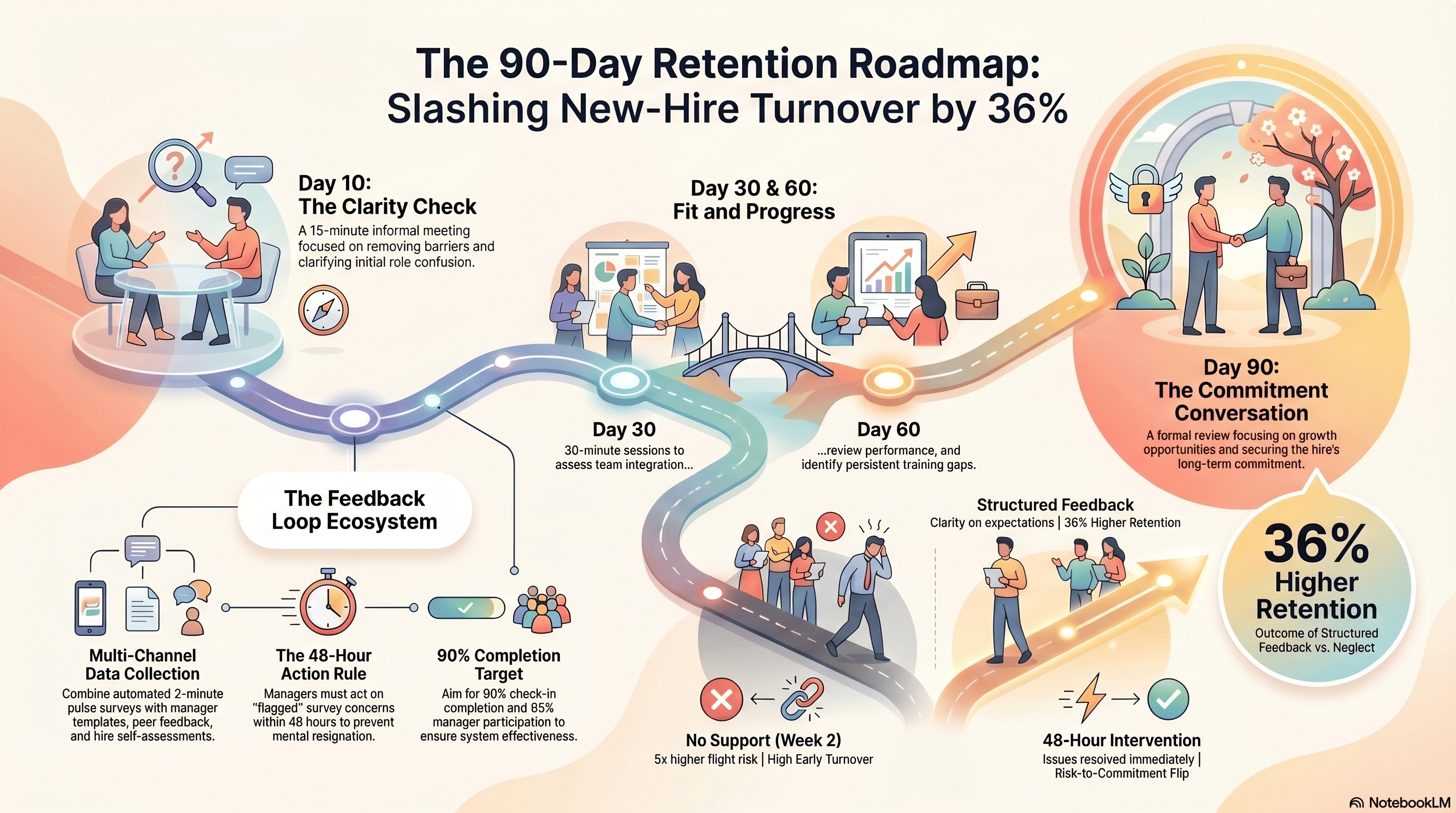
Research from the Josh Bersin Academy shows that new hires who receive structured, actionable feedback in their first 60 days have a 36% higher retention rate than those who don't. More importantly, specific feedback patterns (clarity on expectations, manager support, team connection) are predictive of who will leave.
The data is clear: early feedback isn't just about employee development—it's about early intervention. A new hire who feels lost or unsupported in week two is five times more likely to leave by day 90. But when a manager provides clarifying feedback in week two, that flight risk converts to a committed employee.
The difference between a structured feedback loop and ad-hoc feedback is the difference between preventing turnover and letting it happen.
What Structured Feedback Looks Like
Day 10 Check-In: Clarity and Support
Manager and new hire meet 15 minutes (informal, not formal review). Manager asks: What's going well? What's confusing? Do you feel supported? What do you need from me? This isn't about performance; it's about removing barriers. The hire gets clarity on unclear expectations. The manager learns if training was insufficient.
Day 30 Conversation: Role Fit and Adjustment
30-minute one-on-one. Manager reviews first-month performance: What have you accomplished? Where did you struggle? How are you connecting with the team? Any surprises? Manager gives feedback on what the hire is doing well and one area for improvement. Hire gets a sense of progress. Manager learns if role fit is solid or if adjustments are needed.
Day 60 Structured Review: Progress Against Expectations
30-minute review focused on two months of progress. Manager and hire review role expectations (were they clear? are they still accurate?). Discuss performance on core tasks. Identify any persistent gaps. Set expectations for month three. This is where the manager and hire align on what success looks like.
Day 90 Final Review: Onboarding Completion and Commitment
45-minute formal 90-day review. Covers overall performance, adherence to expectations, areas of growth, areas needing improvement. Most importantly: the manager has a conversation about quarter two and beyond. "You're doing well. Here's what I see as your growth opportunity. Are you excited to stay and develop in this role?" This is where you capture the hire's commitment.
Feedback Mechanisms: How to Collect Structured Feedback
Manager conversations are important, but feedback must also come from the hire. Use multiple channels:
Pulse surveys: Short (2-minute), automated surveys at days 10, 30, 60, 90. Questions: "I understand my role expectations" (1-5 scale). "My manager supports me" (yes/no). "I feel part of my team" (1-5). Responses are aggregated; hires flagged as "strongly disagree" on any question trigger manager action ("Let's talk about what's not clear").
Manager feedback templates: Simple one-page guide for each check-in (what to discuss, how to document). Removes guesswork. Ensures consistency across managers.
Peer feedback: By day 30, have the hire's buddy or mentor provide feedback (informal, not formal). "Is Sarah getting trained well? Does she seem engaged? Any concerns?" Peer insights often reveal issues managers miss.
Hire self-assessment: At day 60, hire completes a simple self-assessment (5-minute form). "How confident do you feel in your role? What do you need help with? Are you enjoying working here?" This signals flight risk (if a hire rates themselves low on "enjoying working here," they're likely to leave).
Combining these (manager conversation + pulse survey + peer feedback + self-assessment) creates a robust early-warning system.
Using Feedback Data for Intervention
Collecting feedback is only half the battle. The other half is acting on it.
Example 1: Clarity Gap
Day 10 feedback shows the hire is confused about expectations. Intervention: Manager spends 30 minutes clarifying role, creating a one-page role expectation document, assigning a peer mentor to reinforce training. Cost: 30 minutes manager time. Impact: clarity resolved by day 15.
Example 2: Manager Disconnect
Day 30 feedback shows the hire feels unsupported by their manager (manager is busy, rarely checks in). Intervention: HR coaches the manager on the importance of check-ins. Manager commits to weekly 15-minute check-ins for the next 30 days. Cost: HR coaching (30 minutes), manager time (15 minutes/week). Impact: hire feels supported, manager learns importance of connection.
Example 3: Team Integration Gap
Day 30 feedback shows the hire feels isolated (hasn't met many team members, eats lunch alone). Intervention: Buddy makes a point of including hire in team activities. Team lead invites hire to a lunch or informal gathering. Cost: minimal (social coordination). Impact: hire feels connected.
Example 4: Flight Risk Signal
Day 60 pulse survey shows hire rated themselves low on "enjoying working here" and "clear on expectations." Intervention: Manager schedules urgent conversation (not punitive, supportive). "I want to make sure you're set up for success. What's not working? What would help?" Manager listens, offers support (additional training, schedule adjustment, peer reassignment if needed). This conversation prevents a departure. Cost: 1 hour manager time. Impact: retained hire + identified systemic issue to address.
The key is having a systematic process for acting on feedback within 48 hours of identification. Delayed response ("we'll address that next month") doesn't work—the hire has already mentally left.
Scaling Feedback Loops Across Managers
For a 500-hire annual organization, managing feedback loops for each hire could overwhelm managers. Automation is essential:
Automated pulse surveys: Send at predefined dates (day 10, 30, 60, 90). Results populate a dashboard. Managers see their new hires' responses and any flagged concerns.
Manager reminders: "Schedule day 10 check-in with Sarah by Friday." "Day 30 review conversation due by EOW." These automated reminders prevent check-ins from being forgotten.
Template-driven documentation: Manager opens a form (5 questions), fills in check-in notes, submits. Notes go into HRIS. Removes burden of free-form documentation.
Aggregation and trends: HR can see patterns (e.g., "Managers in store A have lower hiring clarity scores; they need more training support"). This informs HR support and manager coaching.
Integration with retention: Link feedback data to actual retention outcomes. Show managers: "Stores where we conducted structured day-30 check-ins had 85% 90-day retention. Stores without structured check-ins had 72%." This makes the business case for engagement.
The Manager's Role: Coaching Beyond Feedback
Feedback is information. Coaching is action. Managers must be trained to coach, not just evaluate:
Listen first: Ask open-ended questions. Let the hire talk. Many managers jump to solutions before understanding the problem.
Validate: "That makes sense. I can see why role expectations weren't clear." Validation builds trust.
Problem-solve together: "What would help clarify expectations? Let's create a simple guide." Co-creation is more effective than top-down fixes.
Follow up: "We agreed you'd shadow Sarah for one week. How's that going? Is it helping?" Follow-up shows that the manager cares and holds the hire accountable to the plan.
Praise progress: "Last week you were confused about the system. This week you processed 10 orders independently. That's real progress." Recognition builds confidence.
Managers often resist structured feedback conversations ("I don't have time; my team knows I'm available if they need help"). But research shows that informal availability is less effective than structured conversations. The hire interprets "my door is always open" as "you should figure it out yourself." Structured check-ins signal "I'm actively invested in your success."
Measuring Feedback Loop Effectiveness
Track these metrics to assess whether feedback loops are working:
Feedback completion rate: % of hires receiving day 10, 30, 60, 90 check-ins (target: 90%+)
Feedback response time: Average time from feedback collection to manager action (target: <48 hours for flagged concerns)
Flight-risk detection rate: % of hires flagged by feedback as at-risk who are actually retained (if feedback is predictive, most should be retained after intervention)
90-day retention: % of hires retained past day 90 (should improve with structured feedback from 70-75% to 85-90%)
Hire satisfaction on support: % of hires rating "manager supports me" as "agree" or "strongly agree" on pulse surveys (target: 80%+)
Manager participation: % of managers completing structured check-ins on time (target: 85%+). Low participation suggests managers need training or support.
Link these metrics to business outcomes (retention, productivity, engagement) to show the ROI of structured feedback.
How Cadient Talent SmartSuite Helps
SmartSuite's feedback loop module includes automated pulse surveys (day 10, 30, 60, 90), manager check-in templates and reminders, feedback documentation in HRIS, flight-risk flagging based on survey responses, and aggregated dashboards showing feedback trends by manager and location. Integration with retention data allows tracking of which feedback interventions actually prevent turnover.
References and Further Reading
- Josh Bersin Academy, 'The Early Feedback Advantage' (2024)
- Gallup, 'The Power of Regular One-on-Ones' (2023)
- SHRM, 'Feedback and Retention in the First 90 Days' (2023)
- Harvard Business Review, 'How to Give Feedback to New Hires' (2023)
How Cadient Talent SmartSuite™ Helps
Cadient Talent’s SmartSuite™ platform automates compliance workflows, embeds regulatory guardrails directly into your hiring process, and maintains audit-ready documentation at every stage—so your team can focus on finding great talent while staying protected from costly violations.
