The ROI of structured onboarding compounds across the first three years.
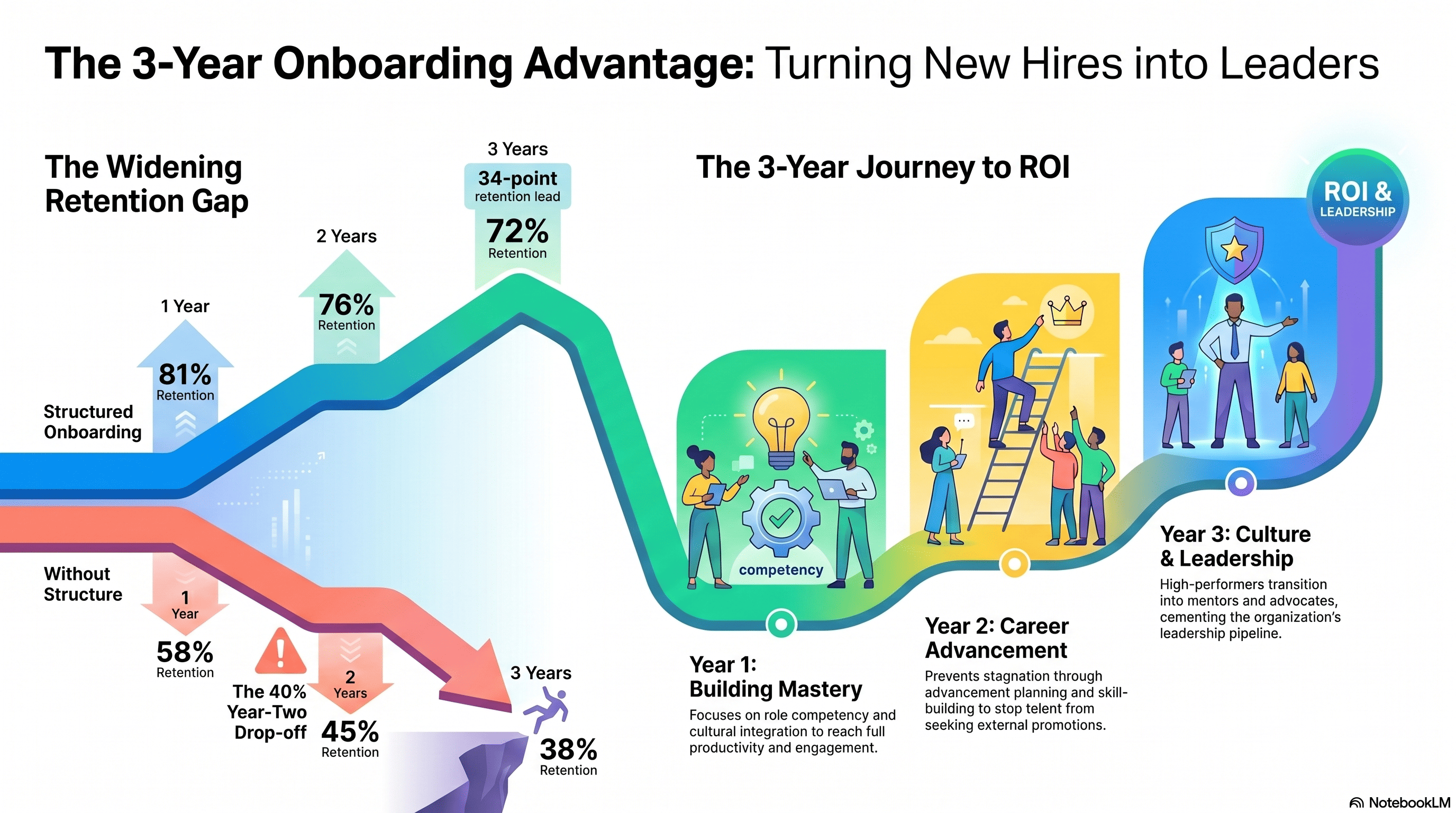
The 3-Year Retention Advantage
SHRM's 2023 research on onboarding shows that organizations with formal, structured onboarding (beyond day one) see measurably higher retention not just at 90 days, but at 1 year, 2 years, and 3 years.
Data from 2,400 organizations:
- 90-day retention with structured onboarding: 89% vs. 72% without (17 point difference)
- 1-year retention: 81% vs. 58% (23 point difference)
- 2-year retention: 76% vs. 45% (31 point difference)
- 3-year retention: 72% vs. 38% (34 point difference)
The gap widens over time. This is because structured onboarding creates lasting culture fit, skill development, and engagement. Early departures (caused by poor onboarding) don't happen. Longer-term departures (caused by stalled development) are prevented by ongoing onboarding investment.
Conversely, organizations without structured onboarding lose 40%+ of hires by year two. The cumulative cost is devastating.
Year 1: Foundation Setting
Year 1 focuses on role competency and cultural integration:
- Months 1-3: Intensive onboarding (forms, training, role clarity, team integration)
- Months 4-6: Skill deepening (more complex tasks, feedback loops, confidence building)
- Months 7-12: Role mastery (independent execution, mentoring peers, expanded responsibilities)
Investment: 120-150 hours of manager/mentor time per hire. Cost: $5,000-$7,500 per hire in labor.
Outcome: Hire reaches full productivity. Engagement levels are high (they feel invested in). Retention by year-end: 81%+ (vs. 58% without structure).
Year 2: Development and Advancement
Year 2 is about progression and preventing plateau:
- Months 13-18: Advancement planning (what's the next step? what skills do they need?)
- Months 19-24: Skill-building for advancement (training, stretch assignments, mentorship from senior staff)
Without this continued investment, employees stagnate. They feel they've hit a ceiling. They become flight risks ("I'm not growing here"). A competitor calls with a promotion, and they leave.
With structured development, retention by end of year 2 is 76%+ (vs. 45% without structure).
This is where most organizations fail. They pour resources into year 1, then abandon onboarding entirely in year 2-3. The ROI disappears.
Year 3 and Beyond: Culture and Leadership
Year 3 is about cementing culture, developing leaders, and creating advocates:
- Months 25-30: Leadership readiness (preparing high performers to lead, mentor new hires)
- Months 31-36: Leader contribution (the hire is now mentoring newer employees, amplifying the organizational culture)
Employees in year 3 who received structured onboarding are embedded in the culture. They're advocates, mentors, and potential leaders. They're significantly less likely to leave.
Retention by end of year 3: 72%+ (vs. 38% without structure).
This compounding effect is the hidden value of structured onboarding. An organization that invests in year 1 but also maintains momentum in years 2-3 builds a stable, high-performing workforce.
The Long-Term ROI Calculation
For a 500-hire annual cohort:
Scenario 1: No structured onboarding
- 500 hires year 1
- By end of year 1: 290 remain (58% retention)
- By end of year 2: 225 remain (45% of original 500)
- By end of year 3: 190 remain (38% of original 500)
- Cumulative cost of turnover: (210 + 65 + 35 departures) × $12,876 = $3,865,680
Scenario 2: Structured onboarding across all 3 years
- 500 hires year 1
- By end of year 1: 405 remain (81% retention)
- By end of year 2: 380 remain (76% of original 500)
- By end of year 3: 360 remain (72% of original 500)
- Cumulative cost of turnover: (95 + 25 + 20 departures) × $12,876 = $1,555,680
- Cumulative investment in onboarding: 500 hires × 200 hours per hire × $25/hour (loaded cost) = $2,500,000
- Total cost: $1,555,680 + $2,500,000 = $4,055,680
Difference: Scenario 2 costs $190,000 MORE upfront. But the organization retains 170 additional hires (360 vs. 190), worth $2.3M in avoided turnover. The payback is almost immediate, and the ROI is massive in years 4+.
The key insight: structured onboarding requires investment, but the investment prevents even larger turnover costs.
Making the 3-Year Case to Leadership
Most organizations see onboarding as a day-one/week-one HR activity. Positioning it as a 3-year investment requires data and narrative change.
Presentation to leadership:
"Our current approach is high-cost and low-retention. We're investing $5-7K per hire in onboarding, but losing 40%+ of hires by year two. A structured, 3-year approach costs more upfront ($10K per hire), but retains 72% of hires by year 3. The math works: 170 additional hires retained × $12,876 = $2.2M in value vs. $2.5M investment. Break-even by year 4, with significantly higher returns in years 5+. We're choosing between short-term savings and long-term stability. Let's invest in stability."
How Cadient Talent SmartSuite Helps
SmartSuite tracks onboarding and development across the 3-year lifecycle. Year 1 check-ins, year 2 development planning, year 3 leadership readiness assessments. Retention dashboards show the ROI of structured onboarding over time.
References and Further Reading
- SHRM, 'Benefits of Onboarding Programs' (2023)
- Harvard Business Review, 'The Long-Term Impact of Onboarding' (2023)
- Deloitte, '3-Year Employee ROI Analysis' (2023)
- Center for American Progress, 'Long-Term Retention Costs' (2024)
How Cadient Talent SmartSuite™ Helps
Cadient Talent’s SmartSuite™ platform automates compliance workflows, embeds regulatory guardrails directly into your hiring process, and maintains audit-ready documentation at every stage—so your team can focus on finding great talent while staying protected from costly violations.
Ready to transform your hiring?
See how Cadient Talent helps you find the right people, faster.
Learn More
