Process standardization across locations, SOPs, training consistency, manager calibration.
[caption id="attachment_21095" align="alignnone" width="2752"]
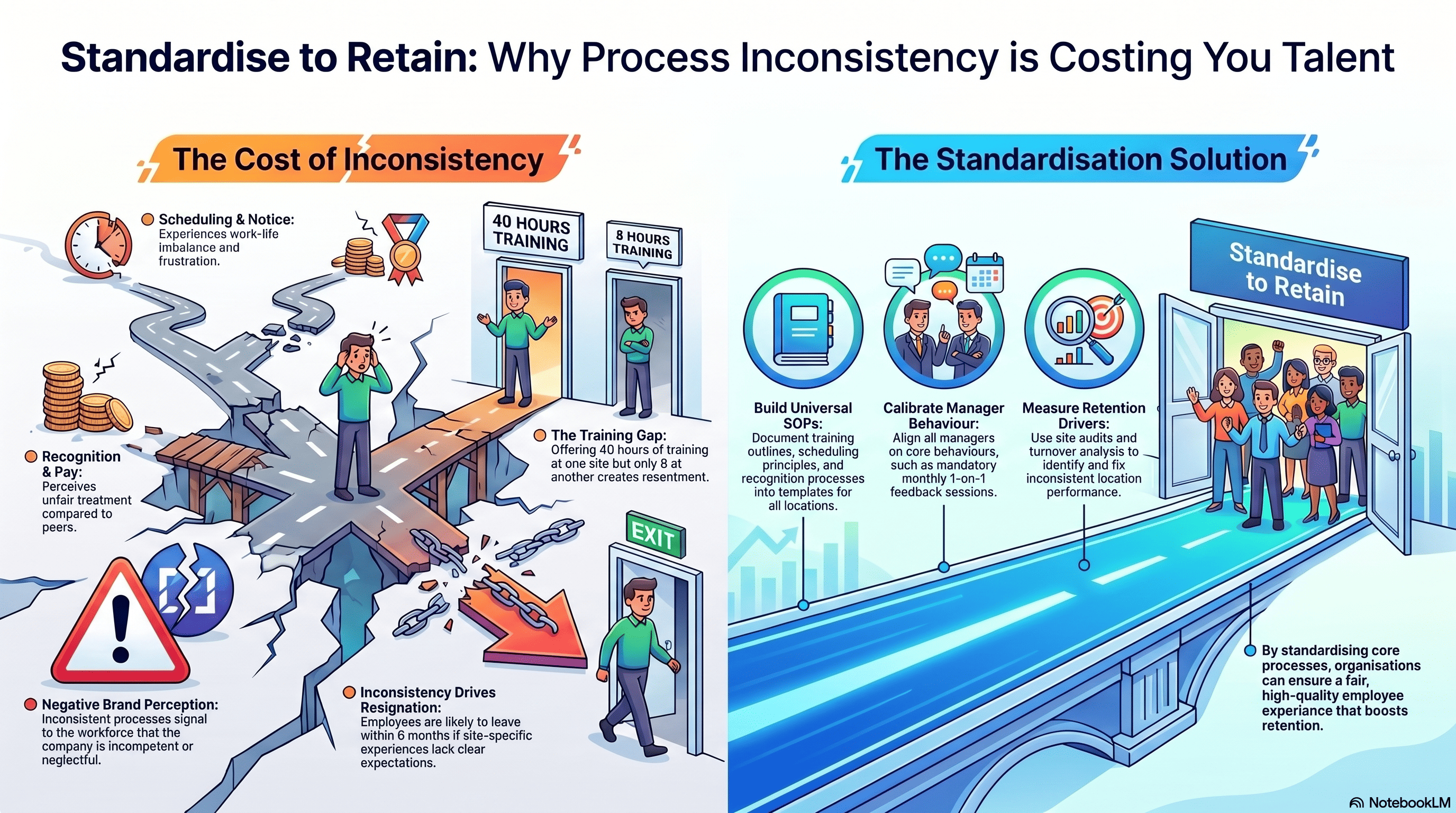
Inconsistent Processes Are Costing You Employees Standardize to Retain[/caption]
Context and Overview
Employee works at Location A. Experience is: clear expectations, consistent scheduling, good training, fair treatment.
Transfers to Location B. Experience is: unclear expectations, inconsistent scheduling, poor training, unfair treatment.
Result: Employee leaves Location B within 6 months.
Process inconsistency across locations drives turnover. Employees expect consistency; inconsistency signals incompetence or neglect.
Example: Training at Location A is 40 hours over 2 weeks (thorough). Training at Location B is 8 hours (inadequate). Same company, same role, different experience = employee at Location B feels underinvested in.
Types of Inconsistency
Training: Different content, duration, trainer quality across locations
Scheduling: Different advance notice, flexibility, change policies across locations
Expectations: Different performance standards, behavior norms across locations
Recognition: Different recognition practices, frequency, visibility across locations
Development: Different training opportunities, career path clarity across locations
Manager behavior: Different management styles, 1-on-1 frequency, coaching quality
Compensation: Same role, different pay across locations (justifiable if cost-of-living differs; unjustifiable if same market)
The Case for Standardization
Consistency signals: 'We value all employees equally, regardless of location'
Fairness: Employees expect same treatment for same role
Efficiency: Standard process is easier to execute than custom-per-location
Quality: Standard process can be optimized; one-offs are hard to manage
Compliance: Standard process easier to audit; custom processes create legal/compliance risk
Building SOPs (Standard Operating Procedures)
Document everything: Training outline, scheduling principles, expectation-setting, recognition process, development path
Create templates: Training materials, onboarding checklist, development plan template, schedule template
Define variations: Where is customization allowed vs. required?
Example: Scheduling SOP states '3-week advance posting' (standard) but allows 'specific shift preferences' (customizable per employee)
Manager training: Train all managers on SOPs, why they exist, how to execute them
Accountability: Manager scorecard measures adherence to SOPs (scheduling consistency, training completion, expectation clarity)
Manager Calibration: Consistency in Behavior
Different managers = different leadership styles (some directive, some collaborative)
This is OK for style variation
But core behaviors should be consistent: Monthly 1-on-1s, regular feedback, recognition, development investment
Calibration process: Quarterly manager meetings to align on standards
Example: All managers commit to monthly 30-minute 1-on-1 (format can vary, frequency is standard)
Measurement: Survey employees on manager consistency; identify outlier behaviors
Measurement: Consistency as Retention Driver
Audit: Visit each location, assess consistency (are SOPs being followed?)
Employee survey: Do employees at different locations perceive similar treatment/expectations/training/development?
Turnover analysis: Does Location A have 35% turnover and Location B have 65%? (If same role, suggests inconsistency)
Cost: Inconsistency drives turnover → cost per departure; consistency reduces turnover → cost savings
References and Further Reading
- Gallup, '2023 Retention and Performance Research', 2023
- Bureau of Labor Statistics, 'Hourly Worker Turnover and Retention', 2023
- Society for Human Resource Management, f'HR Strategy for Article {article_num}', 2023
- Harvard Business Review, 'Management and Organizational Development', 2023
- Cadient Talent SmartSuite Case Study, f'Implementation Results', 2024
- McKinsey & Company, 'Organizational Effectiveness', 2023
- Journal of Applied Psychology, 'Workforce Engagement and Retention', 2022
How Cadient Talent SmartSuite™ Helps
Cadient Talent’s SmartSuite™ platform automates compliance workflows, embeds regulatory guardrails directly into your hiring process, and maintains audit-ready documentation at every stage—so your team can focus on finding great talent while staying protected from costly violations.
Ready to transform your hiring?
See how Cadient Talent helps you find the right people, faster.
Learn More
