
Build a defensible assessment framework using the Green factors and rehabilitation evidence
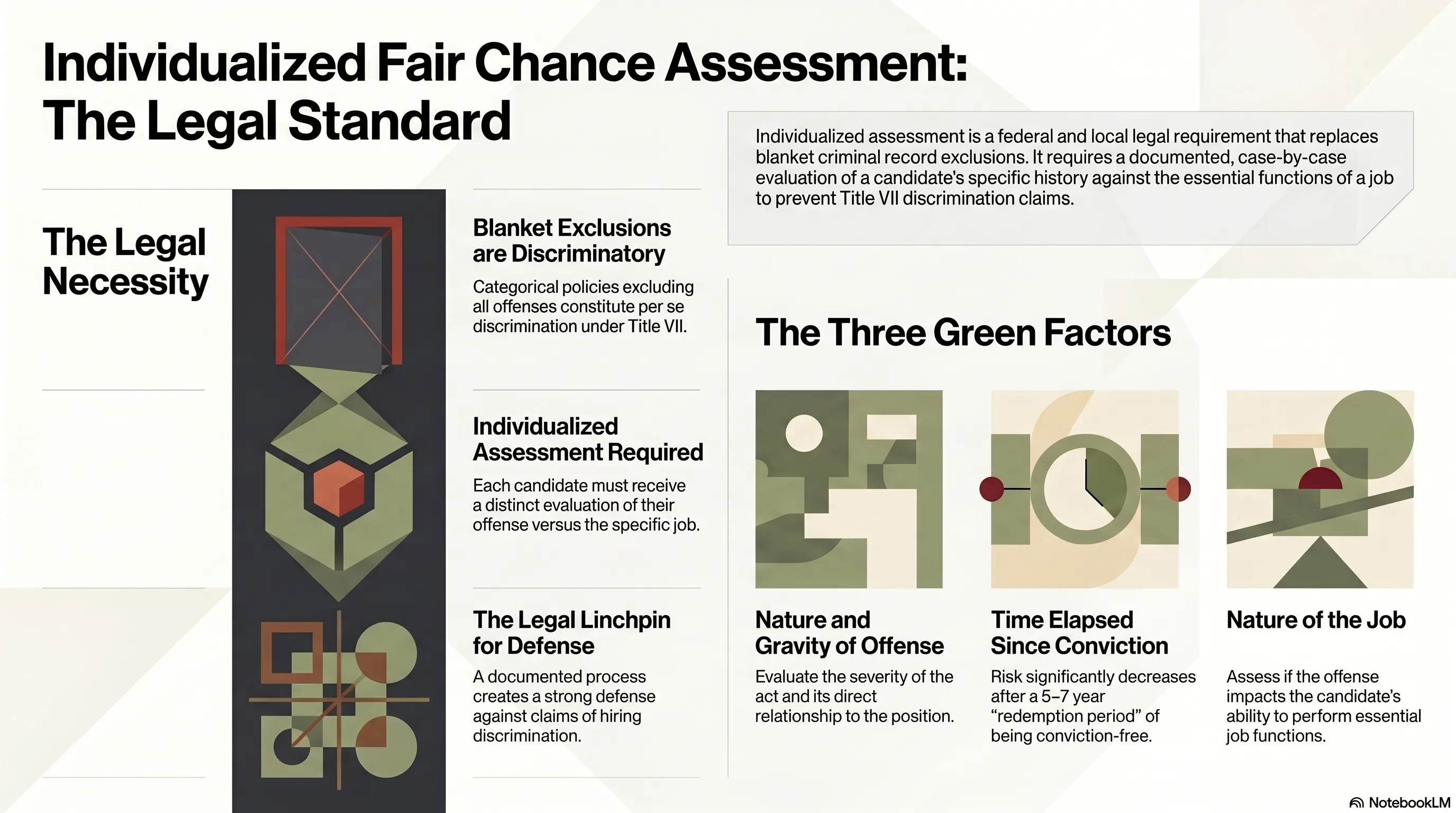
Why Individualized Assessment Is the Legal Linchpin
Individualized assessment is not a best practice suggestion; it is a legal requirement under federal EEOC doctrine and state/local Ban-the-Box laws. The failure to conduct individualized assessment is the most common legal vulnerability in criminal history hiring decisions, and it is the most easily defensible when done properly.
The legal foundation is straightforward: blanket exclusions of applicants based on criminal conviction status constitute per se discrimination under Title VII. The Third Circuit's decision in United States v. Bronstein held that categorical policies excluding entire classes of offenses without regard to individual circumstances are inherently discriminatory in effect. The EEOC's 2021 Enforcement Guidance explicitly requires that employers conduct individualized assessment when considering criminal records in hiring decisions.
Individualized assessment means that each candidate whose criminal record might disqualify them receives a distinct evaluation analyzing how their specific offense relates to their specific job. It means that two candidates with similar convictions may reach different hiring decisions based on time elapsed, evidence of rehabilitation, and job-specific factors. It means decision-makers consider documented criteria, not hunches or implicit biases.
Without individualized assessment, employers violate Title VII regardless of intent. With a robust, documented individualized assessment process, employers create a strong legal defense against discrimination claims. Courts recognize that employers who take assessment seriously—who document their reasoning, apply criteria consistently, and genuinely consider evidence of rehabilitation—are acting in good faith and consistent with law, even if a candidate is ultimately rejected.
The three Green factors (nature and gravity, time elapsed, nature of job) provide the analytical framework, but individualized assessment extends beyond these factors to encompass broader rehabilitation evidence, employment history, and circumstantial context.
The Three Green Factors: Comprehensive Analysis
Nature and Gravity of the Offense: Comprehensive Analysis
The first Green factor examines how serious the offense is and whether it directly relates to the specific job. This factor has two components: the inherent severity of the offense, and its relationship to the position sought.
Severity analysis: Felonies are generally more severe than misdemeanors; violent offenses more severe than property crimes; offenses of dishonesty more severe than offenses of violence in certain contexts. A conviction for aggravated assault with a weapon carries different implications than a simple battery. A conviction for embezzlement carries different implications than a conviction for jaywalking.
However, severity cannot be assessed in the abstract. A felony drug conviction might be more serious in the abstract than a misdemeanor assault, but if the job involves driving, the assault conviction may be less relevant than if the job involves drug analysis. The assessment must be position-specific.
Position specificity: The employer must identify the specific essential functions of the job and assess whether the offense directly impacts the candidate's ability to perform those functions. The EEOC provides helpful analysis in its guidance: "An employer may not make assumptions about a conviction's relationship to a position—the employer must examine the actual job duties."
Examples of direct relationships: (1) Conviction for embezzlement or theft → position involving access to financial assets; (2) Conviction for sexual assault or child abuse → position involving care of children or vulnerable adults; (3) Conviction for DUI or reckless driving → position involving operation of vehicles; (4) Conviction for violent felony → position involving physical confrontation (security guard, law enforcement); (5) Conviction for fraud or forgery → position requiring trustworthiness in financial or legal documentation.
Examples of tenuous relationships: (1) Conviction for marijuana possession 20 years ago → position as data entry clerk with no substance abuse risks; (2) Conviction for assault from age 18 → position as accountant 30 years later after decades of stable employment; (3) Conviction for shoplifting → position as remote customer service representative with no access to merchandise.
Position-specific documentation: Create a written position risk assessment for each role that requires criminal history screening. This assessment should identify: the specific essential functions of the position, the assets or populations at risk, the specific types of criminal conduct that directly impact the ability to safely perform those functions, and the types of offenses that are not relevant to that position. This document becomes part of the individualized assessment framework and demonstrates that the assessment is not based on blanket category exclusions but on genuine job-related analysis.
Time Elapsed Since Offense and Conviction: The Rehabilitation Evidence Framework
The second Green factor acknowledges that individuals can rehabilitate. The relevant timeline is not just years elapsed but the pattern of conduct during those years.
Guideline timelines: The EEOC guidance and most state laws suggest that convictions more than seven years old become increasingly difficult to use as a basis for exclusion. However, this is not a bright-line rule; it is a rebuttable presumption. A conviction 20 years old may weigh heavily if the candidate has been incarcerated since then or has a subsequent conviction. A conviction 5 years old may weigh lightly if the candidate has maintained steady employment and completed rehabilitation programs since.
Calculation methodology: Begin timing from the date of conviction, not arrest. If the candidate was sentenced to prison, account for incarceration length. If the candidate is on parole or probation, the timeline extends through the parole/probation termination date. If there is a subsequent conviction, the timeline essentially restarts from the most recent conviction.
Rehabilitation evidence categories: The EEOC identifies factors supporting rehabilitation: (1) employment history and job performance since conviction, (2) completion of educational or vocational programs, (3) evidence of substance abuse treatment or recovery (if substance-related), (4) family and community ties, (5) completion of parole or probation without incident, (6) character references from employers, teachers, clergy, or community members, (7) lack of any subsequent criminal activity, (8) evidence addressing the root causes of the original offense.
Employment history analysis: The most persuasive rehabilitation evidence is sustained, stable employment since conviction. If a candidate was convicted of theft in 2015 but has maintained employment with the same company (or in the same field) since 2016 with positive performance reviews, this demonstrates both that they can perform job duties and that they have abandoned criminal conduct. Conversely, if a candidate has been incarcerated repeatedly, unemployed for extended periods, or repeatedly convicted, rehabilitation is questionable despite years elapsed.
Mitigating circumstances: Some offenses are products of circumstances that no longer apply. An applicant convicted of drug trafficking while struggling with addiction who has been sober for 10 years with documented recovery evidence demonstrates changed circumstances. An applicant convicted in the context of economic desperation who has achieved financial stability demonstrates changed circumstances. These should be explicitly considered and documented.
Nature of Job Held or Sought: Position-Specific Risk Analysis
The third Green factor isolates which positions are implicated by which convictions. This factor prevents over-broad exclusions and ensures that assessment is tailored to actual risk.
Position categories and criminal relevance: The EEOC recognizes that certain categories of positions legitimately require criminal history screening while others do not. Positions involving vulnerable populations (children, elderly, disabled individuals, patients) generally warrant criminal history screening. Positions involving access to sensitive information, financial assets, or security systems warrant screening. Positions involving public safety (law enforcement, security, transportation of hazardous materials) warrant screening. Positions with no such legitimate risk factors do not warrant exclusion based on criminal history even if screening was conducted.
Some employers argue that all positions warrant criminal history screening to protect company liability. This argument, while understandable, is legally indefensible. If a position does not involve legitimate risk, excluding candidates based on criminal history constitutes illegal disparate impact under Title VII regardless of the employer's intent to reduce risk.
Job duties documentation: Document the specific essential functions of each position that potentially implicate criminal history screening. For example: "The position of Finance Manager handles accounts payable and payroll processing with access to employee financial information, vendor banking information, and company assets. This position involves a direct fiduciary duty." This documentation allows assessment of whether convictions related to dishonesty are relevant while convictions unrelated to trust are not.
Nature of job analysis in context: An applicant convicted of assault 3 years ago might be disqualified from a security guard position (where the nature of the job involves physical confrontation and weapons) but well-qualified for a data analyst position (where the job involves programming skills and no public safety implications). This analysis must be explicit and documented.
Legitimate restrictions versus blanket policies: A legitimate position-specific restriction might be: "All candidates for this position must have a background check because this position involves care of children. Convictions for sexual abuse, child abuse, or crimes involving dishonesty in a childcare context will be considered disqualifying." A blanket policy ("all candidates must have a background check; all felonies are disqualifying") is illegal.
Beyond the Three Factors: Additional Assessment Considerations
While the three Green factors provide the analytical framework, EEOC guidance and case law recognize additional factors that should be considered in individualized assessment:
Education and training completed: Post-conviction education demonstrates that the candidate is investing in rehabilitation. A candidate with a felony conviction who subsequently completed an associate degree in accounting, earned professional certifications, or completed trade training demonstrates commitment to staying out of the criminal justice system and becoming productive. This should weigh in the candidate's favor.
Employment history and job performance: Sustained employment with the same company, promotions, positive performance reviews, and advancement all indicate that the candidate is committed to legitimate work. A candidate with a 15-year-old felony who has been employed continuously for the past 12 years with a single company and has received four raises and a promotion demonstrates rehabilitation through work.
Family and community ties: Roots in a community—homeownership, family responsibilities, participation in community organizations—make criminal behavior less likely. An applicant who is a homeowner with school-age children, participates in their children's school, and has extended family in the community demonstrates social integration that reduces risk.
Character references and testimonials: Independent voices attesting to the candidate's character carry weight. References from previous employers (particularly if they knew about the conviction and hired the candidate anyway), teachers, clergy, social service providers, and community leaders all provide evidence that the candidate is trustworthy and reformed.
Root cause analysis: Some offenses are clearly products of addressable circumstances. A parent who committed theft to feed their children but has since achieved financial stability demonstrates changed circumstances. Someone who committed substance-related offenses but is now in long-term recovery demonstrates changed behavior. Someone who committed an offense while in an abusive relationship but has since left that relationship demonstrates changed circumstances. These should be explicitly considered.
Age at offense: Youth is relevant. A conviction from age 18 carries less predictive weight at age 35 than it would at age 20. The brain continues developing into the mid-20s, and psychological literature recognizes that juveniles and young adults have less developed judgment and impulse control. If the candidate was young at the time of the offense, this should factor into the assessment.
Isolated incident vs. pattern: A single conviction stands apart from a pattern of multiple convictions. Someone convicted once 20 years ago and never since is different from someone with convictions every 3-4 years. The frequency and recency of convictions signal different risk levels.
Response to authority: If an applicant was convicted but completed their sentence without incident, completed parole or probation without incident, and has maintained a clean record since, this shows they can comply with legal and employment requirements. Conversely, someone with multiple incarcerations or probation violations shows they have difficulty with compliance.
Documenting Individualized Assessment: The Assessment Matrix
Documentation is where individualized assessment becomes legally defensible. An undocumented assessment exists only in the mind of the decision-maker; in litigation, that decision-maker's credibility is easily attacked. A documented assessment creates objective evidence of the employer's reasoning.
A practical assessment matrix structure:
Candidate Name, Position, and Conviction Information: [Name], [Position Title], [Conviction: offense, date, sentence]
Nature and Gravity Analysis:
- Offense category: [Violent/Property/Drug/Dishonesty/Other]
- Severity assessment: [Brief description of why this offense is serious or not]
- Relationship to position: [Specific job duties and direct/indirect/no relationship to conviction]
- Assessment: [Does this offense relate to essential functions of this position? Yes/No; if yes, degree of relationship: Direct/Moderate/Minimal]
Time Elapsed Analysis:
- Date of conviction: [date]
- Years elapsed: [number]
- Incarceration period: [dates]
- Parole/probation completion: [date]
- Subsequent convictions: [Yes/No; if yes, describe]
- Employment history since conviction: [Continuous/Sporadic/None]
- Education/training completed since: [Describe]
- Assessment: [Has sufficient time elapsed? Evidence of rehabilitation: Strong/Moderate/Weak]
Nature of Job Analysis:
- Position title and essential functions: [Description]
- Vulnerable populations involved: [Yes/No; describe if yes]
- Sensitive information/assets: [Yes/No; describe if yes]
- Public safety implications: [Yes/No; describe if yes]
- Assessment: [Does this position legitimately warrant criminal history screening? Yes/No; if yes, degree of relevance of applicant's conviction to position: High/Moderate/Low]
Additional Factors Assessment:
- Character references: [Describe what was provided; assessment of credibility]
- Employment references: [Describe what was provided; assessment of quality]
- Education/training post-conviction: [Describe]
- Evidence of rehabilitation: [Describe]
- Community and family ties: [Describe]
- Root cause of offense addressed: [Describe]
- Age at offense: [Age; assessment of relevance to current reliability]
- Pattern of behavior: [Isolated incident or repeated conduct; assessment]
Applications of Green Factors to Job Requirements:
[Detailed explanation of how each Green factor applies to this specific job and this specific candidate]
Conclusion: [After applying all factors, is the conviction disqualifying for this position? Yes/No]
Rationale: [Specific explanation of why the conviction is or is not disqualifying, with reference to factors analyzed above]
Decision: [Candidate is hired/offer is withdrawn]
This matrix becomes part of the permanent record and, in litigation, is the primary evidence of the employer's compliance with the individualized assessment requirement.
Identifying and Preventing Per Se Discrimination
Per se discrimination is discrimination by definition—practices that are inherently discriminatory and cannot be justified even with legitimate business reasons. Blanket criminal exclusion policies are per se discrimination.
Examples of per se discriminatory policies:
"No applicants with felony convictions will be hired." This policy excludes all candidates with any felony, regardless of when it occurred, what the felony was, or what the job is. This is per se discriminatory.
"All candidates with drug convictions are automatically rejected." This policy categorically excludes all drug convictions without individualized assessment. It is per se discriminatory.
"Any applicant with more than one conviction will not be hired." This policy automatically rejects based on number of convictions rather than their relevance. It is per se discriminatory.
"Applicants with convictions within the past 10 years will not be hired." While more refined than blanket policies, this policy still fails to conduct individualized assessment. A 10-year-old misdemeanor shoplifting conviction is treated the same as a 9-year-old violent felony, which is per se discriminatory.
"All applicants must undergo criminal background checks; negative checks are automatic disqualifications." If applied to positions with no legitimate screening need (e.g., background checks of all applicants regardless of position), this can constitute per se discrimination through disparate impact.
To prevent per se discrimination:
Replace blanket language with position-specific and factor-specific language. Instead of "no felons," state: "Convictions related to dishonesty are relevant to positions involving financial responsibility and will be evaluated using the Green factors. Convictions unrelated to job duties will not be disqualifying."
Require written documentation of individualized assessment before any adverse decision. This shifts the culture from "does the person have a conviction?" to "what is the relevance of this specific conviction to this specific job?"
Train all hiring managers and decision-makers explicitly on what constitutes per se discrimination and why individualized assessment is not merely a best practice but a legal requirement.
Audit hiring decisions annually to identify whether any patterns emerge suggesting the application is effectively blanket despite official policy. If 95% of applicants with felonies are rejected while 5% with misdemeanors are rejected, even if the policy says individualized assessment is used, the pattern suggests the policy is not being applied.
Maintain a disparate impact analysis disaggregated by race/ethnicity. If candidates of a particular race are being rejected disproportionately based on criminal history, conduct an internal investigation into whether the assessment criteria are being applied fairly.
Applicant Flow Analysis and Disparate Impact Testing
Individualized assessment must be coupled with applicant flow analysis to identify whether the assessment system is working fairly in practice.
The Four-Fifths or 80/20 Rule: The EEOC's Uniform Guidelines on Employee Selection Procedures (29 CFR §1607) establish that if a selection rate for any protected class is less than 80% of the highest selection rate, the practice may constitute illegal disparate impact.
For criminal history decisions, applicant flow analysis should disaggregate hiring outcomes by race/ethnicity at the criminal history assessment stage. For example:
White applicants who reached conditional offer stage: 100
White applicants hired (conditional offer not withdrawn): 85 (85% hire rate)
Black applicants who reached conditional offer stage: 50
Black applicants hired (conditional offer not withdrawn): 25 (50% hire rate)
Black hire rate (50%) is 59% of the White hire rate (85%), well below the 80% threshold. This indicates potential illegal disparate impact.
When disparate impact appears:
Conduct a validity study to determine whether the criminal history criteria are actually predictive of job performance, safety, or legitimate business outcomes. Can the employer prove that the criteria it is using actually predict who will be a safe, reliable employee? Or is it based on assumption?
If validity is questionable, revise the criteria. Perhaps excluding all felonies is not necessary; perhaps excluding only recent convictions (within 5 years) or only convictions directly related to the position achieves the same legitimate business purpose with less discriminatory impact.
Document the analysis. Keep records showing: the applicant flow analysis that identified the disparate impact, the validity study conducted (or explanation of why none was possible), and the business justification for any criteria that remains despite disparate impact.
If disparate impact cannot be justified, the criteria must be modified. Courts have repeatedly held that employers cannot maintain clearly discriminatory practices simply because eliminating them would be inconvenient or might require assessing candidates on individualized merit.
Training and Consistency in Assessment
Individualized assessment requires decision-maker training and consistency mechanisms to ensure that the assessment framework is applied consistently across all candidates.
Training should cover:
The three Green factors with position-specific examples. Walk through hypothetical cases showing how the same conviction leads to different outcomes for different positions (e.g., DUI conviction for a delivery driver vs. a software engineer).
The concept of individualized assessment and why blanket policies are illegal. Help decision-makers understand that the goal is not to avoid risk through exclusion but to assess whether each candidate, given their specific history, rehabilitation, and the specific job, is suitable.
Implicit bias and how stereotypes about "criminals" can lead to inconsistent decision-making. Help decision-makers recognize that evaluating a conviction through the lens of race (whether conscious or unconscious) contaminates the assessment process.
The specific procedural requirements in each jurisdiction where the company hires (response opportunities, notice requirements, record-keeping obligations).
Documentation best practices and the importance of contemporaneous written assessment.
Consistency mechanisms:
Use the assessment matrix template for all criminal history decisions, even if the decision is to hire. This ensures consistency.
Have multiple reviewers assess important decisions (particularly those resulting in offer withdrawal) to reduce the chance of individual bias affecting the outcome.
Compare decisions for candidates with similar convictions in similar positions to identify inconsistencies. If one candidate with a theft conviction 8 years ago is hired while another with a similar profile is rejected, examine whether the assessment factors differ or whether bias crept in.
Periodically audit decision files to ensure the assessment matrix was completed, is documented with clear reasoning, and applies the Green factors.
Compare outcomes by decision-maker. If one hiring manager consistently rejects candidates with criminal history at a much higher rate than others, investigate whether they are applying the criteria consistently.
Maintain a central database of criminal history decisions (with candidate names and identifying information appropriately protected) so that consistency across positions and over time can be monitored.
Managing Candidate Response and Appeals
Individualized assessment continues through the candidate response and appeals process. If a candidate submits evidence of rehabilitation or mitigating circumstances, the employer must genuinely reconsider and document that reconsideration.
Response evaluation process:
When a candidate receives a pre-adverse action notice, they typically have a period (5-10 business days depending on jurisdiction) to respond with evidence. This response should be evaluated using a structured process:
Assessment of response content: What did the candidate submit? Character references? Employment history? Explanation of circumstances? Education certificates? Recovery documentation?
Evaluation of credibility: Are the references credible? Is the employment history corroborated? Does the explanation align with court records?
Integration into Green factors analysis: How does the response affect the assessment? If the candidate showed evidence of sustained employment since conviction, does this change the time elapsed analysis? If character references are strong, does this indicate rehabilitation? If the candidate addresses the root cause of the offense (e.g., now sober for 10 years after a substance-related conviction), does this change the assessment?
Reconsideration: Genuinely reconsider whether the original adverse decision should be upheld. If the response provides substantial evidence of rehabilitation, the employer should be prepared to revise its decision.
Documentation: Document the response evaluation even if the decision does not change. The fact that the employer considered the response and made a reasoned decision to proceed with the adverse action strengthens the employer's position in litigation.
Appeal process:
While not all jurisdictions require an internal appeal process for criminal history decisions, establishing one strengthens the employer's legal position and provides fairness to candidates. An appeal process might work as follows:
After the final adverse action notice, a candidate has the opportunity (e.g., 15 days) to request an appeal.
The appeal is reviewed by someone other than the original decision-maker, ideally someone with HR or legal expertise.
The appeal reviewer examines the original assessment matrix, the candidate's response, and the original adverse decision.
The appeal reviewer conducts an independent assessment using the same Green factors and considers whether the original decision applied the criteria consistently.
If the appeal reveals inconsistency or defect in the original assessment, the decision is revised and the candidate is offered the position.
If the appeal upholds the original decision, the candidate receives a written explanation of the appeal outcome.
Maintaining an appeal process, even if rarely used, demonstrates that the employer takes the assessment process seriously and is willing to reconsider if error is identified.
Best Practice Implementation Checklist
- For each position that will require criminal history screening, create a written position risk assessment identifying the specific job duties, assets at risk, and types of criminal conduct directly relevant to that position.
- Establish written criteria for individualized assessment that identify which types of offenses are relevant to which position categories, but explicitly state that blanket exclusions are prohibited.
- Develop and implement the criminal history assessment matrix template to be used for every candidate whose conviction might disqualify them.
- Ensure that all assessment matrices are completed before the adverse decision is communicated, showing contemporaneous reasoning rather than post-hoc justification.
- Create training program on the three Green factors, disparate impact risks, implicit bias, and the legal requirement for individualized assessment, and conduct annually for all hiring managers and decision-makers.
- Implement a dual-reviewer process for all criminal history adverse decisions to reduce the chance of individual bias.
- Establish a candidate response evaluation process that genuinely reconsiders the original decision in light of evidence of rehabilitation.
- Create an internal appeal process allowing candidates to challenge adverse decisions and to have them reviewed by a different reviewer.
- Establish applicant flow data tracking disaggregated by race, ethnicity, and gender to monitor for disparate impact in criminal history decisions.
- Calculate the four-fifths rule annually to identify whether any protected class is being rejected at a disproportionately high rate.
- If disparate impact appears, conduct a validity study to determine whether the criminal history criteria actually predict job performance and safety.
- If validation studies show that criteria cannot be justified, revise the criteria to be more tailored to legitimate job-related risk.
- Maintain centralized, indexed records of all criminal history assessment matrices, responses, and decisions for a minimum of three years.
- Conduct annual audits of criminal history decision files to ensure assessment matrices are complete, reasoning is clear, and the Green factors are applied consistently.
References and Further Reading
- EEOC Enforcement Guidance on the Consideration of Arrest and Conviction Records in Employment Decisions (2021 update)
- Green v. Missouri Pacific Railroad, 523 F.2d 1290 (8th Cir. 1975)
- United States v. Bronstein, 849 F.2d 1503 (11th Cir. 1988) (blanket criminal policies are per se discriminatory)
- Title VII of the Civil Rights Act of 1964, 42 U.S.C. §2000e et seq.
- EEOC Uniform Guidelines on Employee Selection Procedures, 29 CFR §1607
- Griggs v. Duke Power Co., 401 U.S. 424 (1971) (disparate impact doctrine)
- California Labor Code §432.7
- New York General Business Law §296(16) (Fair Chance Act)
- Philadelphia Code §9-4801
- San Francisco Administrative Code Chapter 12T
- Los Angeles Municipal Code §104.01
- The Sentencing Project, Criminal Justice Facts (2023)
- National Institute of Justice, Pathways to Desistance Study (2014) (rehabilitation and recidivism research)
How Cadient Talent SmartSuite™ Helps
Cadient Talent’s SmartSuite™ platform automates compliance workflows, embeds regulatory guardrails directly into your hiring process, and maintains audit-ready documentation at every stage—so your team can focus on finding great talent while staying protected from costly violations.