Strategic question design eliminates low-fit candidates while maintaining candidate experience and legal compliance
What Are Knockout Questions and Why They Matter
Knockout questions are screening questions with binary outcomes: answer correctly and proceed, answer incorrectly and you're disqualified. They're designed to eliminate candidates who lack absolute minimum qualifications.
Examples:
- 'Are you available to work weekends?' If the role requires weekend work and candidate says no, they're disqualified.
- 'Do you have a valid driver's license?' If the role requires driving and candidate says no, they're disqualified.
- 'Are you legally authorized to work in the United States?' If candidate says no, they're disqualified.
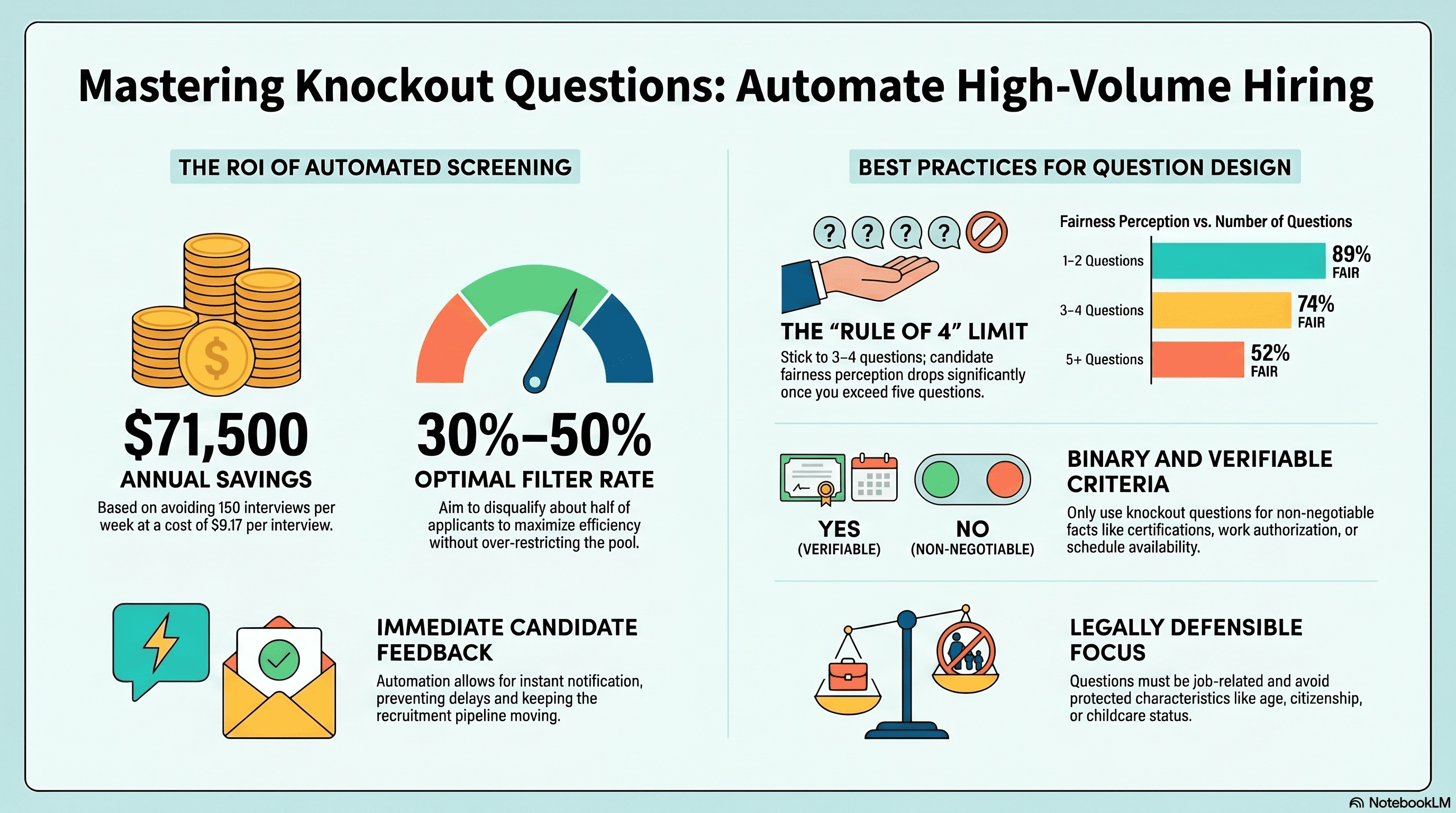
Knockout questions are powerful because they filter efficiently and early. A retail chain hiring 500 people per week might ask 3-4 knockout questions. If 30 percent of applicants fail knockout questions, the chain screens out 150 candidates without human interview time.
At $22/hour (typical recruiter cost) × 25 minutes per interview = $9.17 per avoided interview × 150 candidates = $1,375 saved per week, or $71,500 per year.
The power of knockout questions is that they're automated and immediate. Candidates answer via self-service application. No recruiter time. No delays. Candidates who fail are notified instantly.
Types of Knockout Questions: Location, Availability, Certification, Eligibility
Not all qualifications are equally important. Knockout questions should address absolute minimum criteria that disqualify a candidate if missing. Characteristics of knockout questions: (1) Non-negotiable (no exceptions), (2) Binary (yes/no or pass/fail), (3) Legally defensible (job-related), (4) Verifiable (can you confirm the answer?).
Location / Commute
Question: 'Are you able to commute to [location address]?'
Why: If you have a specific retail location and candidates from 2+ hours away are unlikely to stay, location is a knockout criterion. Research shows commute over 45 minutes correlates with higher turnover.
Alternative (if willing to consider remote/relocation): 'Would you be willing to relocate to [location]?' This allows candidates to self-select. Those not willing to move are disqualified; those willing proceed.
Availability / Schedule
Question: 'Are you available to work [specific schedule: weekends, nights, full-time, 40+ hours/week]?'
Why: Many hourly roles require availability outside standard 9-5. If position requires weekend work and candidate is only available weekdays, they're a bad fit. Ask directly instead of hoping they'll be flexible after hire.
Work Authorization / Legal Status
Question: 'Are you legally authorized to work in the United States without sponsorship?'
Why: This is an EEOC-required screening for all employers. Do not ask 'What is your citizenship?' or 'Where were you born?' These are inappropriate. Ask only about work authorization.
Required Certifications / Licenses
Examples: 'Do you have a valid driver's license?' (for delivery roles) 'Do you have a food handler certification?' (for food service) 'Do you have a current security clearance?' (for sensitive roles)
Why: Some roles truly require specific credentials. Don't make someone go through interview if they lack the certification.
Age / Legal Eligibility
For roles requiring age (e.g., 18+ for alcohol service): 'Are you 18 or older?' (Don't ask actual birth date; just confirm age minimum)
For roles requiring age (21+ for alcohol sales): 'Are you 21 or older?'
Prior Experience (Only If Truly Required)
Question: 'Do you have prior [specific type] experience?' (e.g., 'Have you worked in retail before?')
Caution: Only use this as knockout if the role truly cannot accommodate someone with no experience. Most hourly roles can train people with zero prior experience. Using 'prior experience required' when not necessary artificially narrows your pool.
Better approach: 'How quickly do you learn new systems and processes?' This assesses coachability instead of penalizing career changers.
Designing Knockout Questions: Legal Considerations and Best Practices
Knockout questions are subject to employment law. They cannot discriminate based on protected characteristics (race, gender, age, disability, etc.). They must be job-related and consistent with business necessity (EEOC standard).
Legal dos and don'ts:
DO: Ask about work authorization ('Are you legally authorized to work in the US?')
DON'T: Ask about country of origin or citizenship ('Are you a US citizen?')
DO: Ask about availability for required schedule ('Are you available to work weekends?')
DON'T: Ask why they're available or what their family situation is ('Do you have childcare?')
DO: Ask about required certification ('Do you have a food handler card?')
DON'T: Ask how they obtained it or when they got it ('Where did you get trained?')
DO: Ask about driver's license if required ('Do you have a valid driver's license?')
DON'T: Ask how many accidents or tickets ('Have you ever had an accident?')
DO: Ask about commute logistics ('Can you commute to this location?')
DON'T: Ask about transportation or living situation ('Do you own a car?' 'Where do you live?')
DO: Ask about previous criminal conviction only if specifically job-related ('Have you been convicted of a felony involving theft?' for a retail role)
DON'T: Ask general criminal history or misdemeanors unrelated to the job
When designing knockout questions, ask: 'Is this job-related? Is this non-negotiable? Can a candidate's answer disqualify them from consideration?' If yes to all three, it's likely a valid knockout question. If uncertain, consult legal/compliance.
Best practice: Test your knockout questions for adverse impact. If they screen out women, minorities, or older workers at rates significantly higher than others, you need validation evidence showing they're predictive of job success. Without validation, you're legally exposed.
Balancing Efficiency with Candidate Experience: The Disqualification Dilemma
Knockout questions create a tension: efficiency vs. candidate experience.
From an efficiency standpoint, more knockout questions = fewer unqualified candidates = less recruiter time. From a candidate experience standpoint, too many knockout questions feel gatekeeping and frustrating.
Research on this: A 2023 Workable study surveyed 2,000 hourly job applicants who experienced different numbers of knockout questions. Key findings:
- 1-2 knockout questions: 89% of applicants felt the screening was fair
- 3-4 knockout questions: 74% felt fair
- 5+ knockout questions: 52% felt fair
- 5+ knockout questions + failure: Only 28% would apply to this company again
Implication: Use knockout questions strategically. Include only those that are truly non-negotiable.
Optimal approach:
- Limit to 3-4 knockout questions maximum.
- Ask the most critical first. If someone fails location (you need someone local), don't waste time asking about schedule.
- Frame knockout questions positively. Instead of 'Do you lack a driver's license?' ask 'Do you have a valid driver's license?' This is less presumptuous.
- Provide immediate feedback. If someone fails a knockout question, tell them immediately: 'We're looking for someone available to work weekends. Based on your response, we won't move forward. Best of luck with other opportunities.'
- Consider appeals. If someone says 'no' to weekend availability but then explains 'I meant I'm not available every weekend but can do some,' allow them to clarify. The yes/no is binary; the nuance matters.
Example: A candidate fails the 'available for weekends' knockout. They explain they can work 2 out of 4 weekends per month. Is that acceptable? Depends on your needs. If the role truly needs someone every weekend, they fail. If the role can accommodate 2 weekends, they proceed. Allow this nuance in your knockout design.
Another consideration: Self-selection. Some candidates will fail knockout questions because they realize the job isn't for them. A candidate who needs evenings free realizes the role requires nights and self-selects out. This is good—they're not a fit. Other candidates will be disqualified despite potential fit. Balance this by being specific in your questions. 'Available to work evenings' is vague; 'Available to work 5-9pm shifts' is clear. Candidates can self-select accurately.
Conditional Logic and Smart Knockout Flow
In a sophisticated ATS, knockout questions can branch based on responses. This improves efficiency and experience.
Example 1: Location Branching
Q1: 'Are you available to work at our [City A], [City B], or [City C] location?'
If candidate selects City A: Show Q2a specific to City A schedule
If candidate selects City B: Show Q2b specific to City B schedule
If candidate selects City C: Show Q2c specific to City C schedule
If candidate selects 'none of these': Disqualify with message 'We don't have positions matching your location preferences at this time. Best of luck!'
This personalizes the screening experience. Candidate feels heard ('You asked about my location preference') instead of disqualified arbitrarily.
Example 2: Conditional Certification Questions
Q1: 'Which role are you interested in? [Retail Associate / Food Service / Warehouse]'
If Food Service: Show Q2a 'Do you have a current food handler certification?'
If Warehouse: Show Q2b 'Do you have forklift certification?' [conditional on answering yes to another question]
If Retail Associate: Skip certification questions
This avoids asking irrelevant questions. A retail candidate doesn't need food handling certification.
Example 3: Fallback Logic
Design knockout questions with fallback options so that 'failure' doesn't always mean disqualification.
Q: 'Are you available to work weekends?'
If No: Follow-up 'Would you be willing to work a flexible schedule with periodic weekend availability?'
If Yes to follow-up: Proceed
If No to follow-up: Disqualify
This gives candidates a chance to clarify. The initial 'no' might mean 'no every weekend,' but they might be open to occasional weekend work. Conditional logic allows you to explore this nuance.
Optimizing Pass/Fail Rates: Finding the Right Threshold
A well-designed knockout question set should disqualify 30-50 percent of applicants. If you're disqualifying 80 percent, your questions are too strict. If you're disqualifying 10 percent, your questions aren't filtering effectively.
How to optimize:
- Pilot: Run knockout questions with 500+ applicants. Measure: What percentage pass? For each question, what's the pass rate?
Example results:
- Location question: 72% pass (28% live too far away)
- Weekend availability: 58% pass (42% cannot work weekends)
- Work authorization: 97% pass (3% lacking authorization)
- Prior retail experience: 45% pass (55% have no prior experience)
- Evaluate each question: Is this pass/fail rate appropriate?
- Location (72% pass): Makes sense. In any area, some candidates are just outside your service radius.
- Weekend availability (58% pass): Expected. Many people can't work weekends.
- Work authorization (97% pass): Good. Only small percentage lack authorization.
- Prior experience (45% pass): Too strict? Do you really need prior experience, or can you train?
- Adjust: Remove questions that are too strict or not job-critical. Modify questions to be more precise.
Example: Instead of 'Prior retail experience required,' ask 'How quickly do you typically learn new systems and processes?' This assesses trainability instead of penalizing career changers.
- Re-test: Run revised questions with another 500+ applicants. Measure pass rates again. Target: Overall pass rate 50-70% (meaning 30-50% are disqualified by knockout questions).
Monitor adversity impact: Track pass rates by demographic group. If women are passing at 70% but men at 45%, investigate why. The question may have unintended bias. Example: 'Do you have reliable childcare?' disproportionately affects women and is not job-related. Remove it.
False Positives and False Negatives: The Cost of Mistakes
Knockout questions have two failure modes:
False Positive: Candidate is disqualified by knockout question but would have been an excellent hire. Example: 'Do you have 2+ years retail experience?' You disqualify a career changer who's motivated and coachable. You missed a great hire.
False Negative: Candidate passes knockout question but is not a good hire. Example: 'Do you have a valid driver's license?' Someone claims they do, but they're lying or it expires next week. You hire someone who can't legally do the job.
Knockout questions have tradeoffs. Strict questions (more false positives) filter aggressively but risk eliminating good candidates. Lenient questions (more false negatives) let people through but don't filter effectively.
Optimal approach: Be strict on questions you can verify (work authorization, certifications, driver's license). Be lenient on subjective questions (experience, skills) that you'll assess later anyway.
Example:
- Strict: 'Do you have a food handler card?' (You can verify this on offer stage.)
- Lenient: 'Do you have food service experience?' (You'll assess capability through interview/assessment anyway.)
For questions you rely on, verify the answer before making an offer. A candidate claims they have a driver's license? Request a copy. They claim food handler certification? Verify the certificate number. False positives on verifiable questions are preventable.
Implementation: From Questions to Automation
Step 1: Identify Your Knockout Criteria (1 week)
Convene hiring managers. For your most common role, list all the absolute minimum qualifications. Candidates without these are not hires, period. Examples might be: work authorization, location, schedule availability, specific certifications, age requirements.
Narrow list to 3-4 criteria maximum. Anything else should be assessed during interview, not knockout.
Step 2: Write Questions (1 week)
For each knockout criterion, write a clear question. Test the question: Is it job-related? Is it legally defensible? Can you verify the answer?
Write follow-up messages for pass and fail. If they fail, provide immediate feedback: 'Thank you for your interest. Based on your response to our screening question, we're unable to move forward at this time.'
Step 3: Configure ATS (1 week)
Embed knockout questions in your application form. Configure branching logic: If answer = X, go to next question. If answer = Y, disqualify and show rejection message.
Configure the ATS to automatically disqualify candidates based on knockout answers. No manual review. If they fail a knockout, they're out.
Step 4: Pilot and Monitor (2-4 weeks)
Run knockout questions with 500+ applicants. Measure pass rate for each question and overall. Monitor adverse impact (are pass rates similar across demographic groups?).
Review feedback from hiring managers: Are knockout questions filtering appropriately? Are you losing good candidates?
Step 5: Refine and Deploy (1 week)
Based on data, refine questions. Deploy across all similar roles. Monitor pass rates ongoing. Adjust questions quarterly based on hiring results.
References and Further Reading
- Workable. (2023). Knockout Questions and Candidate Experience Study. Workable Research.
- Society for Human Resource Management (SHRM). (2023). Screening Best Practices. SHRM Research Report.
- Equal Employment Opportunity Commission (EEOC). (2007). Uniform Guidelines on Employee Selection Procedures. 29 CFR Part 1602.
- Bureau of Labor Statistics. (2023). Hiring and Retention Data by Industry. BLS Publication.
- Center for Talent Innovation. (2023). Adverse Impact in Screening and Selection. CTI Research.
- LinkedIn. (2024). Applicant Disqualification Patterns: Trends and Drivers. LinkedIn Insights.
- Harvard Business Review. (2023). Screening Pipeline Optimization for High-Volume Hiring. HBR Research.
How Cadient Talent SmartSuite™ Helps
Cadient Talent’s SmartSuite™ platform automates compliance workflows, embeds regulatory guardrails directly into your hiring process, and maintains audit-ready documentation at every stage—so your team can focus on finding great talent while staying protected from costly violations.
