Belonging is the most powerful predictor of long-term retention.
The Belonging Hypothesis
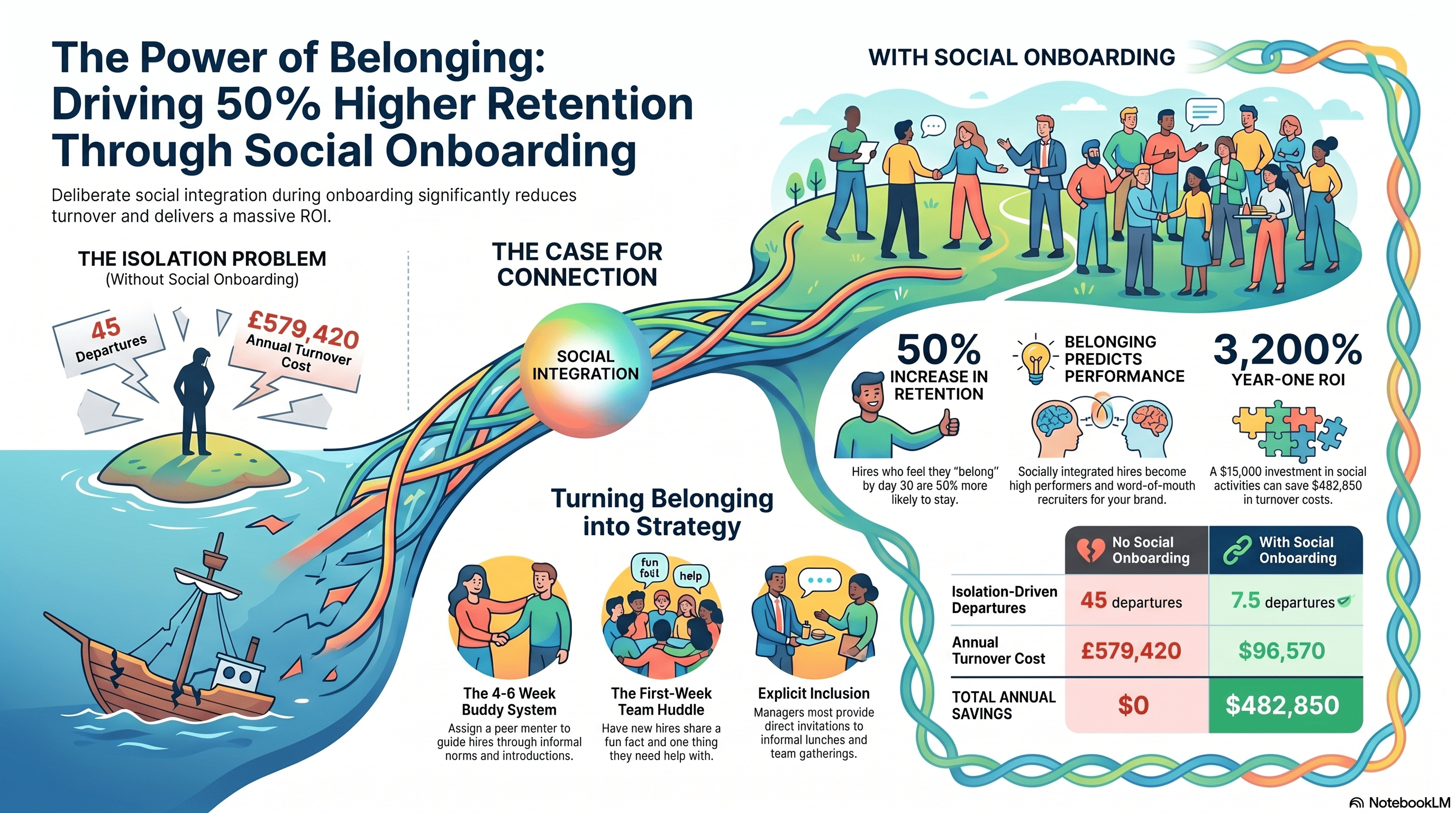
Harvard's Make Me Belong research (2023) shows that new employees who feel they "belong" and are "part of the team" by day 30 are 50% more likely to be retained at 12 months, compared to those who feel isolated or uncertain.
Further: belonging is predictive of engagement, productivity, and advocacy. Hires who feel they belong become your word-of-mouth recruiters and high performers. Those who don't belong become flight risks.
Yet most onboarding programs treat belonging as an accident—"the team will integrate them eventually"—rather than by design. A deliberate social onboarding strategy turns belonging from chance into certainty.
What Social Onboarding Includes
Buddy System
Assign each new hire a peer mentor (buddy) for the first 4-6 weeks. The buddy's role: answer questions, include them in informal team activities, make introductions, show them the informal norms (where people eat, who's talkative, what topics to avoid). The buddy is explicitly told "Your job is to help them feel part of the team." This structured approach converts informal peer relationships into an onboarding tool.
Team Introduction Event
Within the first week, have the new hire present (briefly) to the team. Introductions don't need to be formal. A team huddle where the new hire shares their name, background, one fun fact ("I'm Sarah, I'm new to the area and I love hiking"), and something they need help with ("I'm still learning the system, so be patient with me"). This signals to the team "here's a new person, make them welcome" and creates informal accountability for integration.
Informal Team Activity
Organize a low-key team lunch, coffee break, or after-work gathering in the first two weeks. For frontline roles with shifting schedules, an in-store team huddle works. The goal: conversation, not training. The new hire learns names, hears stories, starts feeling like part of the group.
Cross-Functional Introduction
Introduce the new hire to people in adjacent roles/departments. In a retail store: introduce to the store manager, other shift leads, stockroom staff. In a warehouse: introduce to QC, safety team, logistics coordinator. These brief (5-10 minute) introductions expand the new hire's sense of belonging beyond their immediate team.
Explicit Inclusion
Managers should explicitly include new hires in team activities. "We're having a team lunch on Friday—you're coming." "The team goes to happy hour sometimes—you should join." Without explicit invitation, new hires often assume they're not welcome in "established" team dynamics.
The Business Case for Social Onboarding
A frontline organization with 500 annual hires and 30% annual turnover (150 departures):
Current state (no deliberate social onboarding):
- Isolation-driven departures: ~30% of departures are driven by feeling isolated or not part of the team
- Cost: 45 departures × $12,876 = $579,420
With social onboarding (buddy system, team introduction, inclusive activities):
- Isolation-driven departures: ~5% (most hires feel integrated)
- Cost: 7.5 departures × $12,876 = $96,570
- Savings: $482,850 annually
Investment required:
- Buddy coordination (HR time): $10,000/year
- Team lunch/activity budget: $5,000/year
- Total: $15,000
ROI: $482,850 / $15,000 = 3,200% in year one.
Social onboarding is one of the highest-ROI retention investments.
Measuring Social Connection
Track these metrics:
- "I feel part of my team" (pulse survey, day 30): target 80%+
- "I have a friend/mentor at work" (day 60): target 75%+
- Buddy assignment and engagement: % of hires paired with buddy, buddy check-in frequency
- Team introduction completion: % of hires introduced to team within first week
- Retention of socially-connected cohorts: Compare 90-day retention for hires who report "feel part of team" vs. those who don't. Difference should be 15-20 percentage points.
Scaling Social Onboarding
In high-volume operations, social onboarding can feel informal and hit-or-miss. Systematize it:
- Buddy assignment: HR assigns buddy at time of hire (not left to chance). Buddy is notified and given role description.
- Buddy training: Brief orientation for buddies on their role and what makes good peer mentoring.
- Team introduction: Manager schedules a 10-minute team huddle within first week. Scripted intro (name, background, need help with).
- Activity calendar: HR or team lead schedules regular informal team activities (weekly lunch, monthly happy hour, etc.). New hires are explicitly invited.
- Check-in: At day 30, ask the hire: "Do you feel part of the team? Who's been helpful?" Use responses to identify if integration is working.
How Cadient Talent SmartSuite Helps
SmartSuite includes buddy assignment workflows, buddy role descriptions, team introduction templates and scheduling, automated pulse surveys on belonging, and integration tracking. Managers can see which new hires feel integrated and which are isolated.
References and Further Reading
- Harvard, 'Make Me Belong Research' (2023)
- Gallup, 'The Power of Belonging in the Workplace' (2023)
- SHRM, 'Social Integration and New-Hire Retention' (2023)
- Center for American Progress, 'Team Connection and Retention' (2023)
How Cadient Talent SmartSuite™ Helps
Cadient Talent’s SmartSuite™ platform automates compliance workflows, embeds regulatory guardrails directly into your hiring process, and maintains audit-ready documentation at every stage—so your team can focus on finding great talent while staying protected from costly violations.
Ready to transform your hiring?
See how Cadient Talent helps you find the right people, faster.
Learn More
