How to Maintain Consistency Across 50, 100, or 500 Sites
The Multi-Location Challenge
[caption id="attachment_20931" align="alignnone" width="2752"]
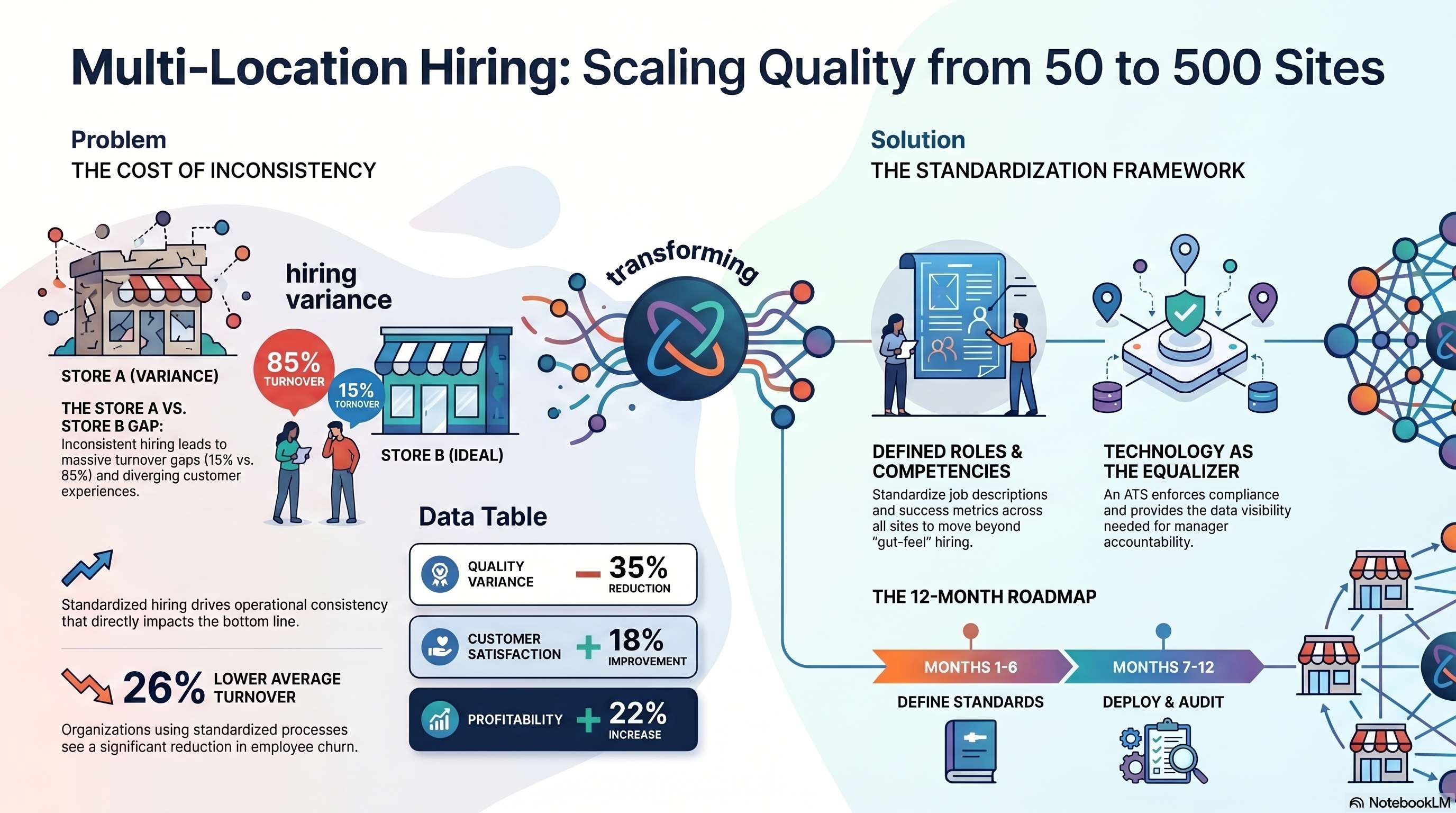
Multi-Location Hiring[/caption]
A 200-location retail chain faces a fundamental problem: Store A manager hires rigorously and builds a high-performing team (15% first-year turnover). Store B manager hires loosely and has chaotic hiring (85% first-year turnover). Inconsistency cascades: Store A has better culture, better service, better financial performance. Store B is understaffed and burns out. Customer experience diverges. Brand dilutes. Scaling hiring quality across locations is a critical but underaddressed challenge.
Research from the Kellogg School of Management shows that organizations with standardized hiring processes across locations achieve: (1) 35% reduction in quality variance between locations; (2) 26% lower average turnover; (3) 18% improvement in customer satisfaction consistency; (4) 22% higher profitability per location (due to operational consistency). Yet most multi-location organizations have location-by-location hiring autonomy with minimal standardization.
Standardization Framework
Standardization requires multiple components working together: (1) Role definitions aligned across locations; (2) Competency frameworks defining what success looks like for each role; (3) Structured interview guides; (4) Assessment tools (skills tests, culture fit assessments); (5) Hiring checklists ensuring consistent steps; (6) Training programs for hiring managers; (7) Quality audits and feedback loops; (8) Technology platforms (ATS) enforcing process consistency.
Roles: Define each role in a standard way across all locations. A "Retail Cashier" should have the same job description, key responsibilities, and success metrics whether at Store 1 or Store 200. This enables consistent hiring and performance management.
Competency Frameworks: Define the competencies required for success. For a Retail Cashier: (1) Customer service orientation (empathy, patience); (2) Accuracy and attention to detail; (3) Systems proficiency; (4) Teamwork and communication; (5) Integrity and honesty. Each competency has observable behavioral indicators. This moves hiring from gut feel to systematic assessment.
Structured Interviews: Develop standardized interview guides with 5-8 behavioral questions probing for competencies. All managers use the same questions in the same order, with a scoring rubric (1-5 for each competency). This dramatically reduces variance in hiring decisions and bias.
Assessment Tools: Use validated tools measuring job-relevant skills and culture fit. For retail roles: typing speed/accuracy tests, situational judgment tests (how would you handle difficult customer?), culture fit assessments. Tools should be research-validated (proven to predict job performance) and applied consistently across all locations.
Hiring Checklists: Standard checklist ensures all steps are followed. Example: (1) Post job description on all platforms; (2) Screen resumes against competency framework; (3) Conduct phone screen with standard questions; (4) Conduct in-person interview with structured guide; (5) Check references; (6) Conduct background check; (7) Make offer; (8) Onboard with standard materials. Checklist prevents skipping steps and ensures consistency.
Training: Train all hiring managers quarterly on interviewing, assessment interpretation, and unconscious bias. Certification program: managers pass assessment before conducting independent hiring. Recertification annually.
Technology: ATS platforms enforce process. When a manager tries to make an offer, system requires: interview form completed, reference check documented, background check initiated. Process steps are mandatory before progression.
Quality Audits: HR reviews hiring decisions monthly. Are competency scores defensible? Are scorings consistent across managers? Are decisions documented? Feedback and coaching result.
Balancing Standardization with Location Autonomy
Complete centralization (corporate hiring for all locations) is impractical for geographically distributed organizations. Complete autonomy (each location hiring independently) creates inconsistency. The optimal model is standardized process with localized execution.
Approach: (1) Corporate defines standards (role descriptions, competency frameworks, interview guides, assessment tools, training). (2) Locations execute hiring following those standards. (3) Corporate conducts quality audits and provides coaching. (4) Locations have autonomy over hiring timing, job posting channels, and offer details (salary bands vary by market).
Example: Corporate defines that retail cashiers must score 70+ on a situational judgment test and pass a structured interview with average competency rating of 3.0+. Store managers have autonomy to post aggressively, conduct interviews per schedule, and offer within approved salary bands ($17-$19/hour depending on market). This creates quality consistency while allowing local flexibility.
Treatment of underperforming locations: If a location consistently has hiring quality issues (low interview scores, high turnover, poor performance reviews), escalate to regional leader. Options: (1) Manager training/coaching; (2) Hire a corporate recruiter for that location (temporary); (3) Manager replacement if issues persist. Make clear that hiring quality is a manager accountability metric.
Technology as the Equalizer
ATS platforms enable consistency at scale. Best-in-class ATS implementations include: (1) Job description templates (standardized role descriptions with local customization options); (2) Sourcing integration (one place to post to all job boards, social media, careers page); (3) Application forms standardized but customizable per location; (4) Screening workflows automated (application screening based on criteria); (5) Interview scheduling tools (candidate can book time with location manager); (6) Scorecard templates (structured interview forms with competency assessment); (7) Assessment integration (skills tests, culture fit assessments embedded); (8) Collaboration tools (hiring team can communicate via system); (9) Offer management (corporate can monitor offer decisions before extension); (10) Analytics and reporting (hiring metrics visible across all locations).
ATS analytics enable transparency: Which locations have highest/lowest time-to-fill? Which have highest quality hires (retention data)? Which hiring managers score candidates consistently vs. those with outlier patterns? This visibility enables coaching and accountability.
Cost: Good ATS systems for mid-market organizations (200-1,000 employees) cost $1,500-$5,000 monthly. ROI: A 200-location organization reducing first-year turnover from 72% to 58% by standardized hiring saves $2-4M in replacement costs annually against system costs of $25K-$60K. ROI: 30:1 to 80:1.
Brand Consistency as Competitive Advantage
Standardized hiring enables brand consistency. When a customer visits Store A then Store B, they experience the same brand: professional, friendly, knowledgeable associates. This consistency builds brand equity and customer loyalty.
Brand consistency metrics: (1) Customer experience consistency (same satisfaction scores across locations); (2) Service delivery consistency (same product knowledge, professionalism); (3) Culture consistency (associates at all locations reflect company values). These are harder to measure than operational metrics but equally important.
Leading retailers invest heavily in hiring standardization because they understand that brand experience starts with frontline hire quality. Starbucks, for example, has highly standardized hiring processes (even across franchise partners) to ensure consistent customer experience globally. Target uses standardized hiring and training to ensure consistent brand experience across 1,900+ stores.
Implementation: Brand teams should define "brand ambassadors" competencies—what does an associate need to embody to represent the brand? Train hiring managers on brand values and how to assess for them. Audit: Do hired associates reflect brand? Measure: Do locations with higher brand-ambassador hiring have higher customer satisfaction?
Compliance and Consistency
Standardized hiring also ensures compliance. Without standardization, different locations might have different hiring practices, some of which violate employment law. Standardization creates defensible, documented processes.
Compliance elements: (1) EEOC compliance—structured, objective assessment reduces disparate impact risk; (2) ADA compliance—accessible application processes; (3) Background check compliance—consistent application of results; (4) Documentation—all hiring decisions documented with justification, creating audit trail.
Best practice: Legal review of standardized hiring process. Before rolling out, have employment attorney review job descriptions, interview guides, assessment tools, and scoring rubrics. Ensure alignment with employment law. Get sign-off. Then, all locations follow approved process. If a lawsuit emerges, you have documented, legally-vetted process that was consistently applied. This is far stronger defense than individual location processes that vary and may not be defensible.
Cost of this legal review: $2,000-$5,000. Value: Prevents a single employment lawsuit ($50K-$500K+ in legal and settlement costs). Risk reduction is profound.
Building a Multi-Location Hiring Roadmap
Implementation: (1) Year 1 (Months 1-6): Define roles, competencies, and standardized interview guides. Train managers. Audit current practices. (2) Year 1 (Months 7-12): Deploy ATS platform. Move hiring to ATS-based workflow. Conduct quality audits. Coach underperforming locations. (3) Year 2 (Ongoing): Quarterly manager training updates. Annual competency framework review. Ongoing analytics and reporting. Measure outcomes and iterate.
Quick wins in first 6 months: Select one role (e.g., retail cashier, most common) and standardize hiring for that role across 25% of locations (first pilot group). Measure time-to-fill, quality, and first-year retention. Compare to legacy process. Share results and expand to all locations.
Expected outcomes: By year-end implementation, standardized hiring should generate: (1) 20-25% reduction in time-to-fill (due to clearer standards and faster screening); (2) 15-20% reduction in first-year turnover (due to better quality hiring); (3) 30-35% reduction in hiring variance between locations; (4) 18-22% improvement in customer experience consistency; (5) Documented, legally defensible hiring process reducing compliance risk.
Conclusion: Standardization as Strategic Lever
Multi-location organizations that standardize hiring while maintaining local execution achieve dramatically better outcomes: Lower turnover, higher quality, better brand consistency, and reduced legal risk. The investment is moderate (ATS platform, training, one-time setup) but the returns are significant.
Begin by auditing current hiring variance across locations. Where are the biggest gaps? Build a pilot standardization program for one role in one region. Measure impact (time-to-fill, quality, retention). If successful, expand. By year-end, standardized hiring becomes competitive advantage.
The companies winning at multi-location hiring are those making hiring quality a strategic, measured, standardized discipline. Begin today.
References and Further Reading
- Kellogg School of Management: 'Standardized Hiring in Multi-Location Retail' (2024)
- Society for Human Resource Management: 'Competency Frameworks and Structured Interviewing' (2023)
- McKinsey: 'Hiring Consistency and Performance Variance' (2024)
- Harvard Business Review: 'Standardization and Brand Consistency' (2023)
- Workable: 'ATS Implementation and Multi-Location Coordination' (2023)
- Talentware: 'Hiring Process Standardization Best Practices' (2024)
- Target, Starbucks: 'Multi-Location Hiring and Brand Consistency' (2023)
- employment law experts: 'EEOC Compliance in Distributed Hiring' (2024)
How Cadient Talent SmartSuite™ Helps
Cadient Talent’s SmartSuite™ platform automates compliance workflows, embeds regulatory guardrails directly into your hiring process, and maintains audit-ready documentation at every stage—so your team can focus on finding great talent while staying protected from costly violations.
