Gallup engagement data, hourly worker challenges, and the practical improvement strategies that move the needle.
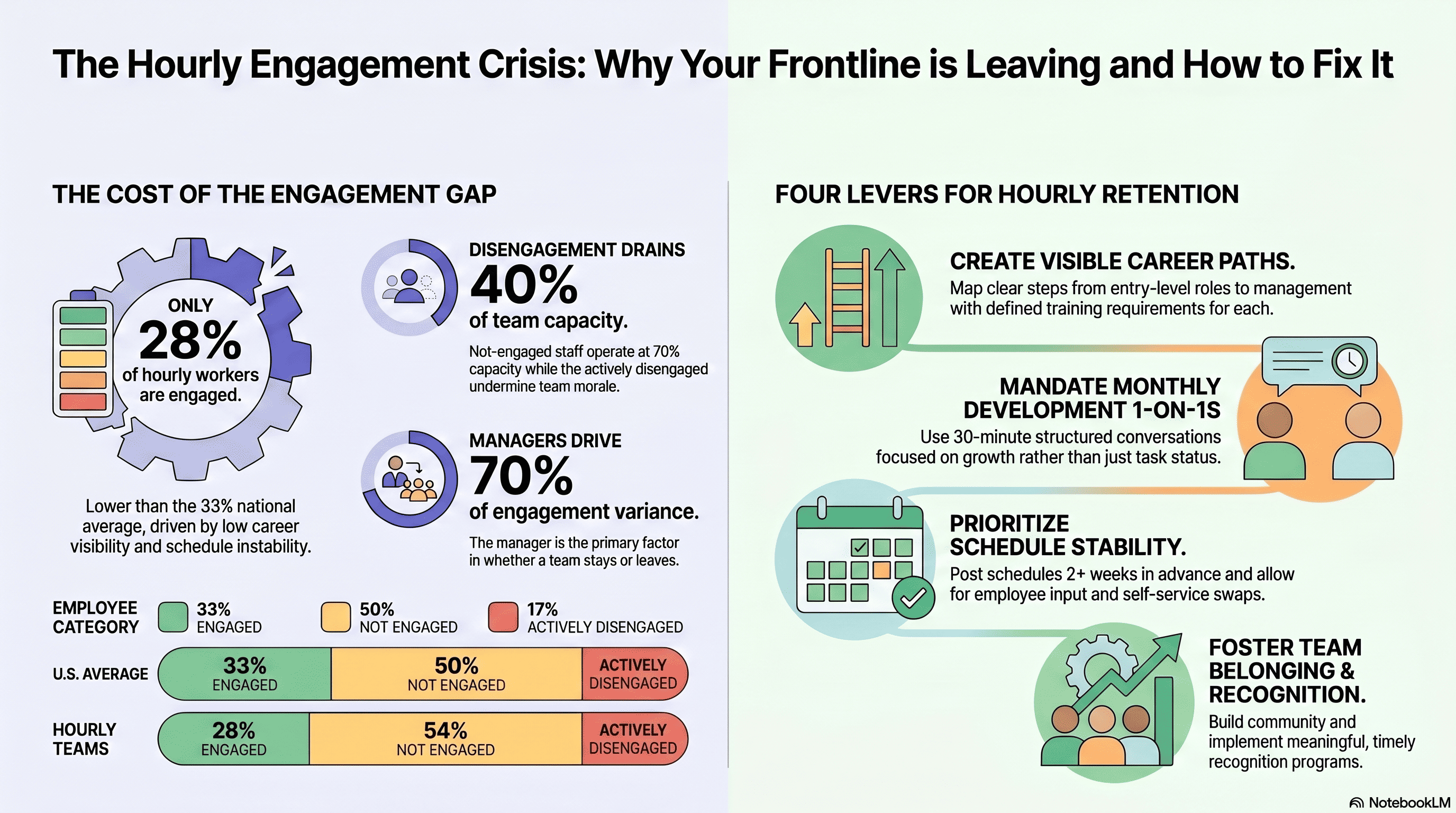
The Engagement Crisis: 33% is the Baseline You're Fighting
Gallup's latest engagement research (2023) shows that only 33% of U.S. employees are engaged at work. That means:
- 33% are engaged (active, committed, contributing)
- 50% are not engaged (present, productive minimum, not disengaged but not invested)
- 17% are actively disengaged (demoralized, undermining team morale, likely to leave)
For hourly workers specifically, engagement is worse:
- Hourly engaged: 28%
- Hourly not engaged: 54%
- Hourly actively disengaged: 18%
Why the gap? Hourly workers face engagement headwinds that salaried staff don't:
Low career visibility: Salaried worker sees clear promotion path (coordinator → manager → director). Hourly worker sees no path ("I'm a cashier; how do I get promoted?").
Manager under-investment: Salaried worker has dedicated manager investing in development. Hourly worker's manager oversees 15-20 staff with minimal 1-on-1 time.
Transactional relationship: Salaried role is relationship-based. Hourly role is often transactional ("Come in, do your shift, leave").
Compensation gap: Salaried raises build over time. Hourly worker hits wage ceiling quickly ("$15/hr is the standard for this role").
Schedule instability: Salaried worker has predictable schedule. Hourly worker has varying shifts, limited notice, last-minute changes.
No development investment: Salaried worker gets professional development budget. Hourly worker gets none ("No budget for line staff training").
These structural factors depress hourly engagement below the already-low 33% baseline.
The business impact of low engagement:
Disengaged employees (54% of hourly staff):
- 40% higher absenteeism
- 30% lower productivity
- 60% higher error rates
- 3x more likely to leave within 12 months
Actively disengaged employees (18% of hourly staff):
- Actively undermining team morale
- Influencing others to disengage
- Creating turnover ripple effect ("If she's leaving, maybe I should too")
In a 100-person hourly team:
- 28 engaged employees generating full value
- 54 not-engaged employees operating at 70% capacity
- 18 actively disengaged employees actively harming productivity
Net capacity loss from disengagement: 35-40%.
The Four Pillars of Engagement: Where Hourly Teams Fail
Gallup identifies four engagement pillars. Hourly teams typically score well on one and poorly on three.
Pillar 1: Clear role expectations ("Do I know what's expected of me?")
Hourly score: 65% meet this
- Why it's decent: Role expectations are often clear (scan items, serve customers, package products)
- Why it's not great: Beyond basic tasks, expectations are vague ("Provide excellent customer service" is undefined)
Improvement: Behavioral expectation definitions
- Instead of "Provide excellent customer service," define: "Make eye contact, greet within 30 seconds, use customer name if possible, ask if you can help further before moving to next customer"
- Instead of "Work safely," define: "Check equipment daily, report issues immediately, use all safety gear, never bypass safety protocols"
Pillar 2: Materials and tools to succeed ("Do I have what I need?")
Hourly score: 52% meet this
- Why it's poor: Hourly staff often lack basic tools
- No tablet/phone access (can't look up inventory or policies)
- Broken POS systems (slow registers frustrate customers and staff)
- No quiet space to prepare/plan
- Outdated equipment ("This scanner hasn't worked right in months")
Improvement: Systematic tool audit
- What tools would make this job 20% easier? (Headset for warehouse staff, mobile POS, self-checkout to reduce line wait, better signage to reduce customer questions)
- What's broken? (Repair or replace immediately)
- What's missing? (Budget for basics)
This is often cheap (many tools cost <$100) but dramatically improves both productivity and satisfaction.
Pillar 3: Manager cares about development ("Does my manager invest in my growth?")
Hourly score: 38% meet this (lowest pillar)
- Why it's terrible: Managers of hourly staff are under-resourced and under-trained
- Manager oversight: 1 manager / 15-20 hourly staff (salaried ratio: 1 manager / 6-8 staff)
- Manager training: Most managers of hourly staff receive zero training on coaching, development, or engagement
- Time constraint: Manager spends 80% of time on scheduling, compliance, and operational crises. 20% on development.
- Development expectation: "Hourly staff don't need development. Just do your job."
Improvement: Manager behavior change
- Monthly 1-on-1s (30 minutes minimum) focused on development, not just task status
- Manager training on coaching (how to have development conversations)
- Clear expectation: Manager's job includes developing high performers
- Manager bonus tied to engagement scores (5-10% bonus for achieving 40%+ engagement on team)
Pillar 4: Company invests in growth ("Does the company invest in my future?")
Hourly score: 31% meet this (lowest overall)
- Why it's terrible: Hourly staff receive minimal training and development investment
- Annual training: Often 0-4 hours (mostly mandatory compliance)
- Career pathing: "There is no path. You're a cashier. You'll be a cashier."
- Promotion probability: Salaried staff have 40-60% likelihood of promotion within 5 years. Hourly staff have 8-12%.
- Education support: "We don't pay for hourly staff education."
Improvement: Investment in growth
- Structured training programs with clear skill progression
- Career pathing conversations ("What role do you want in 2 years? Here's how you get there.")
- Internal mobility program ("Hourly warehouse staff can transition to lead role, then supervisor role")
- Education/certification support (tuition reimbursement for job-related learning)
- Visible advancement (celebrate internal promotions publicly)
The engagement multiplier effect:
When you improve all four pillars, engagement compounds:
- Improve expectations + tools: Engagement moves 5-8 points
- Add development conversations: Engagement moves another 8-12 points
- Add company investment: Engagement moves another 10-15 points
- Total potential: 23-35 point engagement improvement (from 28% to 50-60%)
This requires systemic change, not quick fixes. But the ROI is enormous.
The Turnover-Engagement Link: Why Disengagement Predicts Departure
The most predictive engagement question for turnover is: "I see myself working here in 12 months."
Gallup research shows:
- Engaged employees answering "Yes": 90% still employed in 12 months
- Not-engaged employees answering "No": 20% still employed in 12 months
- Actively-disengaged employees answering "No": 10% still employed in 12 months
For hourly workers, the trend is even steeper. A disengaged hourly worker is likely gone within 12 months.
Why engagement predicts turnover:
Engagement measures psychological commitment. An employee who is engaged believes:
- "I matter here"
- "I have a future here"
- "This company invests in me"
- "My work contributes to something meaningful"
These beliefs are the strongest retention factors. Compensation, benefits, and schedule matter, but psychological commitment is primary.
An employee who is disengaged believes:
- "I'm interchangeable"
- "There's no future for me here"
- "This company doesn't care about me"
- "My work is just a paycheck"
These beliefs drive exit behavior: "I'm looking for another job." It's not that the employee actively dislikes the role. It's that they don't believe the company values them.
The intervention window:
Turnover isn't sudden. It follows a psychological trajectory:
Month 1-2: Engagement decline ("I'm starting to feel undervalued")
Month 3-4: Job search begins ("Let me explore other options")
Month 5-6: Competing offer arrives ("I have another opportunity")
Month 7: Resignation ("I'm giving notice")
Intervention opportunity: Months 1-4, before job search begins.
How to identify early disengagement:
- Pulse engagement surveys (monthly or quarterly, not annual)
- Absenteeism spike (early sign of disengagement)
- Performance dip
- Manager observation ("Employee seems less motivated")
- Behavioral signals: declining participation in team activities, more complaints, reduced communication with manager
Once job search begins (Month 3+), intervention is harder. Employee is in "evaluate offers" mode. Any competing offer with decent compensation becomes attractive.
Prevention strategy: continuous engagement monitoring and rapid intervention.
Engagement survey strategy:
Annual engagement survey is too infrequent. By the time you get results, disengaged employees have already left.
Better: Pulse surveys (brief, frequent)
- Monthly 5-question survey (takes 60 seconds)
- Questions focus on engagement pillars: expectations clarity, tools, manager development, company investment, job satisfaction
- Dashboard updated weekly (manager sees team engagement trend)
- Threshold: If team engagement drops >3 points in month, trigger manager discussion
This creates early-warning system for disengagement before it becomes turnover.
A healthcare company implementing monthly pulse surveys identified emerging disengagement in nursing assistants (engagement dropped 4 points in March). Manager conversations revealed lack of development investment as cause. Company fast-tracked affected staff into CNA certification program. Engagement recovered by May. Year-end retention improved 18% for that cohort.
Without early detection, those disengaged employees would have left in June-July.
Manager-Driven Engagement: The 70% Rule in Action
Gallup research shows managers account for 70% of variance in team engagement. This means the manager is the primary driver of whether a team is engaged or disengaged.
For hourly teams, this is both the problem and the solution.
Problem: Most managers of hourly staff are not trained to drive engagement.
They're promoted from hourly roles ("You were a great cashier, so we made you a manager") without training on:
- How to have development conversations
- How to create psychological safety
- How to recognize and appreciate
- How to set expectations without micromanaging
- How to coach and feedback
Result: Managers default to transactional management ("Do this task. Here's your schedule. That's all.") instead of developmental management.
Solution: Manager training on engagement fundamentals.
Minimal viable manager training program (20 hours annually):
Module 1: Development conversations (4 hours)
- How to have monthly 1-on-1 conversations focused on growth
- How to ask questions about career aspirations
- How to identify development opportunities aligned with aspirations
- How to connect training opportunities to career path
Module 2: Feedback and recognition (3 hours)
- How to give specific, timely feedback ("You handled that difficult customer really well because you stayed calm and asked clarifying questions")
- How to recognize contributions (public + private)
- How to correct performance without demotivating
- How to make recognition feel genuine (not performative)
Module 3: Psychological safety (3 hours)
- How to create environment where employees feel safe asking questions, making mistakes, suggesting ideas
- How to respond to mistakes with curiosity instead of punishment
- How to invite ideas and actually implement them
- How to give employees voice in decisions affecting their work
Module 4: Goal setting and expectation clarity (3 hours)
- How to co-create goals with employees (not dictate)
- How to connect individual goals to team/company goals
- How to set stretch goals that challenge but don't demoralize
- How to check progress monthly (not annually)
Module 5: Peer coaching (4 hours)
- How to identify high performers
- How to develop them into informal leaders/mentors
- How to leverage peer coaching as development tool
- How to create mentorship pairings
Implementation: Make manager training mandatory and measured
- Completion requirement: All managers of hourly staff complete training within first 90 days of assuming role
- Refresher: Annual 4-hour refresher
- Manager scorecard: Manager's engagement score is primary metric (weighted 40%)
- Bonus: Manager bonus tied to engagement improvement (hit 40%+ engagement, get 10% bonus)
Measuring manager engagement impact:
Track team engagement by manager:
- Manager A's team: 42% engagement
- Manager B's team: 31% engagement
- Manager C's team: 48% engagement
Difference between best (Manager C, 48%) and worst (Manager B, 31%) is 17 points. That's the manager effect.
Managers scoring below average get additional coaching/support. Managers scoring above average become mentors.
A retail company tracking engagement by manager discovered:
- Top 25% managers: Average team engagement 46% (18% voluntary turnover)
- Bottom 25% managers: Average team engagement 24% (54% voluntary turnover)
Difference: 30-point engagement gap, 36-point turnover gap.
Same company, same role, same pay. The only variable was manager quality.
They invested in manager training for bottom 25%. Within 12 months, engagement rose from 24% → 38%, turnover fell from 54% → 28%.
The manager effect is real and measurable.
The Four Levers for Hourly Engagement: Practical Improvements
Given the structural barriers facing hourly workers, here are four high-impact engagement levers:
Lever 1: Career pathing (Address Pillar 4)
Problem: Hourly worker sees no future. "I'm a cashier. How do I progress?"
Solution: Create visible career paths
Example retail path:
Salesperson → Lead → Senior Lead → Assistant Manager → Manager → District Manager
Each step has defined training requirements:
- Lead: Inventory management training (4 modules)
- Senior Lead: Customer service training + conflict resolution (8 modules)
- Assistant Manager: P&L understanding + scheduling fundamentals (12 modules)
- Manager: Full management certification program (40 hours)
Employee can see the path: "If I complete this training and perform well in this role, I move to Lead. Then Senior Lead. Then Assistant Manager."
Communicate the path:
- Poster in break room showing progression
- Annual conversation: "Here's your career path. What's the next step?"
- Tracking: Employee completes training, role assignment follows
Impact: Research shows employees with visible career paths show 18% higher engagement and 25% higher retention.
Lever 2: Manager development conversations (Address Pillar 3)
Problem: Manager doesn't invest in development because (a) they don't know how, (b) they don't have time, (c) they don't believe it's their job.
Solution: Structured monthly development conversation
Monthly manager-employee 1-on-1 (30 minutes):
- First 10 minutes: How is work going? Any challenges?
- Next 15 minutes: Development focus
- "What did you learn this month that made you better at your job?"
- "What skill do you want to develop next?"
- "What training would help you?"
- "How are you progressing on your career path goal?"
- Last 5 minutes: Manager recognition ("I appreciated how you handled X situation this month")
This is low-barrier: It's monthly (not constant), 30 minutes (manageable), structured (not intimidating for untrained managers).
Manager script: Use the same questions every month. Consistency builds habit.
Impact: Employees having monthly development conversations with manager show 28% higher engagement vs. those with annual or no conversations.
Lever 3: Investment in training (Address Pillar 4)
Problem: Hourly workers receive minimal training. All budget goes to salaried staff.
Solution: Structured skill development accessible to all staff
- Budget minimum: 8 hours annual training per hourly employee
- Target mix: 30% compliance, 70% skill development
- Delivery: Microlearning (fits around schedule), in-person (for hands-on skills), manager coaching (reinforcement)
- Visibility: Celebrate completion (badges, certificates, public recognition)
Microlearning examples:
- Retail: Customer service excellence (5 modules × 5 min each)
- Warehouse: Safety and equipment operation (8 modules × 7 min each)
- Healthcare: Patient care techniques (10 modules × 5 min each)
Impact: Employees completing >8 hours annual training show 16% higher engagement and 20% lower turnover.
Lever 4: Schedule stability and voice (Address structural barrier)
Problem: Unpredictable schedules cause stress and disengagement (see Article 74).
Solution: Implement predictable scheduling + employee input
- Predictable: Schedules posted 2+ weeks in advance (not day-of-week)
- Employee input: Employee indicates availability preferences ("I prefer mornings, Tuesday-Thursday")
- System balances: Scheduling system matches employee preferences with business needs
- Swap capability: If change is necessary, employee can self-service swap or trade with peer
This isn't about fewer hours. It's about predictability and control. Employees with predictable schedules they had input on show 22% higher engagement.
Combining levers: The engagement flywheel
Implementing all four levers creates compounding effect:
- Career pathing shows "I have a future here" → engagement up
- Manager development conversations show "My manager invests in me" → engagement up more
- Training investment shows "Company believes in my growth" → engagement up more
- Schedule control shows "Company respects my life outside work" → engagement up more
Company starting at 28% engagement (hourly baseline) implementing all four levers typically sees:
- 6-month engagement: 38-42%
- 12-month engagement: 45-50%
Turnover improvement mirrors:
- Baseline: 65% annual voluntary turnover
- 6-month: 48-55%
- 12-month: 35-42%
This isn't achieved through compensation alone. It's achieved through psychological commitment.
Avoiding the Engagement Audit Theater Trap
Many companies commit engagement theater: They survey engagement, get results, and do nothing.
- Annual engagement survey: "67% of employees feel undervalued"
- Response: "We'll work on this next year."
- Next year: Nothing changed.
- Following year: 71% feel undervalued. "Engagement is worse."
Engagement theater wastes resources and demorizes employees ("We tell them we care about engagement, but nothing changes").
Real engagement improvement requires:
- Measurement (understand current state)
- Baseline pulse survey
- Identify lowest-scoring pillar(s)
- Root cause analysis (understand why)
- Why is Pillar X low?
- Interview employees and managers
- Identify specific barriers
- Action planning (identify solutions)
- Which lever addresses root cause?
- What's the implementation plan?
- Who's responsible?
- What's the timeline?
- What's the success metric?
- Execution (implement with discipline)
- Manager training completed by deadline
- Career pathing rolled out with communication
- Training program launched
- Schedule changes implemented
- Monitoring (track progress)
- Monthly pulse surveys
- Progress dashboard (visible to all)
- Monthly manager check-ins on progress
- Quarterly review of metrics
- Course correction (adjust as needed)
- What's working? Double down.
- What's not working? Adjust.
- What's missing? Add.
- Celebrate success (reinforce progress)
- Public recognition of improvement
- Share results with team
- Highlight manager success
- Thank employees for feedback
The key difference: Action and follow-through.
An electronics retailer conducted engagement survey. Results: 32% engagement, lowest pillar was "company invests in growth."
Theater response: "Great feedback. We'll create a training program."
Their 2024 plan: "We have a new LMS. Training is available."
Result: 15% completion. Engagement unchanged at 32%.
Real response:
- Root cause analysis: Manager didn't know how to encourage training. Training had no connection to career path.
- Action:
- Manager training on development conversations (8 hours, mandatory)
- Career path framework (3 clear progression paths)
- Connected training to each path ("Complete these modules to qualify for Lead role")
- Started offering training during work time (removed scheduling barrier)
- Celebrated completions publicly
- Result after 6 months: 61% completion. Engagement 38% (+6 points).
- Result after 12 months: 76% completion. Engagement 44% (+12 points). Voluntary turnover 48% (baseline 68%).
Difference: Real response involved systemic change, clear accountability, and sustained effort. Theater response was "make training available and hope people use it."
Engagement improvement requires more than survey data. It requires committed action.
References and Further Reading
- Gallup, "The State of the Workplace 2023: Engagement Crisis Affecting Hourly Employees," 2023
- Bureau of Labor Statistics, "Occupational Outlook: Hourly Worker Engagement," 2023
- Society for Human Resource Management, "Manager Effect on Employee Engagement," 2023
- Harvard Business Review, "Why Hourly Workers Have Lower Engagement," 2023
- Cadient Talent SmartSuite Case Study, "Engagement Improvement Through Career Pathing," 2024
- Journal of Applied Psychology, "Manager-Employee Development Conversations and Retention," 2022
- McKinsey, "Engagement and Performance Management for Frontline Staff," 2023
How Cadient Talent SmartSuite™ Helps
Cadient Talent’s SmartSuite™ platform automates compliance workflows, embeds regulatory guardrails directly into your hiring process, and maintains audit-ready documentation at every stage—so your team can focus on finding great talent while staying protected from costly violations.
