What Every US Retail and Hospitality HR Leader Needs to Know
The Pay Transparency Landscape: New Realities
[caption id="attachment_20929" align="alignnone" width="2752"]
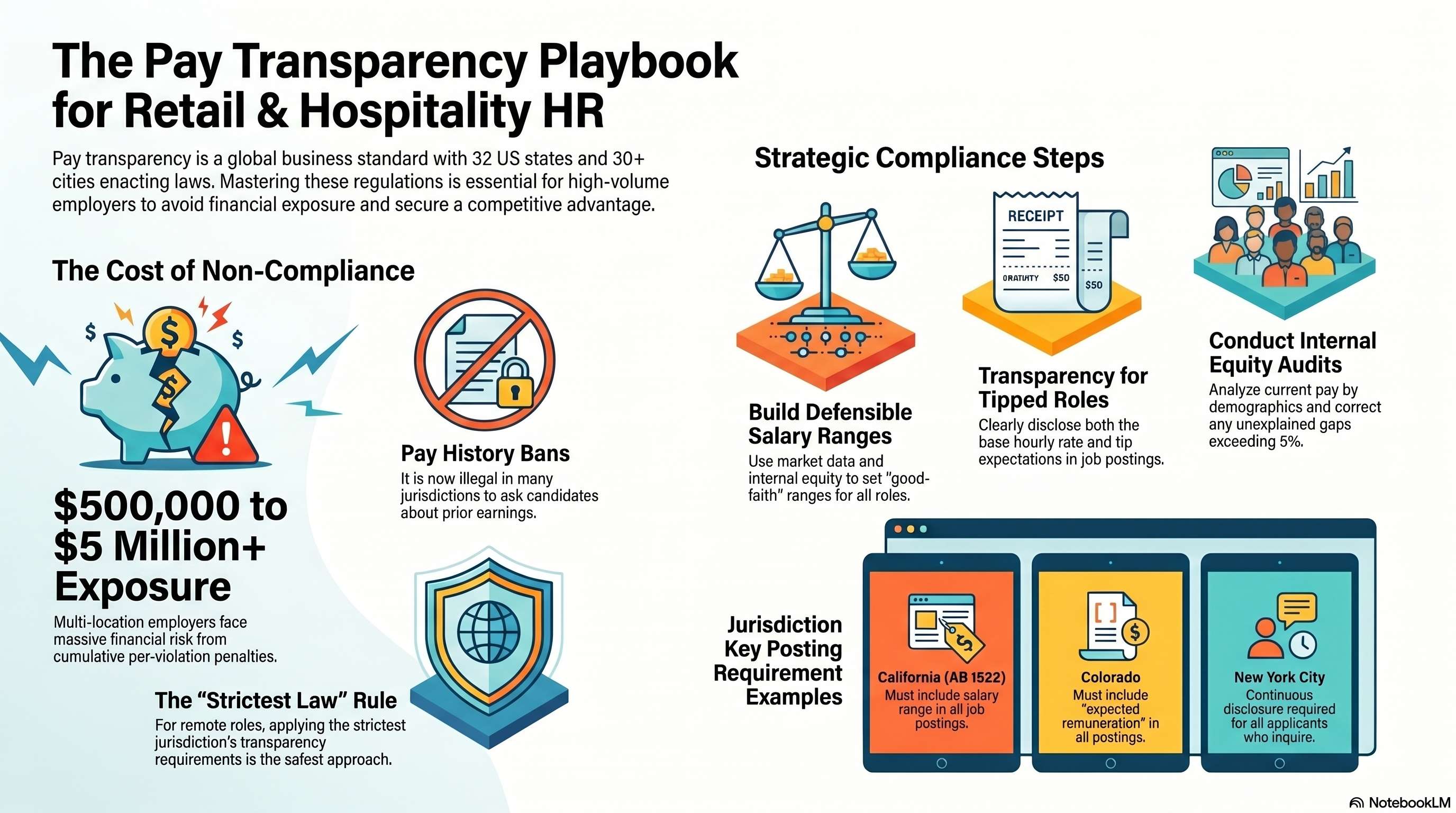
Pay Transparency Laws[/caption]
Pay transparency laws are transforming compensation practices globally. As of 2024, 32 US states and 30+ cities/counties have enacted pay transparency requirements. The European Union, UK, Canada, and Australia have similar mandates. Federal executive order 14026 requires federal contractors to disclose pay ranges. This is no longer niche regulation; it's becoming business standard.
Key regulations: (1) California Pay Transparency Law (AB 1522, effective 2023): Requires salary ranges in job postings for roles filled in CA. (2) New York (2023): Salary disclosure required for all positions applicants apply to. (3) Colorado (2022): Employers with CO employees must include salary range in job postings. (4) Connecticut, Illinois, Maryland, Nevada, Texas, Washington, and 24+ others: Similar requirements. (5) NYC local law (2022): Salary disclosure for roles with one applicant in NYC. (6) Federal contractors: Executive order 14026 requires pay transparency in postings.
Penalties for violations range from $500-$15,000+ per violation, plus attorney fees, penalties, and severe reputational damage. For a multi-location employer with 100 job postings annually, non-compliance could generate $500K-$5M+ in exposure. Risk is material.
Non-compliance behaviors (still common but now illegal): (1) Posting jobs without salary ranges; (2) Instructing recruiters to ask "What are your salary expectations?" and screening based on answer; (3) Declining to discuss salary pre-hire; (4) Using prior salary history to anchor offers. These are violations in regulated jurisdictions.
State-by-State Compliance Requirements
California AB 1522: (1) Must include salary range in all job postings for positions filled in CA or remote for CA residents; (2) Range must be based on good-faith estimate; (3) Must be reasonable, broad range; (4) On request, must provide range to current employees; (5) Cannot retaliate against workers discussing wages. (6) Scope: All employers; no employee threshold.
Implementation: Before posting any job for CA role, determine salary range. Use 25th-75th percentile for role in CA market. Post on job boards. Example: "Retail Store Manager: $62,000 - $82,000." Do not post artificially wide ranges ($50K-$100K) that technically comply but defeat transparency intent.
New York City: Similar to CA but broader. Applies to all roles not just postings. Requires continuous disclosure to applicants who inquire. Must provide range when asked by any applicant. Failure to disclose upon request is violation.
Colorado: Range required in posting. Definition: "Expected remuneration for the position." Can use hourly range for hourly roles. Example: "Retail Cashier: $16.50 - $18.50/hour." Salary ranges should be based on market data.
Remote Work Complexity: If posting remote role, which state's law applies? If any resident of covered jurisdiction could apply, post the range. Safe approach: Apply strictest requirement.
Multi-Location Employers: Best practice is consistent ranges. A job posted in CA should have same range as same role in non-CA states. Inconsistency invites scrutiny.
Compilation Tool: Build salary range matrix for all roles by geography. Maintain in HRIS/ATS. When posting, pull relevant range. This enables rapid, compliant posting.
Other regulated states: Illinois, Maryland, Connecticut, Nevada, Texas, Washington all have similar requirements effective 2023-2024. Adopt same approach across all: determine ranges by role/market, post consistently, update annually, document basis.
Constructing Defensible Salary Ranges
A salary range must be based on good-faith judgment of fair compensation. This protects from challenges (why is range $30K-$60K when market says $40K-$55K?).
Methodology: (1) Market data: Use salary surveys (Bureau of Labor Statistics, PayScale, Salary.com, Glassdoor, industry surveys). For retail, SHRM, NFRA (National Retail Federation), and restaurant associations publish benchmarks. (2) Internal equity: Ensure consistency with similar roles. If Retail Manager is $55K-$75K, Store Supervisor shouldn't be $50K-$55K (insufficient differentiation). (3) Legal review: Have HR or legal review ranges for reasonableness and non-discrimination. (4) Documentation: Document basis. "Set based on: Q1 2024 BLS data for CA retail managers, NFRA salary survey, internal benchmarking to supervisory roles."
Common errors: (1) Posting ranges too wide; (2) Posting ranges misaligned with market; (3) Not updating ranges annually; (4) Different ranges for same role by manager/location (discrimination risk).
Best practice: Establish salary bands (e.g., Retail Cashier: $16.50-$18.50; Stock Associate: $17.50-$19.50; Team Lead: $20-$25; Store Manager: $55K-$75K). Review/update annually using market data. Use consistently in all postings and offers. This is compliant, defensible, efficient.
Pay History Bans and Recruitment Practice Changes
Many jurisdictions ban salary history inquiries. California (SB 358), New York, Illinois, Colorado, Maryland, and 10+ others ban asking candidates about prior salary. Intent: Stop perpetuating pay discrimination (if someone was underpaid historically, basing new offer on prior salary perpetuates inequity).
Banned practices: (1) "What was your salary in your last role?"; (2) "What are you making now?"; (3) Researching candidate salary history and basing offer on it; (4) Making offer contingent on salary history verification.
Allowed practices: (1) Asking, "What are your salary expectations?" (forward-looking); (2) Telling candidate your range and asking if acceptable; (3) Making offer based on market data and role, not prior salary; (4) Negotiation based on candidate skills/experience.
Compliance: Update recruiting scripts, interview guides, offer procedures. Train recruiters/managers on bans. If interviewer asks about prior salary and candidate discloses, disregard it and document you did. Don't use it in decision.
Business case: Pay history bans force market-based pay rather than accidental low salary anchoring. This creates greater equity (women, minorities often have lower historical pay; bans prevent perpetuation). It improves recruitment: Attracting career-changers and non-traditional candidates not anchored to prior low salary.
Implementation: Audit recruiting materials. Remove salary history questions. Add salary expectation questions. Train team. Update offer templates to reference market-based pay.
Internal Pay Transparency and Equity Audits
External transparency (posting ranges) is legally required. Internal transparency (employees discussing wages) is legally protected in most jurisdictions. Both create equity pressure beneficial long-term.
Employees can legally discuss wages with each other. Employers cannot retaliate for wage discussions. Many companies discourage wage discussion through culture/policy. This is illegal.
Better approach: Conduct internal pay equity audit. (1) Analyze compensation data by role, tenure, gender, race/ethnicity. (2) Identify unexplained gaps. (3) Develop remediation plan. (4) Communicate transparency: "We audited pay equity. Found and corrected X gaps. Here's what we're doing."
Tool: Export compensation by role/demographics from HRIS. Simple analysis: For Retail Cashier, gap between men/women? Between white/non-white workers? Gaps of 5%+ warrant investigation. Gaps of 15%+ typically require correction.
Legal note: Conducting this audit creates documentation. If you find gaps and correct them, you're ahead. If discovered in litigation and you knew but didn't correct, liability increases. Recommendation: Audit, document, fix gaps, communicate action. This demonstrates good-faith commitment to equity.
Business case: Pay equity improves retention (workers feel fairly treated), improves recruitment (reputation as equitable employer), and reduces legal risk.
Industry-Specific Applications for Retail and Hospitality
Retail and hospitality are heavily impacted because they're high-volume, low-wage industries with large, diverse workforces. These industries also have significant underpayment of women and minorities historically. Pay transparency creates leverage to correct this.
Retail: A chain with 500 stores has different local labor markets (urban $17/hour, suburban $15/hour, rural $13.50/hour). How post transparently when markets vary? Approach: Post ranges by market/geography ("California: $17-$19.50; Texas: $14.50-$17; etc.") or post one range and note it varies by location. Communicate clearly, don't hide variation.
Hospitality: Tipped positions add complexity. Federal minimum for tipped workers is $2.13/hour; states vary from $2.13 to $15+/hour. When posting, disclose total compensation clearly ("$15/hour + tips" or "$2.13/hour (tipped) + tips"). Transparency about tip income expectations improves recruiting and reduces surprises.
Compliance advantage: Retail/hospitality with strong pay transparency practices attract better talent (candidates know what they're earning), have lower turnover (clarity reduces frustration), and lower legal risk (documented, compliant practices).
Transition and Implementation Timeline
If currently non-compliant: (1) Audit current practices (are you posting ranges? Asking for salary history?); (2) Identify non-compliant jurisdictions; (3) Develop remediation plan; (4) Update job descriptions and posting templates; (5) Train recruiters/managers; (6) Conduct internal pay equity audit; (7) Update offer/negotiation processes; (8) Document everything; (9) Communicate changes to team.
Risk mitigation: (1) Legal review of compliance plan; (2) Background check on recruiting practices; (3) Audit of recent offers (have you been price-anchoring on history?); (4) Comprehensive training; (5) Ongoing monitoring (quarterly audits of recruiting and offer practices).
Quick wins: (1) Update job postings with salary ranges immediately; (2) Train recruiters on banned questions within 30 days; (3) Conduct pay equity audit within 60 days; (4) Develop remediation plan for identified gaps within 90 days.
Expected outcomes: (1) Improved recruitment (candidates appreciate transparency); (2) Better diversity (not anchoring on prior salary removes structural bias); (3) Improved retention (clarity reduces surprises); (4) Reduced legal risk; (5) Enhanced employer brand ("We practice pay equity" is competitive advantage).
Conclusion: Pay Transparency as Strategic Advantage
Pay transparency laws are spreading rapidly. Non-compliance is increasingly costly (monetary penalties plus legal fees and reputational damage). Compliance is achievable with clear process and systematic execution.
More importantly, pay transparency creates opportunity: Better equity, better recruitment, better retention, better brand. Companies embracing transparency outcompete those resisting.
Begin today: Audit current practices. Identify gaps. Develop remediation plan. Train team. Execute. Within 90 days, you can be fully compliant and positioned to benefit from transparency as competitive advantage.
The wave of pay transparency is here. The question is whether you're leading it or being forced to catch up.
References and Further Reading
- California Labor Code Section 432.3 (AB 1522 Pay Transparency)
- New York Executive Law Section 296 (Pay Disclosure)
- Colorado HB 19-1174 (Salary Range Transparency)
- NYC Local Law 1147 (Pay Transparency)
- Federal Executive Order 14026 (Pay Transparency for Federal Contractors)
- Society for Human Resource Management: 'Pay Transparency Laws Overview' (2024)
- National Retail Federation: 'Pay Transparency Compliance Guide' (2023)
- PayScale: 'Pay Equity Analysis Benchmarking' (2024)
- Bureau of Labor Statistics: 'Occupational Employment Wage Data' (2024)
- National Lesbian and Gay Chamber of Commerce: 'Pay Transparency and Equity' (2023)
How Cadient Talent SmartSuite™ Helps
Cadient Talent’s SmartSuite™ platform automates compliance workflows, embeds regulatory guardrails directly into your hiring process, and maintains audit-ready documentation at every stage—so your team can focus on finding great talent while staying protected from costly violations.
