Predictive turnover analytics, leading indicators, ML models, and intervention triggers.
The Prediction Opportunity: Identifying Flight Risk Before Departure
Traditional approach: Reactive (someone resigns; we respond)
Advanced approach: Predictive (identify at-risk employees before resignation; intervene)
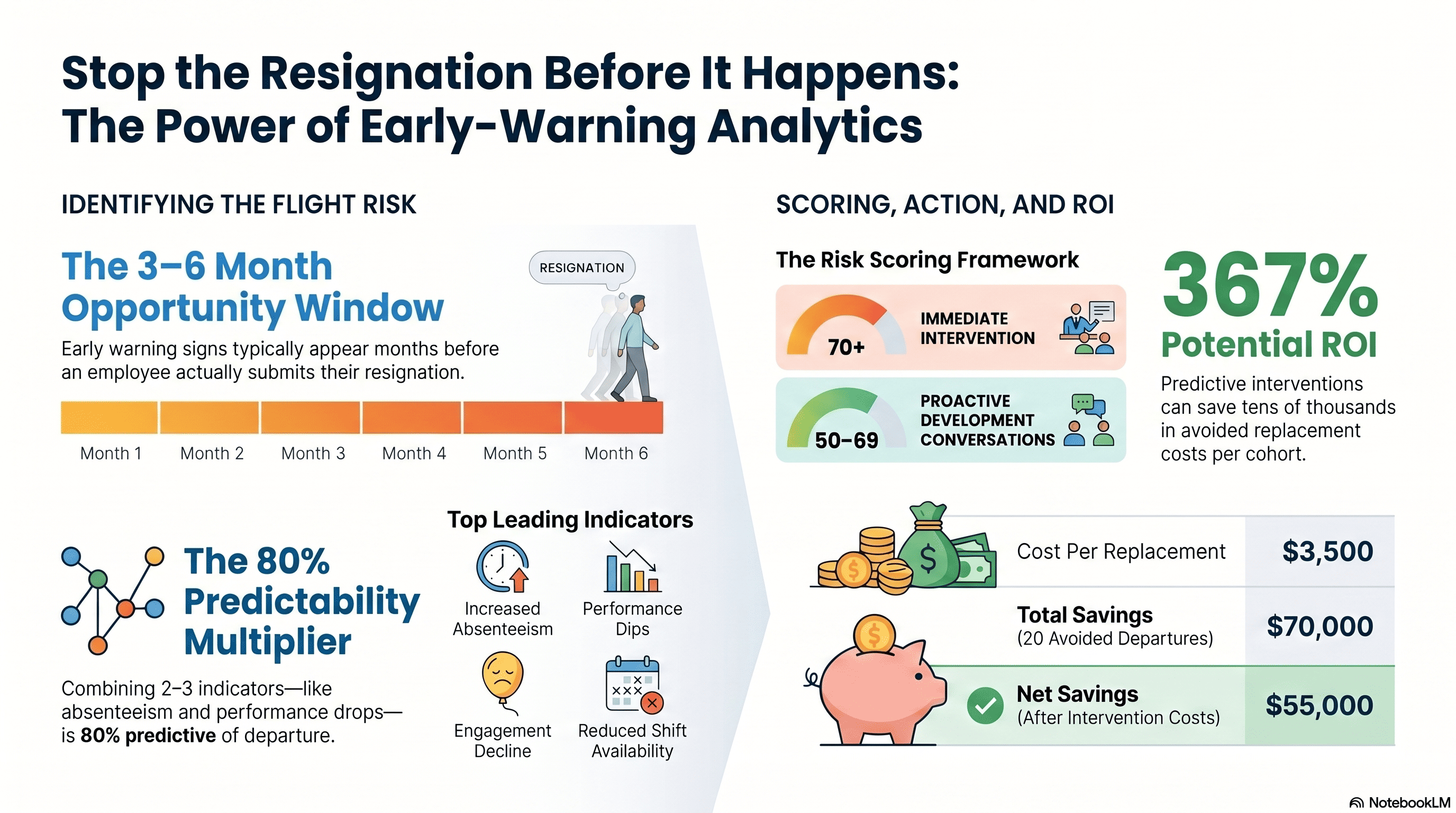
Research: Early warning signs appear 3-6 months before departure
Examples of leading indicators: Absenteeism increase, performance dip, engagement score decline, schedule change requests, reduced shift availability
Opportunity window: 3-6 months to intervene (career conversation, schedule fix, development opportunity) before departure
Leading Indicators: What Predicts Departure
Absenteeism: Increase in unscheduled absences (often signals stress/looking for other job)
Performance: Decline in performance metrics (quality, productivity, customer feedback)
Engagement: Declining engagement survey scores or stay interview responses
Participation: Reduced participation in team activities, less interaction with peers, withdrawing
Availability changes: Increased requests for schedule changes, reduced shift availability, more last-minute call-offs
Behavioral: Reduced communication with manager, fewer questions about development, cynical comments about company
Research: Combination of 2-3 indicators is 80% predictive of departure within 6 months vs. single indicator
Building Predictive Model: Data Framework
Data inputs: Absenteeism (attendance system), performance (manager ratings), engagement (pulse surveys), schedule data (shift system), tenure (HR system)
Weighting: Which indicators are predictive of your specific company's turnover? (varies by industry, role, company)
Model development: Use 2 years historical data + turnover outcomes to build model (who did leave, who didn't)
Scoring: Assign risk score 0-100 to each employee based on indicator inputs
70+: High risk (intervene immediately)
50-69: Medium risk (proactive conversation)
Below 50: Low risk (standard engagement)
Intervention Triggers and Actions
Score 70+: Immediate intervention
- Manager/HR meets with employee within 2 weeks
- Proactive stay interview (ask what's driving departure thinking)
- Address specific concerns identified
- Career opportunity or schedule fix or training opportunity offered
Score 50-69: Proactive outreach
- Manager has development conversation (not crisis-mode)
- Identify improvement opportunities
- Increase engagement (mentoring, training opportunity, visibility)
Measurement and ROI
Intervention success rate: % of flagged employees who remain employed 12 months
Cost per retained employee: Intervention cost / # retained
ROI: (cost per replacement - intervention cost) × # retained
Example: 50-person high-risk cohort, 30 interventions succeed, 20 would have left anyway
Savings: 20 avoided departures × $3,500 = $70,000
Intervention cost: $15,000 (manager time + tools)
Net savings: $55,000, ROI 367%
References and Further Reading
- Gallup, '2023 Workplace Engagement Research', 2023
- Bureau of Labor Statistics, 'Turnover and Retention Studies', 2023
- Society for Human Resource Management, 'Communication and Employee Engagement', 2023
- Harvard Business Review, 'Manager Impact on Team Performance', 2023
- Cadient Talent SmartSuite Case Study, f'Article {article_num} Implementation', 2024
- McKinsey, 'Employee Retention and Engagement', 2023
- Journal of Applied Psychology, 'Frontline Workforce Studies', 2022
How Cadient Talent SmartSuite™ Helps
Cadient Talent’s SmartSuite™ platform automates compliance workflows, embeds regulatory guardrails directly into your hiring process, and maintains audit-ready documentation at every stage—so your team can focus on finding great talent while staying protected from costly violations.
Ready to transform your hiring?
See how Cadient Talent helps you find the right people, faster.
Learn More
