Pulse surveys, continuous feedback, sentiment analysis, action loops, frontline-specific mechanisms.
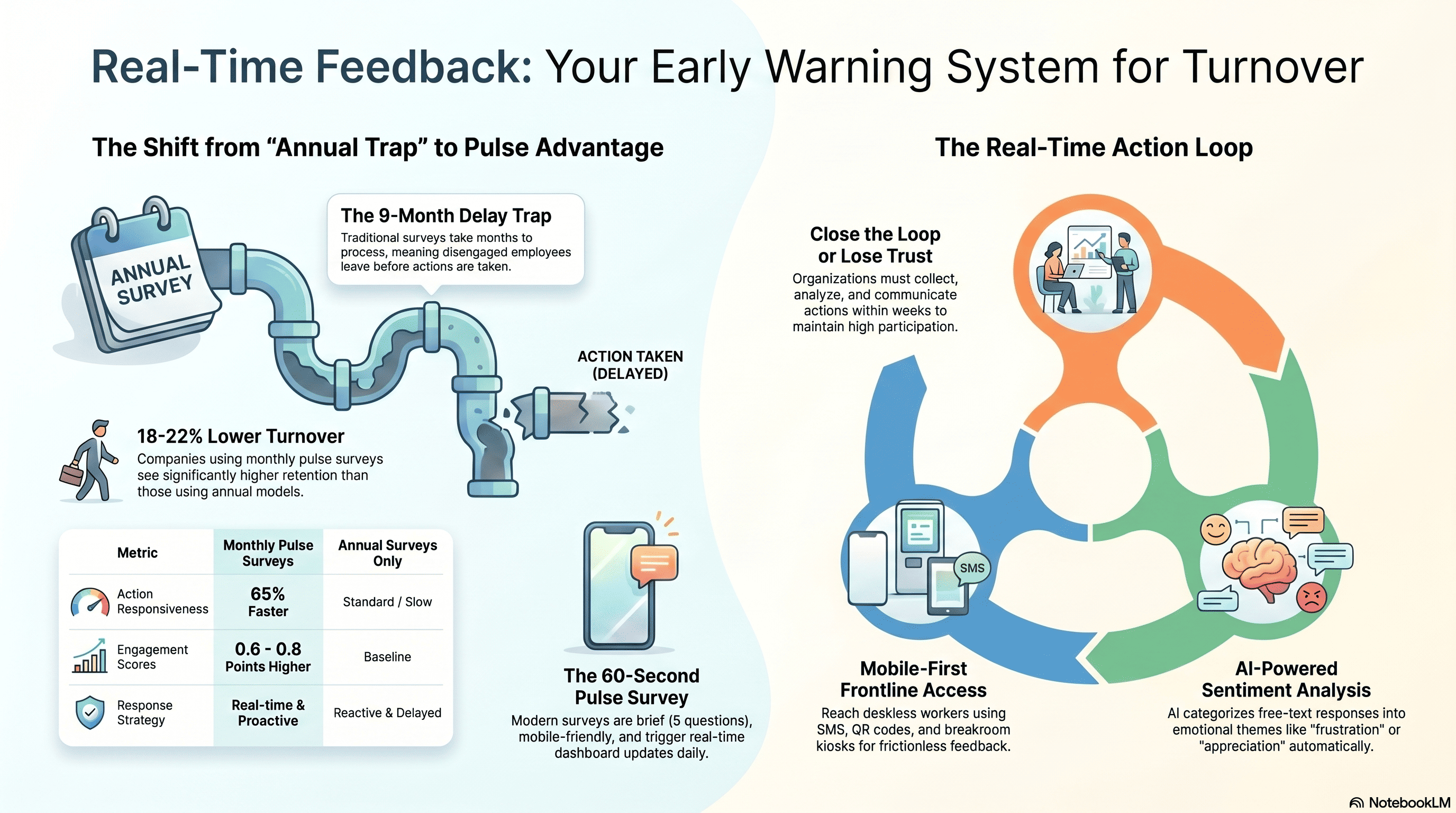
The Annual Survey Trap: By the Time You Get Results, They've Left
Traditional approach: Annual engagement survey (February results → March report → April planning → May action). Nine months to respond to problems identified in February.
By May, disengaged employees have already found new jobs.
Better approach: Pulse surveys (weekly or monthly micro-surveys) + real-time action.
Pulse survey characteristics:
- Brief (5 questions, 60 seconds to complete)
- Frequent (weekly, biweekly, or monthly)
- Mobile-friendly (employees complete on phones)
- Real-time results (dashboard updated daily)
- Action-oriented (results trigger immediate response)
Example weekly pulse survey:
- "How satisfied are you with your work this week?" (1-5 scale)
- "Did your manager recognize your work?" (Yes/No)
- "Do you see yourself here in 12 months?" (Yes/No/Unsure)
- "What's one thing that frustrated you this week?" (free text)
- "What's one thing that energized you this week?" (free text)
Takes 60 seconds. Can be completed during break.
Real-time dashboard:
- Overall satisfaction trending (is engagement improving, stable, declining?)
- Manager recognition frequency (are managers recognizing work?)
- Stay/leave intent (% answering Yes to "I see myself here in 12 months")
- Top frustrations (emerging problems identified immediately)
- Top energizers (what's working, amplify it)
- Segmentation: Satisfaction by location, shift, department, manager
This creates early warning system. Frustration themes emerge → addressed within weeks, not months.
Research support:
Companies conducting monthly pulse surveys vs. annual only:
- Turnover reduction: 18-22% lower voluntary turnover
- Engagement: 0.6-0.8 point higher engagement
- Action responsiveness: 65% faster action on identified issues
- Cost: Monthly pulse + analysis ~$3,000/month for 500-person company; savings from retention easily exceed cost
Sentiment Analysis: Understanding Emotion Behind Responses
Pulse surveys ask yes/no and ratings. But free-text responses reveal emotion and nuance.
Example:
- "My manager never checks in with me" (frustration)
- "I have no clear future here" (anxiety)
- "Sarah helped me solve a hard problem" (appreciation)
- "I'm worried about schedule changes coming" (concern)
Manual reading 500+ responses is unwieldy. Solution: Sentiment analysis (AI-powered).
How it works:
AI reads free-text responses, categorizes by sentiment:
- Positive (grateful, energized, appreciated)
- Negative (frustrated, anxious, uncertain)
- Neutral (factual, informational)
Then groups by theme:
- Manager-related: "My manager is great" vs. "Manager doesn't care about development"
- Schedule-related: "Flexible schedule is amazing" vs. "Unpredictable schedule is stressful"
- Growth-related: "No career path" vs. "Great training opportunities"
- Team-related: "Love my team" vs. "Team conflicts are draining"
- Recognition-related: "Not appreciated enough" vs. "Recognition makes me feel valued"
Dashboard with sentiment insights:
Executive sees:
- 42% of responses are positive
- 38% are neutral/informational
- 20% are negative
Of negative responses:
- 35% are schedule-related frustration
- 25% are manager-related concerns
- 20% are growth/career concerns
- 20% are other
This reveals root causes. Schedule emerges as #1 frustration; that becomes priority.
Action loop:
Week 1: Collect feedback
Week 2: Analyze (sentiment + themes emerge)
Week 3: Leadership reviews, identifies top 2-3 themes
Week 4: Teams develop action plans for top themes
Week 5: Action plans communicated to staff ("We heard X concern; here's what we're doing...")
Week 6-8: Action plans executed
Week 9: Pulse survey again; measure if sentiment improving on addressed theme
Key principle: Close the loop.
If employees give feedback and see action, they'll keep giving feedback. If feedback goes into void with no action, employees stop answering.
One company launched pulse survey, collected 2 months of data, didn't act. Subsequent month, response rate dropped from 60% to 18%. Employees perceived surveys as theater.
Another company launched pulse, acted within 2 weeks on top concerns, communicated actions back to employees. Response rate stayed at 70%+. Employees saw surveys as mechanism for change.
Frontline-Specific Feedback Mechanisms: No Email, No Computer
Standard feedback mechanism: Online survey, email link, complete during work hours.
Problem for frontline staff: No computer access, email buried in phone notifications.
Solutions:
1. SMS-based pulse survey
- Employer sends SMS: "Quick question: How's your week going? 1=Frustrated 5=Great. Reply with number."
- Employee replies with rating
- No app install, no portal, no friction
- Cost: ~$0.01 per SMS
2. QR code in break room
- Posted in break room: "How are we doing? Scan to answer quick survey."
- Employee pulls phone, scans, answers 5 questions (60 seconds)
- Data instantly collected
- Cost: Free (QR code changes weekly, pointing to different survey)
3. Manager verbal survey
- Manager asks during team huddle or 1-on-1: "How satisfied are you with X?" (1-5 scale)
- Manager records responses
- Manager enters into system
- Data aggregated across team
- Cost: Manager time (5 minutes per team per week)
4. Kiosk at punch-in/out
- Tablet at time clock: "Quick feedback: Rate your day (1-5)."
- Employee taps before/after shift
- Data collected as they're leaving
- Cost: Tablet + software ($100-200/month)
5. Mobile app push notification
- App installed on employee phones
- Push notification: "30-second feedback survey"
- Employee taps notification, answers 5 questions
- Can complete during break or after shift
- Cost: $500-1,000/month for app platform
Best practice combination:
Use multiple channels to maximize response. Some employees prefer SMS, others prefer app, others prefer verbal.
- SMS: Weekly check-in ("How's week going?")
- Manager verbal: Bi-weekly team huddle ("Any frustrations we should address?")
- QR code: Monthly deep-dive survey (5-10 questions)
Diversity of channels = higher response rates.
Action Loops: Converting Feedback Into Change
Feedback without action is theater. Action loop ensures feedback drives change.
Stage 1: Collect feedback
Weekly pulse survey; 60% response rate (300 of 500 employees)
Stage 2: Analyze immediately
- Top frustrations identified (by Friday of survey week)
- Themes emerging: Schedule unpredictability, manager recognition gaps, no growth path
- Sentiment: 35% positive, 50% neutral, 15% negative
Stage 3: Leadership review
- Monday: Leadership reviews analysis (15-minute meeting)
- Prioritize top 2-3 themes
- Decide on action
Stage 4: Action plan
For schedule frustration (35% of negative feedback):
- Decision: Implement 3-week advance scheduling
- Timeline: Launch in 4 weeks
- Owner: Operations + HR
- Communication: Announce decision + timeline by Tuesday
Stage 5: Communicate back to employees
"Thank you for your feedback. We heard that schedule unpredictability is frustrating. Starting [date], all schedules will be posted 3 weeks in advance. This gives you certainty for childcare, transportation, and life planning. Here's how it works..."
Key: Employees see their feedback resulted in action. This reinforces feedback culture.
Stage 6: Implement change
4-week execution period to implement change
Stage 7: Measure impact
- Following week: Pulse survey again
- New question: "Have you noticed changes to scheduling?" (Yes/No)
- Sentiment analysis: Is schedule frustration declining?
- Measure: Baseline 35% of negative feedback was schedule → following week 12%
- Success: 23-point improvement in schedule-related sentiment
Stage 8: Communicate results
"Last month, you told us scheduling was frustrating. We listened. We implemented 3-week advance scheduling. This week, we surveyed again. 82% of you said you noticed the improvement. Thank you for the feedback. It works."
This closes the loop. Employees see: feedback → action → improvement. This encourages continued feedback.
Common pitfalls:
Pitfall 1: Slow action
Company surveys in January, acts in May. By May, sentiment unchanged (employees already departed or given up on feedback).
Fix: Commit to 2-week analysis, 4-week action. Feedback → Action in <6 weeks.
Pitfall 2: No communication of action
Company acts but doesn't tell employees. Employees don't realize feedback was heard.
Fix: Communicate action plan and results back to survey participants.
Pitfall 3: Action on wrong thing
Feedback identifies schedule as #1 issue, but company acts on communication (lower priority).
Fix: Prioritize by impact (which theme affects most people? which theme most drives turnover?).
Pitfall 4: Partial action
Feedback requests 3-week advance scheduling; company implements 2-week. Not quite meeting request.
Fix: Act fully on request; if you can't, explain why and offer alternative.
One logistics company implemented action loops:
- Month 1: Feedback identified schedule + training gaps
- Month 2: Implemented 3-week advance scheduling + microlearning platform
- Month 3: Communicated back; measured impact
- Result: Schedule-related frustration dropped 28 points; training interest up 18 points
- Turnover improvement: 8% reduction year-over-year
- Cost of action: $15,000. Savings from retention: $250,000. ROI: 1,567%
Implementation: Building a Feedback Culture
Creating feedback culture requires infrastructure + leadership commitment.
Step 1: Select tool/platform
Options:
- SMS-based: Twilio + custom dashboard ($500-1,000/month)
- App-based: Officevibe, CultureAmp, Peakon ($1,000-3,000/month)
- DIY Google Forms + SMS: Free (requires internal setup)
- Manager survey tool: Qualtrics, SurveyMonkey (enterprise cost)
For most companies: SMS-based or app-based platform, $1,000-2,000/month.
Step 2: Design survey questions
Keep it simple. 5 questions max.
- Overall satisfaction (1-5 scale)
- Manager investment in development (Yes/No)
- Stay/leave intention (Yes/No/Unsure)
- Top frustration (free text)
- Top energizer (free text)
Rotate questions monthly to cover different topics (growth, recognition, compensation, schedule, manager, team, etc.).
Step 3: Launch with communication
"We're launching a feedback survey to understand what's working and what needs improvement. It takes 60 seconds. You'll see actions within weeks. Your feedback matters."
Communicate multiple times (email, team meetings, signage) to build awareness.
Step 4: Set response rate target
Target: 60%+ response rate (achievable with mobile-friendly design + manager encouragement)
Benefit: Higher response rate = more representative data = better decisions
Driver: Managers encourage team completion ("Take 60 seconds this week to give feedback")
Step 5: Create dashboard
Real-time visibility:
- Overall satisfaction trending
- Response rate
- Top themes (sentiment analysis)
- Segmentation (by location, shift, manager)
- Open feedback comments (quality assurance)
Share dashboard with leadership + managers (transparency).
Step 6: Establish action protocol
Weekly or bi-weekly:
- Review feedback (1 hour leadership meeting)
- Identify top 2-3 themes
- Assign ownership for action
- Set deadline
- Communicate back to employees
This becomes cadence. Employees expect weekly feedback → weekly action → weekly communication.
Step 7: Measure and optimize
Track:
- Response rate (trending up? engagement in survey itself)
- Sentiment trend (overall satisfaction improving?)
- Specific theme improvement (did addressing schedule reduce frustration?)
- Turnover impact (correlation between feedback sentiment and departure)
- ROI (cost of program vs. savings from retention improvement)
Timeline for full implementation: 4-6 weeks
- Week 1: Select tool, design survey
- Week 2: Launch, communicate
- Week 3-4: Collect feedback, establish action cadence
- Week 5-6: See results, demonstrate value
After 6 weeks, program should be self-sustaining (employees give feedback, see action, feel heard, stay).
References and Further Reading
- Gallup, "Pulse Survey Impact on Engagement and Retention," 2023
- Harvard Business Review, "Real-Time Feedback vs. Annual Reviews," 2023
- Bureau of Labor Statistics, "Frontline Worker Feedback Mechanisms," 2023
- Society for Human Resource Management, "Action Loops and Feedback Culture," 2023
- Cadient Talent SmartSuite Case Study, "Real-Time Feedback Implementation," 2024
- McKinsey, "Sentiment Analysis for HR," 2023
- Journal of Applied Psychology, "Feedback Response Time and Employee Engagement," 2022
How Cadient Talent SmartSuite™ Helps
Cadient Talent’s SmartSuite™ platform automates compliance workflows, embeds regulatory guardrails directly into your hiring process, and maintains audit-ready documentation at every stage—so your team can focus on finding great talent while staying protected from costly violations.
