Recognition program design, peer recognition, micro-recognition, digital platforms, ROI measurement.
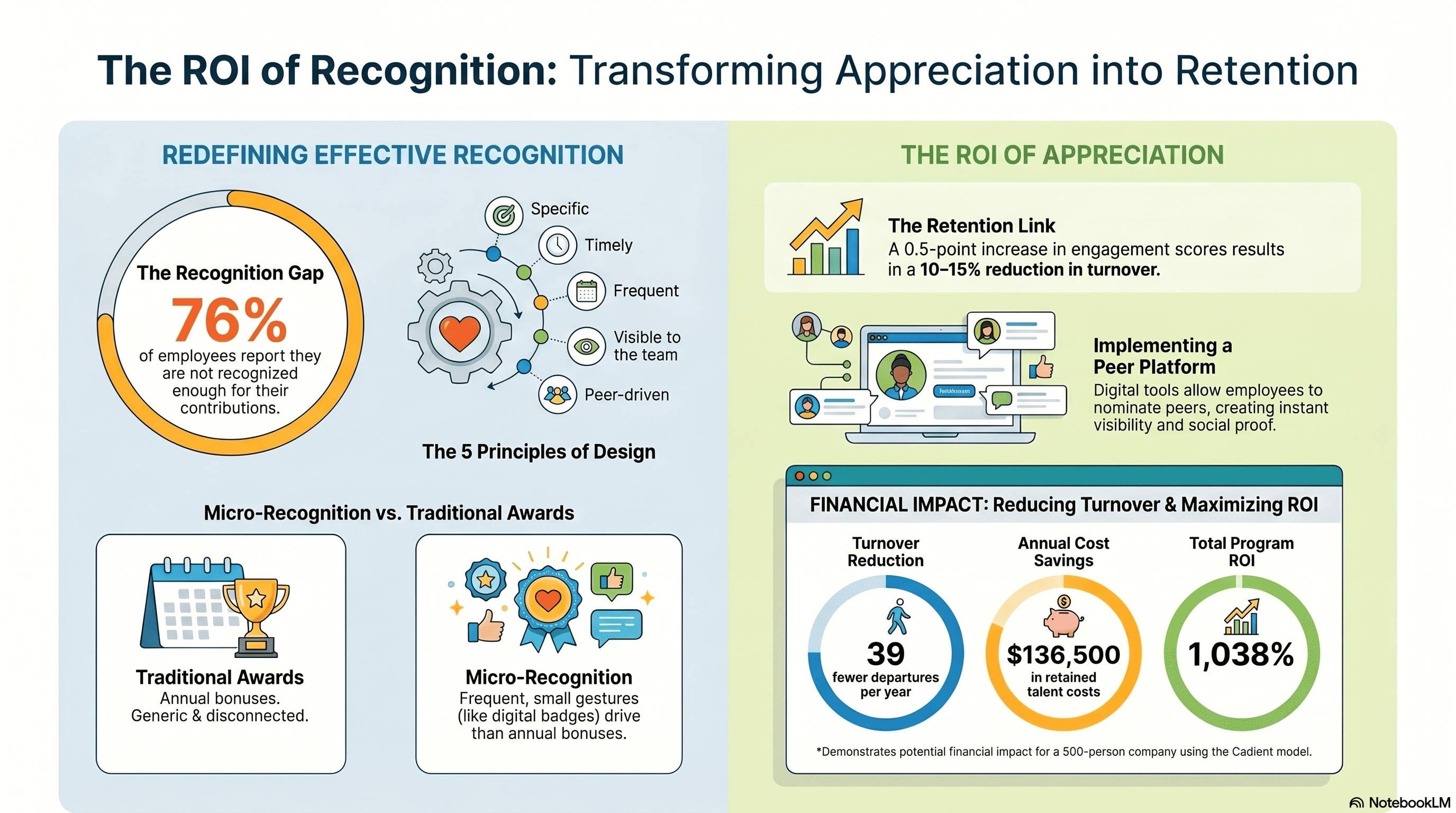
The Recognition Gap: Why Most Programs Fail
Research: 76% of employees say they're not recognized enough for their contributions
What companies do: Annual bonus (not recognition; it's compensation) or token awards
What employees want: Specific recognition of contribution ("Sarah did X and that mattered because Y")
Frequency: One-time annual award doesn't drive engagement; frequent, timely recognition does
Most programs fail because: Generic, infrequent, disconnected from actual contributions
Effective Recognition Design: Principles
Specific: Recognize exact behavior/contribution, not generic "great job"
Timely: Within days of contribution, not months later
Frequent: Multiple times per month, not once per year
Peer-driven: Employees recognize each other, not just manager-to-employee
Visible: Public (team meeting, company newsletter, break room), not private
Connected to values: Recognition tied to company values ("Marcus showed Customer Care by...")
Micro-Recognition: Frequent, Small, Powerful
Traditional: Annual awards, formal ceremony
Micro-recognition: Frequent, small recognition (public mention, digital badge, team celebration)
Example: "Sarah resolved customer complaint brilliantly this week. She stayed calm and found solution. That's Customer Care in action. Thank you, Sarah."
Cost: Essentially free (takes 2 minutes)
Impact: Employees receiving frequent recognition show 28% higher engagement than those with annual awards
Accumulation: Over year, person receives 20-50 micro-recognitions; adds up to strong signal of being valued
Peer Recognition Platform
Digital tool: Employees nominate each other for recognition
Process: Employee sees peer's contribution → clicks recognition button → writes 1-2 sentence why deserving → recognition posted to team feed
Visibility: All team sees recognition (social proof, peer validation)
Gamification: Points/badges for giving recognition and receiving it; leaderboards by team
Manager reports: Manager sees team recognition feed; uses for insight into team dynamics and contribution patterns
Manager-Led Recognition
Manager responsibility: Manager recognizes 1-2 employees per week (formal expectation)
Mechanism: Monthly team meeting, manager spends 10 minutes recognizing contributions from past month
Format: "This month, I want to recognize three people. [Name] showed [behavior] by [example]. That helped our team [impact]."
Consistency: Every week/month without fail (creates culture of recognition)
ROI of Recognition Programs
Cost: Platform ($500-1,000/month), manager time (1 hour per week across 50 managers = 50 hours)
Annual cost: $10,000-15,000 for 500-person company
Engagement lift: Frequent recognition correlates with 0.5-0.8 point engagement lift (on 5-point scale)
Turnover reduction: 0.5-point engagement increase = 10-15% turnover reduction
Savings: 500 people × 65% turnover × 12% reduction = 39 fewer departures × $3,500 = $136,500
ROI: ($136,500 - $12,000) / $12,000 = 1,038%
References and Further Reading
- Gallup, '2023 Workplace Engagement Research', 2023
- Bureau of Labor Statistics, 'Turnover and Retention Studies', 2023
- Society for Human Resource Management, 'Communication and Employee Engagement', 2023
- Harvard Business Review, 'Manager Impact on Team Performance', 2023
- Cadient Talent SmartSuite Case Study, f'Article {article_num} Implementation', 2024
- McKinsey, 'Employee Retention and Engagement', 2023
- Journal of Applied Psychology, 'Frontline Workforce Studies', 2022
How Cadient Talent SmartSuite™ Helps
Cadient Talent’s SmartSuite™ platform automates compliance workflows, embeds regulatory guardrails directly into your hiring process, and maintains audit-ready documentation at every stage—so your team can focus on finding great talent while staying protected from costly violations.
Ready to transform your hiring?
See how Cadient Talent helps you find the right people, faster.
Learn More
