Build Your Hiring Process Like a Production Line
The Operations Mindset
[caption id="attachment_20948" align="alignnone" width="2752"]
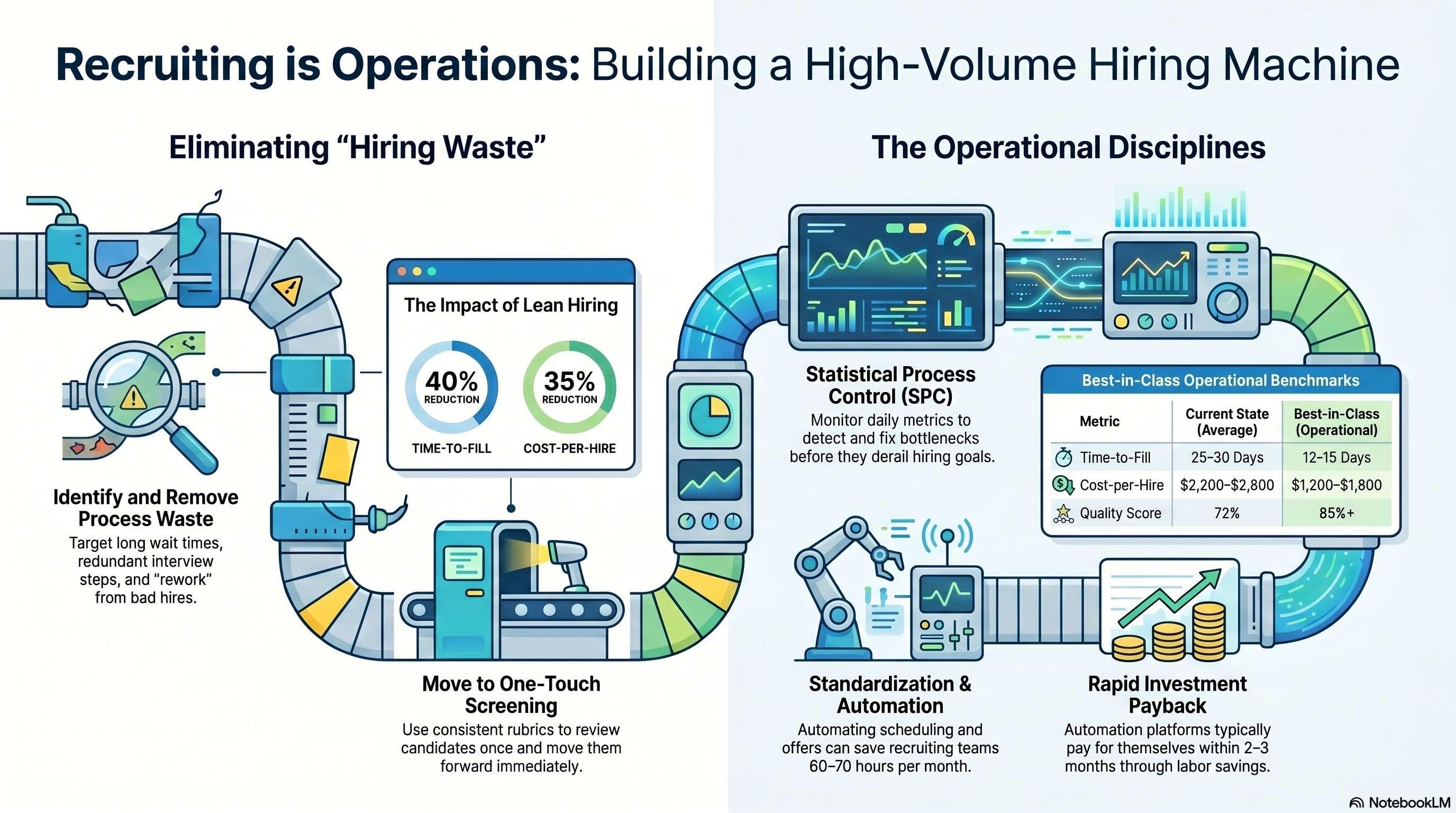
Recruiting Is Operations[/caption]
High-volume manufacturers use lean principles and statistical process control to optimize production. Hiring high-volume workers requires the same discipline. A manufacturing facility achieving 0.1% defect rate applies same rigor to hiring quality. Yet most HR departments treat hiring as ad-hoc, reactive process.
Operations approach: (1) Map the hiring process end-to-end (job posting to day-30 onboarding); (2) Identify bottlenecks and waste (e.g., average time-to-hire 30 days; why?); (3) Standardize steps (all jobs posted to same channels, all candidates screened by same rubric); (4) Measure cycle time and quality; (5) Continuously optimize (remove bottlenecks, improve quality, reduce cost).
Benchmark: Best-in-class retail hiring: 12-15 day time-to-fill, 85%+ quality score, $1,200-$1,800 cost per hire. Your current state: 25-30 days, 72% quality, $2,200-$2,800. Gap analysis shows where investment drives improvement.
Lean Hiring Principles
Lean manufacturing eliminates waste. Hiring waste includes: (1) Long process steps (job posting, screening, interviewing taking excessive time); (2) Rework (candidates rejected then reconsidered, offering positions multiple times); (3) Overprocessing (excessive approvals, redundant steps); (4) Waiting time (positions open for weeks with no interviews scheduled); (5) Defects (bad hires requiring replacement).
Optimizations: (1) One-touch screening (resume reviewed once against consistent rubric, move forward or archive); (2) Rolling interviews (don't wait for all applications; interview as you receive); (3) Same-day offers (qualified candidate interviewed and offered same day, increasing acceptance); (4) Group onboarding (cohorts of 5-10 new hires trained together, reducing per-hire cost).
Measured impact: Companies applying lean hiring reduce time-to-fill by 30-40% and cost-per-hire by 25-35% while improving quality by 15-20%.
Statistical Process Control (SPC) for Hiring
SPC monitoring: Track time-to-fill, cost-per-hire, and quality metrics daily/weekly. Plot on control chart. When metric goes outside normal variation (high or low), investigate. Example: If average time-to-fill is 15 days with 2-3 day standard deviation, and one month it jumps to 22 days, investigate: Why? New bottleneck in approval process? Lower volume of applications? Lower quality requiring more interviews?
Use data to diagnose: "Time-to-fill increased 40%. Investigation revealed job postings not being published to all channels (posting person only using Indeed; not using LinkedIn, TikTok, employee referrals). Fix: Implement systematic posting to all channels. Result: time-to-fill returns to target within 2 weeks."
This is operational discipline, not HR guesswork.
Process Standardization and Automation
Step-by-step standardization: (1) Job posting—same template, same channels, same timing; (2) Application screening—same rubric, same logic applied to all; (3) Interview scheduling—candidate self-books via automated calendar; (4) Interview—same questions, same scoring for all candidates; (5) Offer—automated approval workflow; (6) Onboarding—group cohorts, pre-assigned to trainers, standard curriculum.
Automation examples: ATS auto-screens applications against keywords, eliminating 30% of manual screening work. Scheduling tools auto-sync with interviewer calendars, eliminating back-and-forth emails. Document generation auto-creates offers pulling info from ATS. Time savings: 60-70 hours per month for recruiting team; cost savings: $2,400-$2,800/month.
Investment: ATS platform $2,000-$4,000/month; automation setup 40-60 hours initially. Payback: 2-3 months from labor savings.
Conclusion: Hiring as Competitive Advantage
Companies applying operations discipline to hiring achieve measurably better outcomes. Begin: map your hiring process, measure cycle time and quality, identify bottlenecks, standardize, automate. Within 6 months, time-to-fill decreases, cost per hire decreases, quality improves. Within 12 months, hiring becomes competitive advantage—you fill positions 25% faster and with higher quality than competitors.
References and Further Reading
- Lean Enterprise Institute: 'Lean Principles in HR' (2024)
- McKinsey: 'Operational Excellence in Recruiting' (2024)
- Harvard Business Review: 'Hiring as Operational Process' (2023)
How Cadient Talent SmartSuite™ Helps
Cadient Talent’s SmartSuite™ platform automates compliance workflows, embeds regulatory guardrails directly into your hiring process, and maintains audit-ready documentation at every stage—so your team can focus on finding great talent while staying protected from costly violations.
Ready to transform your hiring?
See how Cadient Talent helps you find the right people, faster.
Learn More
