The Speed-Quality Balance in High-Volume Hiring
The Speed-Quality Tradeoff
[caption id="attachment_20912" align="alignnone" width="2752"]
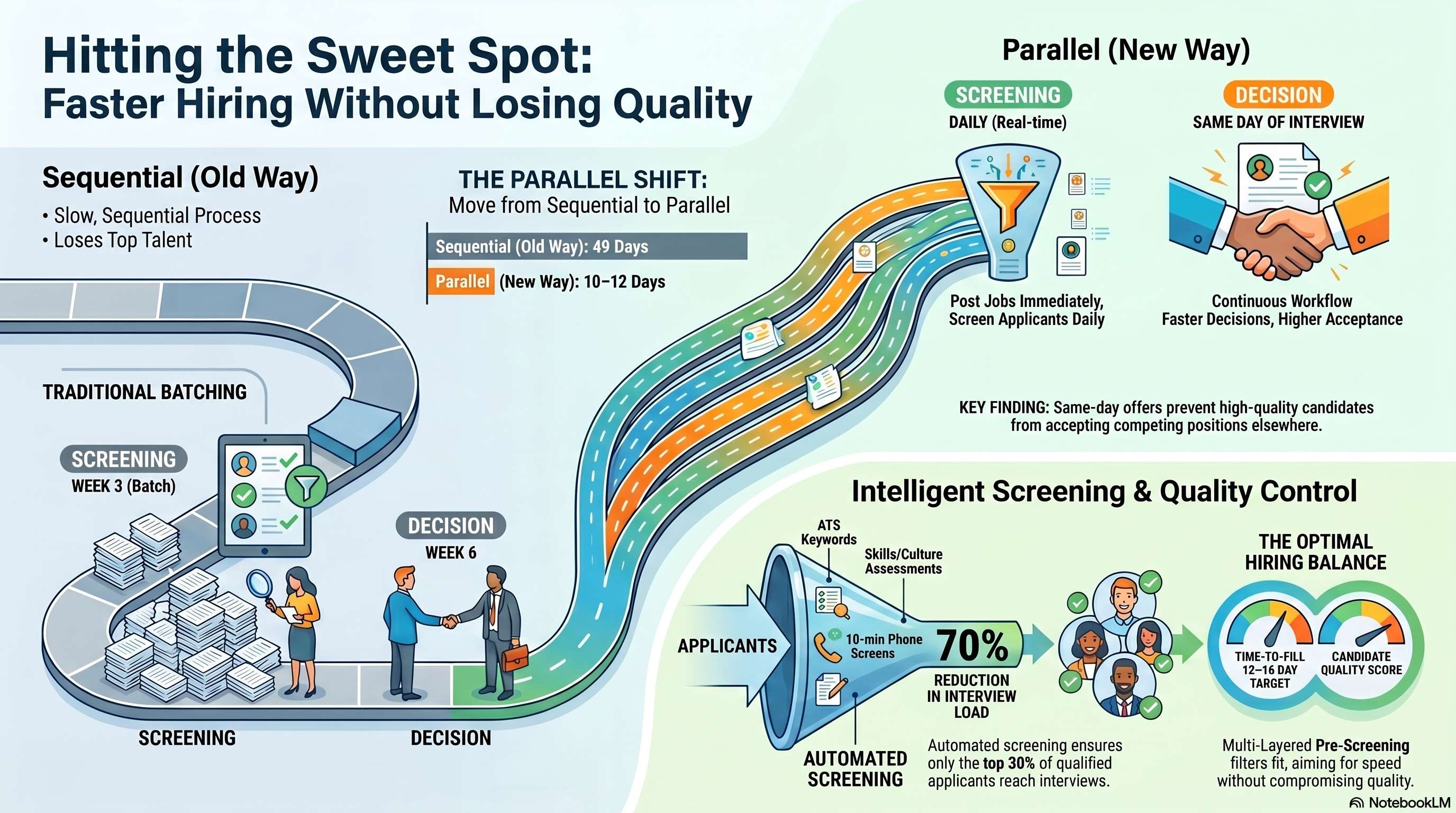
Reducing Time-to-Fill Without Sacrificing Quality[/caption]
Slow hiring (30+ days) means high-quality candidates accept other offers and positions stay vacant, hurting operations. Fast hiring (5 days) risks quality—insufficient screening, poor fit. Optimal balance: 12-16 day time-to-fill with 80%+ quality score.
Mechanism: Faster hiring requires parallel processing (multiple candidates in parallel interview stage, not sequential); immediate availability (not batching applications), and streamlined decision-making (fast approvals). Speed without reducing quality requires: better upfront screening (fewer unqualified candidates), structured assessment (quick, accurate evaluation), and clear decision criteria (quick yes/no decisions).
Parallel Processing
Sequential: Job posts → Applications come in over 2 weeks → Batch screening at week 3 → Interviews week 4-5 → Decision week 6 → Hire week 7. Total: 49 days.
Parallel: Job posts → Applications come in → Screening done daily → Interviews ongoing (as soon as qualified candidates ready) → Decision same day of final interview → Offer same day. Total: 10-12 days.
Implementation: (1) Post immediately (don't wait for multiple postings); (2) Screen daily (don't batch); (3) Continuous interviewing (don't wait for cohort); (4) Fast decision-making (approval by EOD).
Cost: Minimal. Benefit: Reduces time-to-fill by 60-70%, improves candidate experience (faster feedback), increases offer acceptance (candidate not waiting).
Pre-Screening and Automation
Reduce unqualified candidates through better upfront screening: (1) ATS screening—resume scanned for keywords automatically, unqualified rejected; (2) Phone screen—brief 10-min call with candidates, assessing basic fit; (3) Skills assessment—online test (typing, customer service, problem-solving) completed before interview; (4) Culture fit assessment—online questionnaire identifying alignment.
Benefit: Only 30-40% of applicants advance to full interview (vs. 60-70% without screening), reducing interview time-to-hire. If 100 applicants and you interview all vs. 30 qualified, interview load drops 70%, time-to-fill drops 40%.
Accuracy: Screening must be accurate (not rejecting qualified candidates). Validation: Test screening tool against hired candidates; does it predict performance?
Conclusion
Speed and quality aren't enemies. Smart process design, parallel processing, and automation enable both. Target: 12-16 day time-to-fill, 80%+ quality score.
References and Further Reading
- McKinsey: Speed-Quality in Hiring (2024)
- Workable: Time-to-Fill Analysis (2023)
How Cadient Talent SmartSuite™ Helps
Cadient Talent’s SmartSuite™ platform automates compliance workflows, embeds regulatory guardrails directly into your hiring process, and maintains audit-ready documentation at every stage—so your team can focus on finding great talent while staying protected from costly violations.
Ready to transform your hiring?
See how Cadient Talent helps you find the right people, faster.
Learn More
