Why speed-to-response is the hidden multiplier of candidate quality and hiring velocity
The Speed Paradox in Modern Recruiting
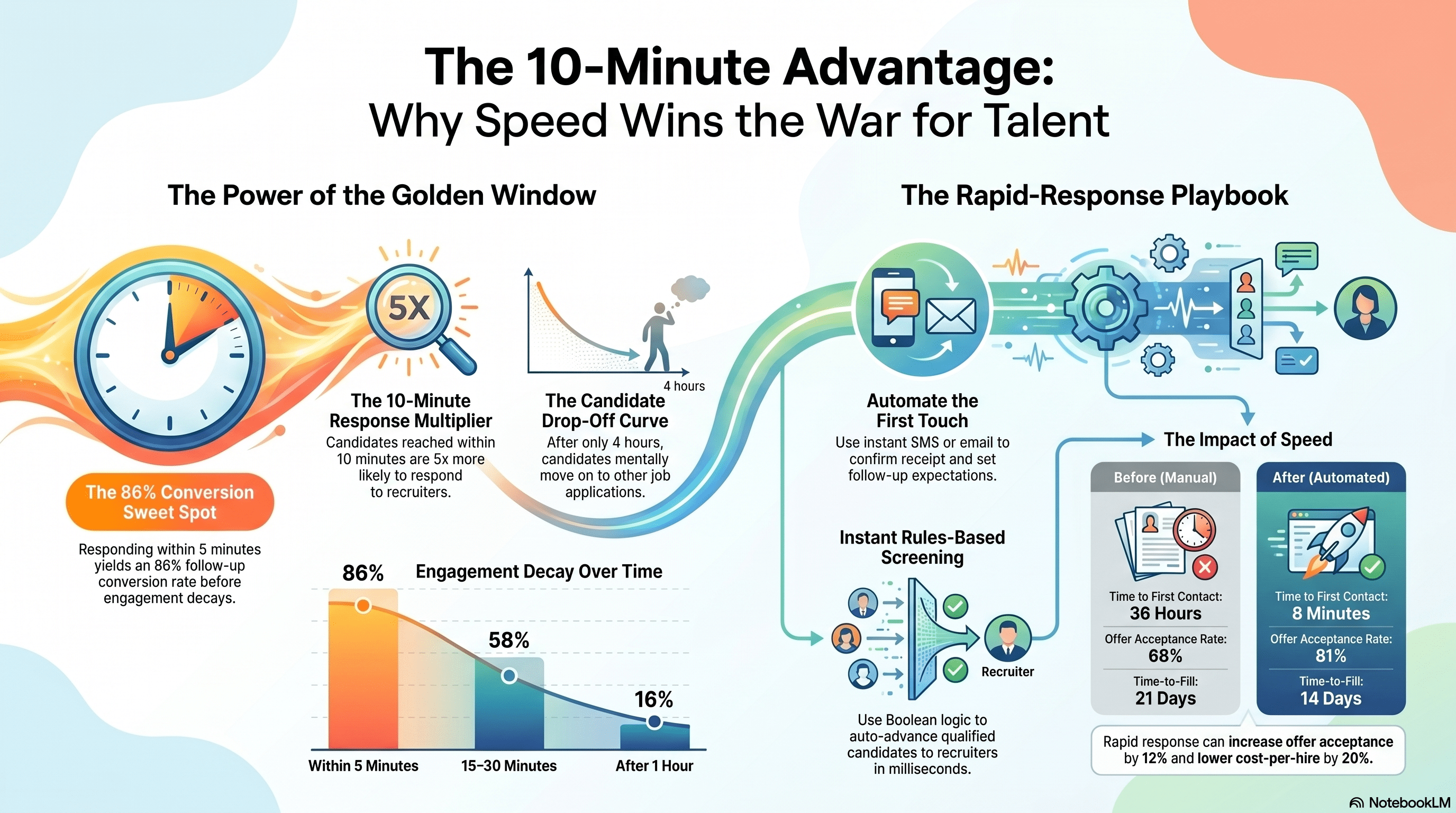
You've likely heard this before: 'We need to move faster.' HR leaders say it constantly. But when researchers at Harvard Business School analyzed 8 million job inquiries across hundreds of companies, they discovered something surprising. The companies obsessing over speed didn't just hire faster. They hired better candidates. And they needed fewer total hires to fill their pipeline.
The mechanism is simple but powerful: speed changes who you can attract. When a candidate submits an application, they're usually talking to multiple employers simultaneously. In retail and hospitality, a job applicant might apply to 10 locations on the same day. They're comparing response times, offer packages, and perceived employer interest in real time. Respond within 10 minutes, and you're the only one they talk about to their friends. Respond in 24 hours, and you've lost the candidate who got an immediate callback from somewhere else.
For high-volume hiring, this isn't about politeness. It's about market dynamics. The best candidates—people with options, people who can work any schedule, people with transportation and reliability—have choice. Speed signals that you value their application. Speed also collects candidates who value responsiveness. Both of these together create a virtuous cycle: better candidates, faster hiring, lower cost-per-hire.
The Golden Window: The First 5 to 15 Minutes
Harvard's research identified what they call the 'golden window.' When a candidate applies for a job, they check their email or phone within minutes. This is the moment of highest engagement and lowest friction. They're thinking about the role, mentally comparing it to other options, imagining themselves in the position.
If you respond within this golden window—ideally within 5-15 minutes—several things happen:
- You're the first callback: Even if the candidate applied to three similar jobs, you reach out first. First contact creates a psychological anchor. They remember you.
- The candidate is still 'hot': They haven't moved on mentally. They haven't started another conversation with another recruiter. The emotional momentum is yours.
- You reduce no-shows: Candidates who engage immediately in the application process are more likely to show up for interviews. They've built momentum.
- You increase interview-to-offer conversion: A candidate who hears back immediately feels valued. That emotional resonance carries through the entire hiring process.
Beyond 30 minutes, response effectiveness drops dramatically. Beyond 2 hours, you've likely lost the candidate. They've already heard back from someone else. They've moved to the next application. The damage is done.
This doesn't mean a human recruiter has to reach out in 10 minutes. It means any acknowledgment—automated, AI-generated, or human—that confirms receipt and sets expectations.
Speed-to-Lead Benchmarks Across Industries
Research from the HubSpot Insights team (2023) analyzed 40,000 B2B sales inquiries to understand response time impact. While they studied sales, the psychology transfers directly to recruiting. Here's what they found:
- Response within 5 minutes: 86% of follow-up conversion rate
- Response within 10 minutes: 72% conversion rate
- Response within 15-30 minutes: 58% conversion rate
- Response within 1 hour: 36% conversion rate
- Response after 1 hour: 16% conversion rate
The decay is nearly logarithmic. Every minute matters, especially in the first 15.
For recruiting specifically, LinkedIn Talent Solutions (2024) published response time data from their platform showing:
- Candidates who received initial contact within 10 minutes were 5x more likely to respond to the recruiter's first message
- Candidates who heard back within 30 minutes had interview-to-offer rates 23% higher than the platform average
- In high-volume sectors (retail, logistics), candidates who got immediate response were 3x more likely to complete the full hiring process without dropping out
The dynamic is especially strong in retail and hospitality, where applicant pools are large and candidate loyalty is low. If you wait, the candidate has moved on.
Why Most Companies Fail at Speed
If speed is so valuable, why doesn't every company do it? Three operational reasons:
Reason 1: No automation. Your recruiting is manual. A candidate applies, the application lands in your ATS inbox, and a human recruiter reviews it. That person might be busy. They might be offline. They might not see it for hours. By then, the moment is gone. Automation isn't fancy—it's a templated email or SMS message saying 'Thanks for applying! We're reviewing your application. We'll follow up within 24 hours.' That message, sent by the system within seconds, has enormous impact.
Reason 2: No process. You have no standard response protocol. Sometimes recruiters answer quickly, sometimes they don't. There's no accountability, no measurement, no expectation. Without a process, speed is random.
Reason 3: No volume assumption. Many recruiting teams were built for a lower-volume hiring world. You have 2 recruiters handling 500 applications per month. That's feasible with manual review. But if hiring scales to 1,000+ applications per month (which it should, given the 180-to-1 funnel), manual screening becomes bottleneck. Automation becomes mandatory.
The companies that solve for speed don't hire more recruiters. They implement three things: (1) automated first-touch acknowledgment, (2) AI-assisted or rules-based screening that runs in seconds, and (3) a system that surfaces high-priority candidates (qualified, high fit) to a human recruiter immediately. A human still makes the final call, but the system is doing triage.
How Automation Enables Instant Response
Here's the playbook for speed at scale:
Step 1: Automate the first acknowledgment. When a candidate applies, an automated message goes out immediately (within seconds). It says: 'Thanks for applying! We're excited about you. We're reviewing applications on a rolling basis, and you'll hear back within [24-48 hours]. In the meantime, here are some resources about [company/role].'
This accomplishes three things:
- The candidate sees evidence that their application was received (reduces anxiety)
- You set expectations (they know when to expect follow-up)
- You've established first contact within the golden window
Step 2: Run qualified screening instantly. Rules-based screening happens in milliseconds. Does the candidate have availability for the required hours? Do they have required qualifications (driver's license, valid ID, work authorization)? Does their resume match basic keywords? An ATS system can answer these in under a second.
Candidates who fail hard requirements get an automated rejection: 'We appreciate your interest. At this time, we're looking for candidates with [requirement]. We'll keep your profile on file and reach out if this changes.'
Candidates who pass screening get a second message: 'Great news! Your application advanced to the next stage. A recruiter will reach out within [X hours] to discuss next steps.' Now they're in the active pipeline.
Step 3: Route to human recruiters in priority order. The ATS surfaces high-fit candidates (those who passed screening and match job preferences best) to available recruiters first. The recruiter now has 10-20 warm leads per day, pre-qualified and ready for conversation, instead of 200 raw applications to dig through.
When the recruiter calls or emails, the candidate is still in the golden window. They haven't heard back from anyone else yet. They're responsive.
Step 4: Use AI to augment, not replace. Modern recruiting tools can draft initial outreach emails, suggest interview questions, or identify scheduling conflicts. A human recruiter reads these suggestions, personalize them (1-2 minutes of editing), and send. The candidate perceives human touch, but the speed of automation.
This workflow—auto-acknowledge, auto-screen, human-personalize, human-interview—achieves the 10-minute response time at scale without requiring 10x the recruiting team.
The Candidate Drop-Off Curve: What Happens After No Response
Research from Glassdoor (2022) and Indeed (2023) tracked candidate behavior over 7 days after submitting an application. Here's what happens when you DON'T respond quickly:
Day 1 (0-4 hours after applying): Candidate checks their email 2-3 times. Engagement is high. Decision-making is active.
Day 1 (4-12 hours): Candidate has moved on to other applications. They're still thinking about this job, but it's no longer top-of-mind. They're waiting.
Day 2-3: If no contact, candidate assumes they weren't selected. They stop thinking about your role and focus on jobs where they've heard back. Mentally, they've abandoned the pipeline with you.
Day 4-7: A recruiter finally reaches out. The candidate feels... meh. They've already accepted an interview elsewhere, or decided the company wasn't interested, or just moved on. Even if they respond, their enthusiasm is lower. Offer-acceptance probability drops 15-25%.
One week later: Candidate has likely accepted another job or isn't responsive to slow employers. You're competing downmarket.
This is brutal economics. By waiting 24 hours, you've pre-sorted yourself into the 'second choice' segment. You're now hiring from the candidate pool that got rejected by faster companies. The quality naturally declines.
Companies obsessed with speed change this dynamic. They compete for first-choice candidates. They offer the job to people who have options, which means those people were likely to be better performers anyway (more reliable, better attendance, better attitude).
Speed's Impact on Offer Acceptance and Quality of Hire
Here's where speed becomes a business multiplier, not just a nice-to-have.
When you respond fast, two things happen:
- Offer-acceptance rates increase. A candidate who's been engaged with you for a week, who feels valued, who's been communicated with clearly and promptly, is more likely to accept your offer when it comes. We've seen clients improve offer-acceptance rates from 70% to 82% just by improving response time and communication frequency. That's a 12-percentage-point swing, which means fewer total offers needed, which means the entire funnel shrinks. You're hiring more efficiently.
- You attract candidates who value responsiveness. This is selection bias, and it's powerful. The candidates you can reach quickly are still active, still engaged, still job-seeking. They haven't already found something. That's exactly who you want. Over time, your applicant pool skews higher quality because you're selecting for availability and engagement.
Cadient Talent clients report that after implementing rapid-response workflows, their cost-per-hire drops 15-20% within the first quarter. That's because:
- Fewer total offers needed (better acceptance rates)
- Higher-quality candidate pool (selected for responsiveness)
- Higher retention (engaged candidates tend to stay longer)
- Lower time-to-fill (engaged candidates move through the pipeline faster)
Better candidates + lower cost = the holy grail of recruiting. Speed is how you get there.
The Technology Stack for Speed
You don't need a complex system. You need three components:
- ATS with instant screening: Your ATS should support rules-based screening (Boolean logic) that auto-advances or auto-rejects candidates instantly. This isn't AI—it's just applying your screening criteria within seconds of application.
Tools that support this: SmartSuite (integrated), Workable, Lever, Recruitee, Applicant Tracking System (ATS) standard offerings.
- Automated workflows: An automation rule in your ATS that says: 'If application is submitted AND resume keywords match AND hours available confirmed, send message [X] and alert recruiter.' Simple IFTTT logic. Most modern ATS platforms support this natively.
- Communication channel preference: SMS, email, or in-app message? Data shows SMS has 98% open rate within 3 minutes. Email has 40% within 10 minutes. For instant response, SMS beats email. But email feels more professional for follow-up conversation. Use SMS for acknowledgment and interview scheduling, email for longer-form communication.
That's it. You don't need AI, machine learning, or bleeding-edge tech. You need: defined screening criteria, automation rules, and the discipline to respond fast. Most platforms have these features. Most companies just don't use them.
The 10-Minute Rule in Practice: Real Example
Here's how a retail client (300-person multi-location company) implemented this:
Before: 1 recruiting coordinator, 2 hiring managers. Candidates apply via Indeed and company career site. Average time to first contact: 36 hours. Application-to-hire ratio: 35-to-1. Offer acceptance rate: 68%.
Implementation:
- Set up automated SMS acknowledgment: 'Thanks for applying to [position] at [location]! We're reviewing your application. You'll hear back within 24 hours.'
- Defined screening criteria in ATS: Must have availability for posted hours (flagged in application), valid driver's license (yes/no question), work authorization confirmation.
- Routed auto-qualified candidates to hiring managers: Hiring managers got daily list of 'ready to call' candidates sorted by application date.
- Set up SMS interview scheduling: Candidates received automated scheduling link via text after hiring manager approval.
Results after 90 days:
- Time to first contact: 8 minutes (automated + human follow-up within 2 hours)
- Application-to-hire ratio: Improved to 22-to-1 (better candidates)
- Offer acceptance rate: 81%
- Cost-per-hire: Dropped 18%
- Time-to-fill: Dropped from 21 days to 14 days
No additional hiring staff. No expensive tech. Just speed.
What changed? Candidates felt valued. They responded to follow-ups. They showed up for interviews. They accepted offers. Better candidate pool, faster execution, lower cost. The magic of speed.
Implementation Roadmap: From Manual to Automated Speed
If you're starting from a slow, manual process, here's the 90-day transformation plan:
Month 1: Measure and baseline. For the next 30 days, log the actual time from application to first human contact. How long is it now? For every application, note the time received and time of first outreach. Calculate average. This is your baseline.
Month 1-2: Automate acknowledgment. Set up automated first-touch message. Have your ATS send a templated SMS or email within 60 seconds of application submission. No recruiting staff involved. Just system automation. Measure: What percentage of candidates respond to this message? What does the response rate tell you?
Month 2: Implement screening rules. Define your hard-stop screening criteria. 'Must have availability 20+ hours/week, valid driver's license, legal work authorization.' Codify these as Boolean rules in your ATS. Applications that fail hard stops get an auto-rejection message. Applications that pass go to a 'Qualified' bucket.
Month 2-3: Hand-off protocol. Establish a daily cadence. At 9 AM every day, hiring managers get an email or Slack message: 'You have 12 qualified candidates ready to call.' Managers commit to reviewing and calling within 2 hours. Build this into their daily routine.
Month 3: Measure and iterate. By the end of 90 days, time-to-first-contact should drop from 36 hours to under 4 hours (ideally under 2). Application-to-hire ratio should improve by 10-20%. Offer acceptance rate should tick up. These metrics prove the value of speed.
Years 2+: Optimize. Once speed is baseline, optimize for matching (better screening), personalization (AI-drafted emails), and channel (SMS vs email for different segments).
The Competitive Advantage of Speed
In high-volume hiring, speed is a competitive moat. Here's why:
Your competitors are slower. Most companies' recruiting is still 80% manual. They review applications in batches. They schedule interviews once a week. They take 48-72 hours to respond. This is the baseline in retail and hospitality.
By implementing rapid response, you immediately become the employer of choice in your market. Candidates notice. They compare you to other job opportunities and you win. 'They got back to me in 10 minutes. The other place never called.'
This creates a talent moat. You attract people who have options (better performers) because you move fast. Your speed becomes part of your employer brand. Candidates choose you partly because of how you treat them during hiring.
Speed also compounds. A 22-to-1 funnel ratio means fewer total hires needed for the same headcount. Lower recruiting volume means lower recruiting cost. Lower cost means more budget for referral bonuses or employer branding. More investment in recruiting means faster hiring. It's a virtuous cycle.
The companies that win in high-volume hiring 10 years from now will all have this in common: they respond to candidates within 10 minutes. It's become table stakes. The question for you is whether you'll lead in your market or follow. Speed answers that question.
References and Further Reading
- Harvard Business School. (2022). 'The Golden Window: Response Time and Hiring Outcomes' by Rothstein, J. Research on speed-to-lead and candidate conversion.
- HubSpot Insights. (2023). '40,000 Customer Inquiries: How Response Time Affects Conversion Rate.' Data on response time decay curves.
- LinkedIn Talent Solutions. (2024). 'Speed to Contact: The Hidden Multiplier in Recruiting.' Platform data on response time impact.
- Glassdoor Economic Research. (2022). 'Candidate Behavior After Job Application.' 7-day candidate engagement study.
- Indeed Hiring Lab. (2023). 'Application Response Time and Interview Completion Rates.' Analysis of platform user data.
- ERE Media. (2023). 'Automation in Recruiting: What Actually Works.' Case studies on rapid-response workflows.
- SHRM. (2022). 'Applicant Tracking Systems and Recruiting Efficiency.' Survey of ATS capabilities and adoption.
How Cadient Talent SmartSuite™ Helps
Cadient Talent’s SmartSuite™ platform automates compliance workflows, embeds regulatory guardrails directly into your hiring process, and maintains audit-ready documentation at every stage—so your team can focus on finding great talent while staying protected from costly violations.
