Flexible scheduling impact, shift swapping, predictive scheduling laws, employee preference matching.
The Schedule Tyranny: Why Unpredictable Hours Drive 35% Higher Turnover
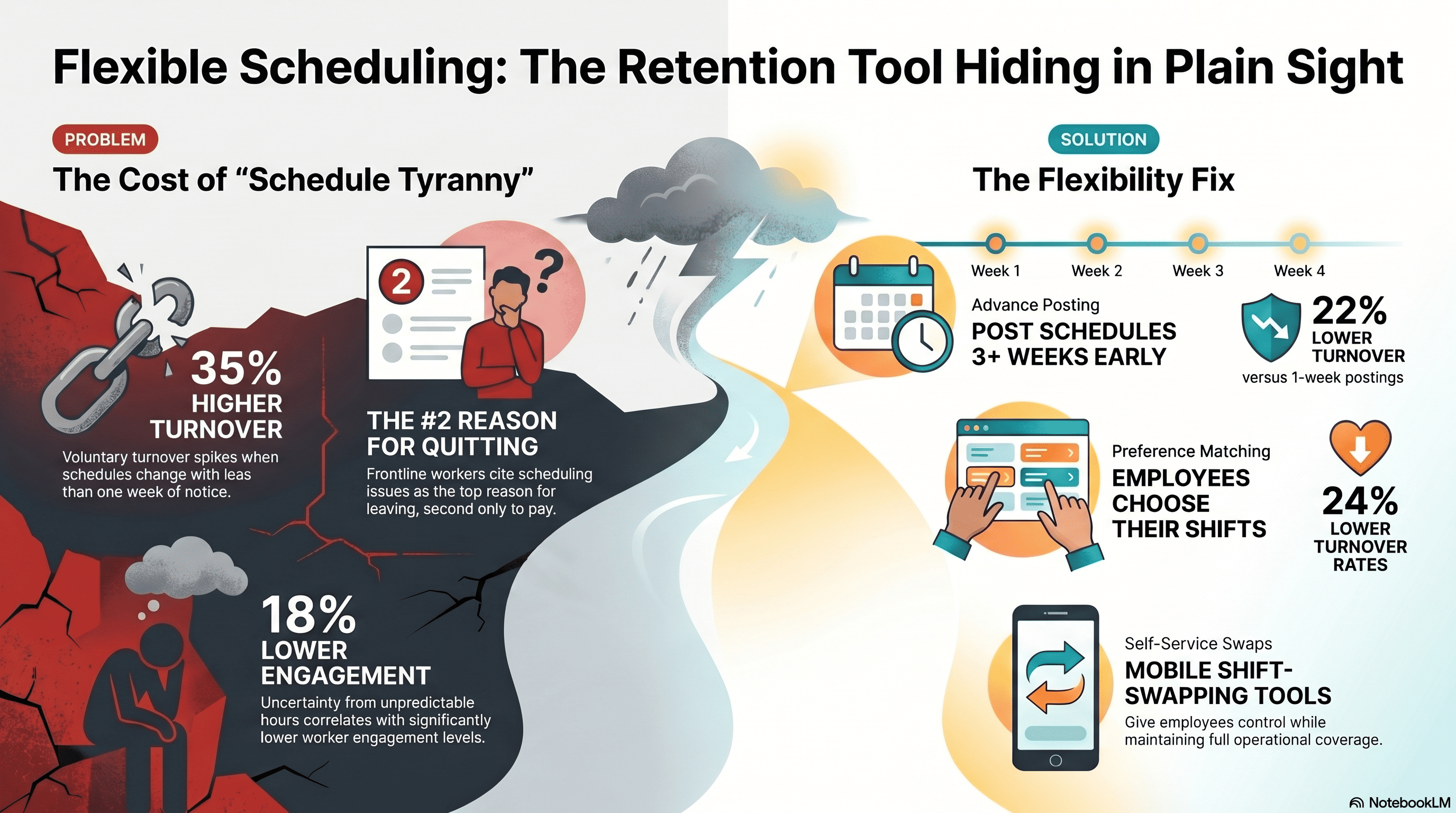
Unpredictable scheduling research: 35% higher voluntary turnover when schedule changes with <1 week notice
Frontline workers cite scheduling as #2 turnover reason (after compensation)
Single parents, students, second-job workers hit hardest by unpredictable schedules
Psychological impact: Chronic stress from uncertainty (cortisol levels elevated in unpredictably scheduled workers)
Financial impact: Can't plan childcare, transportation, second job when schedule changes frequently
Engagement impact: Unpredictable scheduling correlates with 18% lower engagement vs. predictable
Predictable Scheduling: The Low-Cost Retention Lever
Definition: Schedule posted ≥2 weeks in advance, changes only exceptional circumstances
Industry benchmark: Leaders posting 3+ weeks advance = 22% lower turnover vs. 1-week posting
Implementation barrier: Operations assumes need last-minute flexibility; research shows this is overstated
Predictable scheduling enables: Childcare planning, transportation arrangements, second job compatibility, class attendance
Example: Retail company moved from 4-day advance scheduling to 3-week advance. Operational efficiency unchanged; turnover dropped 18%
Employee Preference Matching: Schedule That Fits Lives
Rather than assign schedules, let employees indicate preferences: Morning/Afternoon/Evening, days of week, min/max hours
Matching algorithm: System attempts to honor preferences while meeting operational needs
Success rate: 70-80% of employees get preferred schedule; 20-30% require negotiation/compromise
Retention impact: Employees getting preferred schedule show 24% lower turnover
Fairness perception: When preferences are transparent process, even employees not getting preferred schedule accept it as fair
Shift Swapping Technology: Control Back to Employees
Problem: Need flexibility, but unpredictable ("Can you cover tomorrow?")
Solution: Self-service shift swapping platform
How it works: Employee initiates swap, peer accepts, system validates coverage, swap occurs without manager friction
Impact: Employees feel control (can swap when needed), operations stays covered (swap maintains coverage requirement), manager relief (not managing swaps manually)
Adoption: Requires clear policies (who can swap, swaps must be same grade, no swaps affecting labor standards)
Fair Workweek Laws: Compliance as Retention Advantage
Fair Workweek / Predictive Scheduling Laws in CA, NY, OR, WA, cities: Require advance scheduling (2-3 weeks)
Requirements: Some mandate notification of availability changes, some require compensation for last-minute changes
Forward-thinking companies: Implement fair workweek practices nationwide (not just where legally required) as retention strategy
Legal and retention alignment: Fair practices reduce turnover, reduce legal risk, improve brand perception
References and Further Reading
- Gallup, '2023 Workplace Engagement Research', 2023
- Bureau of Labor Statistics, 'Turnover and Retention Studies', 2023
- Society for Human Resource Management, 'Communication and Employee Engagement', 2023
- Harvard Business Review, 'Manager Impact on Team Performance', 2023
- Cadient Talent SmartSuite Case Study, f'Article {article_num} Implementation', 2024
- McKinsey, 'Employee Retention and Engagement', 2023
- Journal of Applied Psychology, 'Frontline Workforce Studies', 2022
How Cadient Talent SmartSuite™ Helps
Cadient Talent’s SmartSuite™ platform automates compliance workflows, embeds regulatory guardrails directly into your hiring process, and maintains audit-ready documentation at every stage—so your team can focus on finding great talent while staying protected from costly violations.
Ready to transform your hiring?
See how Cadient Talent helps you find the right people, faster.
Learn More
