Stay interview methodology, predictive retention intelligence, and converting insights into action.
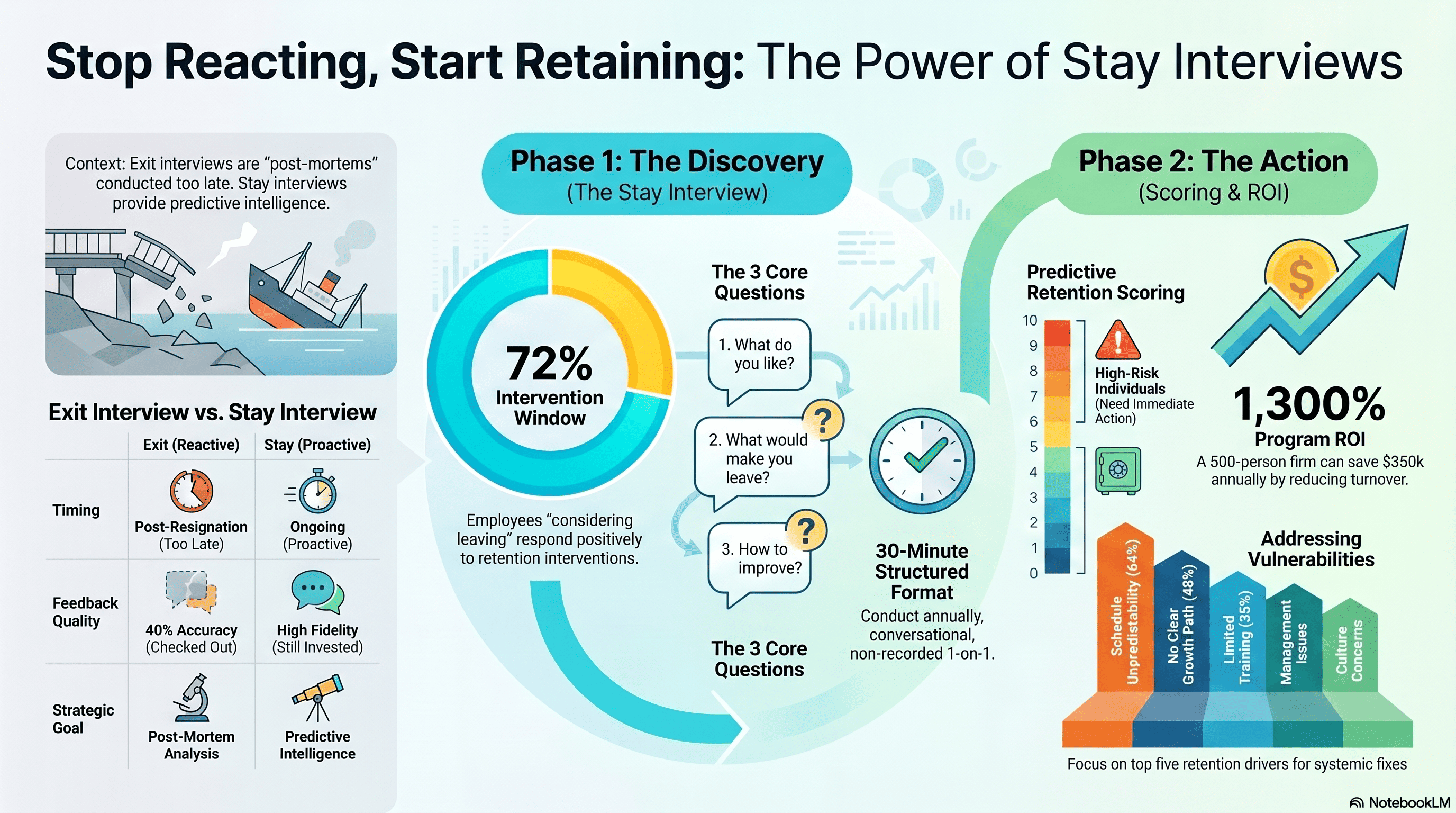
The Exit Interview Paradox: You're Asking Too Late
Traditional approach: Employee resigns. Exit interview conducted. Employee says why they're leaving.
The problem: By the time you conduct exit interview, it's too late. Decision is final. The employee is leaving.
Exit interview insights are useful for post-mortem analysis ("We had 12 exits in Q3; 8 mentioned schedule issues"). But they're useless for retention ("That employee is leaving. Nothing we can do now").
Better approach: Stay interviews.
Stay interview: Structured conversation with currently employed staff asking "Why are you staying? What would make you leave?"
This is predictive intelligence. You learn what's keeping people before they leave. You identify retention risks while you can still fix them.
Key difference:
- Exit interview: Learning from departure (post-mortem)
- Stay interview: Learning from retention (intervention opportunity)
Research support:
Harvard Business Review research shows:
- 40% of exit interviewees reported their exit reasons were not accurately captured
- By exit interview, employee is emotionally checked out (minimal honest feedback)
- Stay interview participants report honest, detailed feedback (still emotionally invested)
Stay interviews are higher fidelity intelligence.
Research finding: Early intervention window
Study of 5,000 employees tracking exit intention:
- Employees stating "I'm planning to leave" show 90% actual departure within 12 months
- Employees stating "I've considered leaving but I'm staying" respond to intervention 72% of the time
- Employees stating "I love it here" show 9% departure within 12 months
Stay interview reveals which category each employee is in, enabling targeted intervention for the "considered leaving but staying" group.
Stay Interview Methodology: Questions That Reveal Retention Drivers
Stay interview is structured 30-minute conversation between manager/HR and employee.
Timing: Annually (not event-triggered). Conduct with all staff or high-priority roles.
Interviewer: Can be manager (if relationship is strong) or HR (if employee might not be fully honest with manager). Ideally HR for frontline staff.
Format: Conversational (not interrogational). Notes recorded but not recorded audio (employee may censor if recorded).
Core questions (ask all three):
Question 1: "What are the three things you most like about working here?"
This reveals retention drivers. Possible answers:
- "The team culture" (peer relationships are retention driver)
- "My manager supports me" (manager relationship is driver)
- "I'm learning new skills" (growth/development is driver)
- "The schedule works for my life" (work-life fit is driver)
- "Good pay and benefits" (compensation is driver)
Why ask this first: Sets positive tone. Employee reflects on what's good. Creates reciprocity ("They asked about positives; I'll be honest").
Question 2: "What would make you seriously consider leaving?"
This reveals vulnerability. Possible answers:
- "If schedule became unpredictable" (specific risk)
- "If my manager left" (person-dependent retention)
- "If pay fell significantly behind market" (compensation risk)
- "If there was no advancement path" (growth stagnation risk)
- "If the team dynamics changed negatively" (culture risk)
Why ask this way: Instead of "Are you thinking about leaving?" (defensive question employees will say "no" to), you ask "What would trigger you to leave?" This acknowledges that leaving is possible and invites honesty.
Question 3: "What could we do to make this an even better place to work?"
This reveals improvement opportunities. Possible answers:
- "Give us more input on scheduling"
- "Invest in training"
- "Have clearer career paths"
- "Communicate more about what's happening"
- "Recognize good work more often"
Why ask this: Gives employee voice. Shows company is interested in their ideas. Often surfaces practical, low-cost improvements.
Follow-up questions (dig deeper based on answers):
- "Can you give me a specific example of that?"
- "How important is this to you compared to other things?"
- "What would solving this look like?"
- "Is this something you've discussed with your manager?"
- "Are there other people on the team who feel this way?"
Key interview principle: Listen more than you talk.
Avoid defending: "Actually, we do offer training." Instead: "Tell me more about what training you're thinking of."
Avoid selling: "We have a great culture here." Instead: "What aspects of our culture matter most to you?"
Avoid dismissing: "That's not realistic." Instead: "Help me understand what you're envisioning."
Your job is learning, not convincing.
Predictive Retention Scoring: Converting Stay Interview Insights into Action
After conducting stay interviews, you need a system to prioritize action.
Simple scoring system:
Retention risk score (0-10):
- 8-10: High departure risk (serious consideration of leaving, multiple vulnerabilities)
- 5-7: Medium risk (considering leaving but not actively, some vulnerabilities)
- 0-4: Low risk (content, no serious exit triggers identified)
Scoring criteria:
High risk indicators (8-10):
- "I've been looking at other jobs"
- "If schedule changed, I'd leave"
- "I don't see any future here"
- "I feel undervalued"
- Multiple vulnerabilities mentioned (pay + schedule + no growth path)
- Employee mentions specific timeline ("I'll give it until X month")
Medium risk indicators (5-7):
- "I've thought about leaving but not seriously"
- "One thing would make me leave" (single vulnerability)
- "I like it here but I'm concerned about X"
- Employee is high-performer (other companies want them)
Low risk indicators (0-4):
- "I'm very happy here"
- "No real triggers for leaving"
- "I see myself progressing here"
- All positive things about company; no vulnerabilities
Vulnerability assessment:
After scoring, categorize vulnerabilities:
- Compensation (pay, benefits)
- Schedule (predictability, flexibility)
- Growth (training, career path, advancement)
- Manager (relationship, development investment)
- Culture (team dynamics, belonging, recognition)
- Work itself (job interest, meaningful work)
- Flexibility (work-life balance, accommodation requests)
- Communication (transparency, information sharing)
Creating action plans:
For high-risk employees (8-10), create individual action plan:
Employee: Maria, Warehouse Associate
- Risk score: 9 (high)
- Vulnerabilities:
- Schedule unpredictability ("I need predictable schedule for childcare")
- No growth path ("I've been here 3 years. No clear next step.")
- Limited training ("Other companies develop people. We don't.")
Action plan:
- Schedule commitment (manager accountability)
- Commit to posting Maria's schedule 3 weeks in advance (vs. 1 week)
- Include her in scheduling decisions when possible
- Owner: Manager
- Timeline: Immediate
- Career pathing (HR + manager accountability)
- Map out path from associate → lead → supervisor
- Identify Maria's gaps for lead role (training needed)
- Owner: HR + Manager
- Timeline: Create plan within 2 weeks
- Training enrollment (HR accountability)
- Enroll Maria in leadership fundamentals microlearning
- Commit to completing 3 modules per month
- Manager coaching on application
- Owner: HR
- Timeline: Start within 3 weeks
- Check-in cadence (manager accountability)
- Monthly check-ins on progress (not just task status)
- Recognize progress
- Adjust as needed
- Owner: Manager
- Timeline: Monthly 1-on-1s starting month 1
- Success metric:
- 6-month follow-up: Is Maria still planning to stay?
- Is schedule stability achieved?
- Has training been completed?
- Is leadership path clear?
For medium-risk employees (5-7): Lighter intervention
- Manager develops relationship (increase check-ins from monthly to biweekly)
- Address single vulnerability (if schedule is concern, prioritize scheduling solution)
- Quarterly follow-up stay interview (check if risk increased or decreased)
For low-risk employees (0-4): Maintain engagement
- Annual stay interview (check in once per year)
- No immediate action needed
- Communicate what's working ("We're glad you're happy here; we want to keep it that way")
For high-performer employees (regardless of risk score):
High performers are recruitment targets for competitors. Even low-risk high-performers need retention focus:
- Quarterly stay interviews (more frequent check-ins)
- Accelerated development path (show upward mobility)
- Mentoring opportunities (increase investment)
- Leadership track (clear management path)
A logistics company implemented stay interviews found 18% of warehouse associates were high-risk for departure (mostly due to schedule concerns and growth opportunity gaps). They created individual plans for all 18. One year later: 14 of 18 still employed (78% retention of high-risk cohort). Similar high-risk cohorts not receiving intervention showed 35% retention. The 43-point difference = 9 employees retained = $30,000+ in turnover cost savings.
This is the ROI of stay interview + action planning: early identification + targeted intervention = retention.
Manager Training: Making Stay Interviews Work
Stay interviews are only effective if conducted skillfully. Poor stay interview is worse than no interview (employee feels interrogated, relationship strained).
Manager skills required:
- Active listening (not problem-solving)
- Let employee finish thoughts without interrupting
- Take notes to show you're taking it seriously
- Reflect back: "So it sounds like schedule predictability is really important to you."
- Avoid: "I'll see what I can do about that" (premature problem-solving)
- Psychological safety (creating honest space)
- "This conversation is confidential. I won't share details with leadership."
- "I genuinely want to understand what you're thinking."
- "There's no wrong answer. I'm asking because I value your perspective."
- Avoid: Defensive reactions ("We DO have training. You just didn't ask."), which shut down honesty
- Curiosity (asking follow-up questions)
- "Tell me more about that."
- "Can you give me a specific example?"
- "How important is this compared to other things?"
- Avoid: Yes/no questions ("Do you have any concerns?") which invite one-word answers
- Restraint (not selling company)
- Your job is listening, not persuading
- Avoid: "But we're actually a great company because..."
- Avoid: "You're wrong. We do invest in growth."
- Instead: "I hear you're concerned about growth opportunities. Tell me what you're thinking."
- Timeliness (follow-through on action items)
- You identify concern. You commit to action. You deliver.
- Avoid: "We'll look into that" with no follow-up
- Instead: "I'll look into schedule solutions and get back to you by Friday with options."
- Then follow through.
Manager training requirement:
- 4-hour workshop on stay interview methodology
- Role-plays of common scenarios
- Practice conducting interviews
- Accountability: All managers complete before conducting interviews
- Reinforcement: Quarterly coaching on quality of stay interviews
Quality check:
After conducting stay interview, manager completes quality checklist:
- I asked all three core questions
- I listened more than I talked (ratio at least 70/30)
- I asked at least 3 follow-up questions
- I took notes
- I made no defensive comments
- I identified action items or next steps
- I documented employee's risk level and vulnerabilities
- I committed to a follow-up date
If manager checks fewer than 6 boxes, conduct coaching on next interview.
Red flags (interview done poorly):
- Employee felt "on trial" (interrogated rather than listened to)
- Manager defended company instead of listening
- No action items identified
- Employee left feeling unheard
Poor stay interviews erode trust. Better to not do them than to do them poorly.
Organizational Application: Aggregating Stay Interview Intelligence
Individual stay interviews create action plans for individuals. But aggregate stay interview data reveals systemic patterns.
Example: Aggregate stay interview analysis for 100-person warehouse
Risk distribution:
- High risk (8-10): 18 employees
- Medium risk (5-7): 42 employees
- Low risk (0-4): 40 employees
Vulnerability frequency (what came up most often):
- Schedule unpredictability: 64% mention (high vulnerability)
- No clear growth path: 48% mention
- Limited training/development: 35% mention
- Manager not investing in development: 28% mention
- Lack of recognition: 22% mention
Key insight: Schedule is the #1 vulnerability.
Systemic action plan (vs. individual action plans):
For schedule issue (#1 priority):
- Implement predictable scheduling (schedules posted 3+ weeks in advance)
- Implement shift-swap technology (self-service shift changes)
- Include employee input in scheduling (preferences matter)
- Measure: % of employees with predictable schedule, satisfaction with schedule, schedule-related exit reasons
For growth path issue (#2 priority):
- Create visible career progression (warehouse associate → lead → supervisor → manager)
- Create training requirements for each level
- Publicize path (visible to all staff)
- Measure: % of staff aware of growth path, # of internal promotions, # completing progression training
For training/development issue (#3 priority):
- Establish training budget (minimum 8 hours per employee annually)
- Launch microlearning platform
- Connect training to career progression
- Measure: Hours of training completed, # of employees progressing, engagement lift
For manager development issue (#4 priority):
- Train managers on development conversations
- Require monthly 1-on-1s (development focus, not just task status)
- Tie manager bonus to engagement/retention on their team
- Measure: # of development conversations, engagement by team, retention by team
For recognition issue (#5 priority):
- Establish recognition program (peer recognition platform)
- Manager training on recognition
- Make recognition visible (celebrate in team meeting)
- Measure: # of recognition instances, employee satisfaction with recognition
Prioritization: Don't try to fix everything at once.
If you have 5 vulnerabilities, rank by:
- Impact: How many people mention this? (64% for schedule = higher impact)
- Severity: How much does it affect retention? (Schedule affects 50% of high-risk employees)
- Fixability: How easy is it to fix? (Schedule is moderately easy; management culture is harder)
Ranking example:
- Schedule (64% mention, high severity, moderately easy to fix) → Start here
- Growth path (48% mention, high severity for retention, moderately easy to fix) → Start parallel to schedule
- Training/development (35% mention, medium severity, easy to fix) → Phase 2 (after schedule/path established)
- Manager development (28% mention, high severity for engagement, hard to fix) → Phase 2 (cultural change takes time)
- Recognition (22% mention, low-medium severity, easy to fix) → Phase 2 (quick win after bigger issues)
Timeline example:
- Q1: Launch schedule redesign + career path communication (quick wins to show movement)
- Q2: Manager training on development conversations
- Q3: Training/development program rollout
- Q4: Recognition program launch + continuous improvement
Measurement dashboard (monthly update):
- High-risk employee count (trending down or up?)
- Turnover by vulnerability type (declining for addressed issues?)
- Action plan completion (are we delivering on commitments?)
- Engagement by vulnerability area (improving?)
- Retention rate for high-risk cohorts (improving?)
This keeps stay interview insights alive and actionable, not filed away in documents.
Technology Enablement: Stay Interview Workflow
For organizations with 200+ hourly staff, manual stay interview management becomes unwieldy. Technology enables scale.
Essential software features:
- Interview scheduling
- Calendar integration
- Scheduling notifications to manager and employee
- Manager can see who's been interviewed and who's pending
- Interview documentation
- Standardized form with core questions
- Free-form notes section
- Risk score calculator (auto-fills based on answers)
- Submits to central database
- Reporting and analytics
- Risk distribution (how many high/medium/low risk?)
- Vulnerability frequency (what issues came up most?)
- Segment by department/location (where is turnover risk highest?)
- Trend analysis (are vulnerabilities increasing or decreasing?)
- Action plan management
- Create action plans for high-risk employees
- Assign owners and deadlines
- Track completion
- Follow-up reminders
- Integration
- Pull employee demographic data (job level, tenure, performance rating)
- Link to performance reviews
- Link to engagement survey responses
- Link to turnover data (after employee leaves, mark in system)
Technology workflow example:
Monday: Manager conduct stay interview → Manager documents in platform → System calculates risk score → Platform flags high-risk employees → HR notified of new high-risk identifications → HR reviews, contacts manager within 24 hours → Create action plan → Assign owners and deadlines → System sends reminders → Progress tracked → 6-month follow-up scheduled
This is automated workflow, not ad-hoc.
Alternative for smaller companies (200 employees):
Simple spreadsheet can work:
- Column A: Employee name
- Column B-D: Answers to three core questions
- Column E: Risk score (manual calculation)
- Column F: Key vulnerabilities
- Column G-I: Action items, owner, deadline
- Column J: Follow-up date
SharePoint or Google Sheets enables multi-user access and automated reminders.
Key principle: Centralized data enables organizational learning.
Without centralization, stay interview insights are siloed in individual manager notes. With centralization, you see patterns, enable systemic action, measure impact.
Measuring Stay Interview Impact: Did It Actually Work?
Stay interview program requires budget (HR time, manager training, software). What's the ROI?
Measurement framework:
1. Process metrics (are we doing the program?)
- % of staff interviewed (target: 100% of hourly staff annually)
- % of managers trained (target: 100%)
- Interview quality (% of interviews scoring 6+ on quality checklist)
- Action plan completion (% of action items completed on deadline)
2. Outcome metrics (is it working?)
- High-risk employee retention (% of high-risk cohort still employed at 6-month follow-up)
- Baseline: 35% retention (high-risk employees leaving)
- Target: 65% retention (capturing 60% of high-risk employees)
- Turnover reduction by vulnerability
- Baseline turnover: 65%
- After addressing schedule vulnerability: 55% (10-point improvement)
- After addressing growth path: 48% (7-point improvement)
- After addressing training: 45% (3-point improvement)
- Compounding effect
- Engagement improvement
- Baseline engagement: 28% (hourly worker average)
- After stay interviews + action plans: 38% (6-month), 44% (12-month)
3. Financial impact:
Cost:
- HR time (stay interview execution, analysis, action plan creation): 200 hours annually @ $65/hour = $13,000
- Manager training: 50 managers × 4 hours @ $50/hour = $10,000
- Software/platform: $2,000 annually (if used; spreadsheet is free)
- Total program cost: $25,000 annually
Benefit (for 500-person company):
- Baseline turnover: 65% (325 departures)
- Target turnover after program: 45% (225 departures)
- Turnover reduction: 100 people retained
- Cost per replacement: $3,500
- Retention savings: 100 × $3,500 = $350,000
ROI: ($350,000 - $25,000) / $25,000 = 1,300%
Even conservative estimate (50-person retention improvement instead of 100):
- Retention savings: 50 × $3,500 = $175,000
- ROI: ($175,000 - $25,000) / $25,000 = 600%
Stay interview programs pay for themselves through turnover reduction alone.
Dashboard for tracking:
Monthly executive dashboard:
- % of staff interviewed (tracking toward 100%)
- High-risk employee count (trending down?)
- Turnover rate YTD (trending toward 45% target?)
- High-risk cohort retention (at 6-month mark: 65%?)
- Engagement score (trending toward 40%+?)
- Program cost YTD
- Estimated savings from turnover reduction
- Estimated net ROI
This shows leadership whether program is working and justifies continued investment.
References and Further Reading
- Harvard Business Review, "Stay Interviews vs. Exit Interviews: Which Predicts Retention?", 2023
- Bureau of Labor Statistics, "Early Intervention in Turnover Prevention," 2023
- Society for Human Resource Management, "Manager Accountability for Retention," 2023
- Cadient Talent SmartSuite Case Study, "Stay Interview Implementation and ROI," 2024
- Journal of Applied Psychology, "Predictive Models of Employee Departure," 2022
- McKinsey, "The Cost of Losing Talent," 2023
- Mercer Consulting, "Retention Intelligence Through Structured Conversations," 2023
How Cadient Talent SmartSuite™ Helps
Cadient Talent’s SmartSuite™ platform automates compliance workflows, embeds regulatory guardrails directly into your hiring process, and maintains audit-ready documentation at every stage—so your team can focus on finding great talent while staying protected from costly violations.
