How job description formatting, language, and tone dramatically impact application rates
The Job Description as Marketing Copy, Not Policy
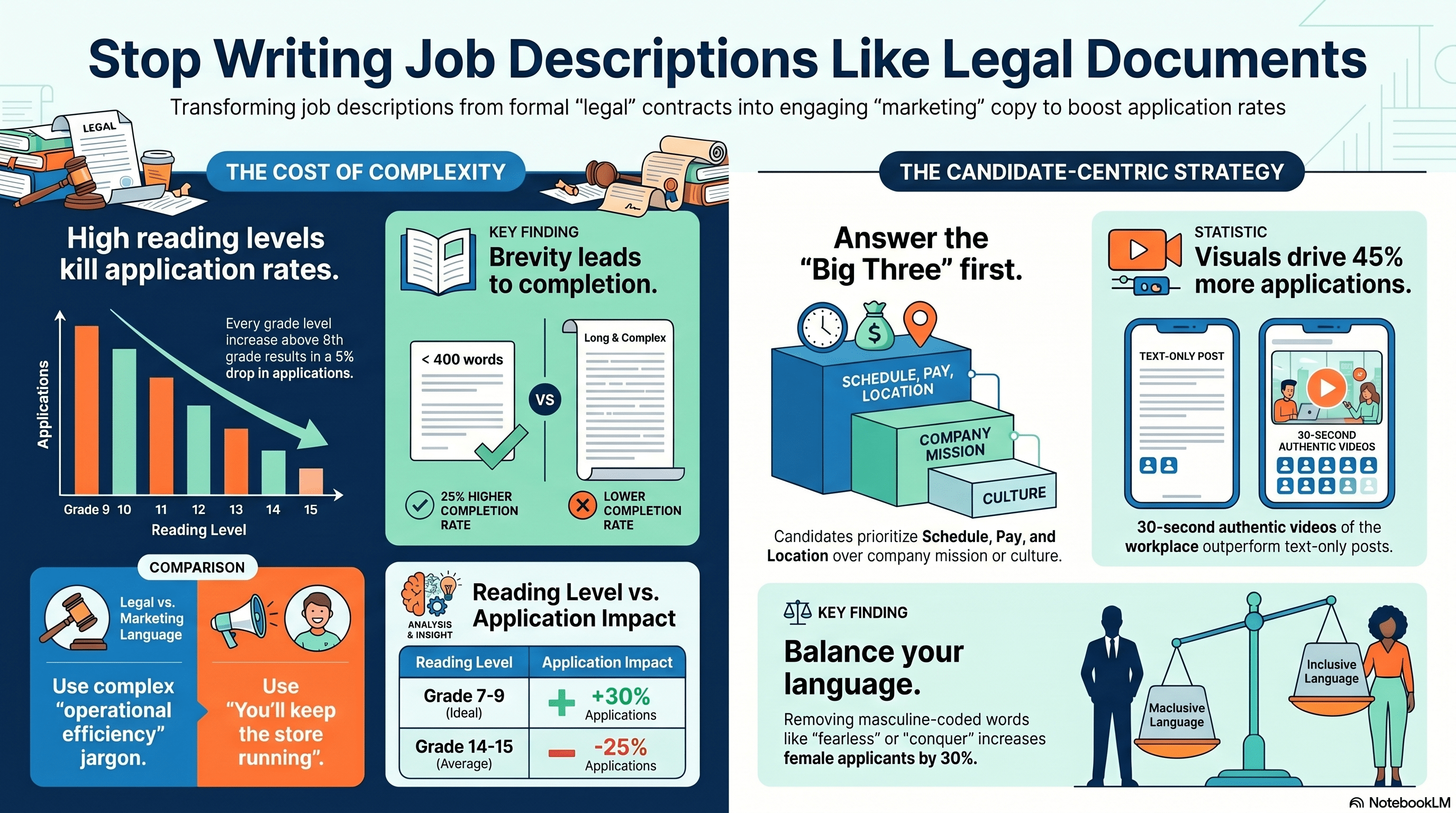
Most job descriptions are written like contracts. They're dense, formal, and designed to cover legal liability. 'Responsible for the performance of assigned duties in accordance with company policy...' This language is death for application rates.
Here's the data: Textio (2023), which analyzes job posting language using AI, found that job descriptions with high readability scores (reading level suited to high school vs. college) generate 30% more applications. Job descriptions under 400 words get 25% higher completion rates. Job descriptions with specific, tangible language ('close daily register,' 'train new team members') get 40% higher application rates than vague language ('drive results,' 'be a team player').
Why? Because candidates read job descriptions to answer one question: 'Can I do this job, and do I want to?' A legal document doesn't answer that. Marketing copy does.
Here's the distinction:
- Legal job description: Dense, formal, HR-approved language designed to defend against lawsuits.
- Marketing job description: Clear, specific, accessible language designed to make candidates excited and confident they can do the job.
You need both. The legal stuff lives in your employment contract and policy manual. The job posting should be marketing.
The Readability Crisis: Reading Level and Application Rates
Job descriptions are written at a reading level that's too high. Most are written for college-educated audiences. But many hourly candidates didn't finish college. That doesn't make them worse candidates—it means the job description is inaccessible to them.
Textio research (2023) analyzed 100,000+ job postings and found:
- Average reading level: Grade 14-15 (college level)
- Ideal reading level for maximum applications: Grade 7-9 (high school level)
- For every grade level increase above Grade 9: -5% applications
This means a job description written at Grade 14 (college) will get 25% fewer applications than the same job description written at Grade 8 (high school).
Readability isn't about 'dumbing down' content. It's about clarity. Short sentences. Simple words. Active voice. Concrete language.
How to improve readability:
Before: 'Individuals in this position will be responsible for facilitating operational efficiency through the execution of designated responsibilities while ensuring adherence to established organizational protocols and regulatory standards.'
After: 'You'll keep the store running smoothly by doing your assigned tasks on time and following company rules.'
Before uses 19 words and complex structure. After uses 16 words and simple structure. After is more concrete and more persuasive.
Textio's Readability Score measures this. Most ATS tools don't have readability built in, but you can use tools like the Flesch-Kincaid Grade Level calculator (free online) to check your job descriptions.
Rule of thumb: Write for a high school reading level. Use short sentences (under 15 words average). Use common words. Avoid jargon. Avoid passive voice ('will be accomplished' vs. 'you'll accomplish'). Test every job description for readability before posting.
What Hourly Candidates Actually Care About (And What They Don't)
Most job descriptions focus on the wrong things. They emphasize company values, mission, and long-term growth. Hourly candidates care about those things, but they care more about the basics:
What hourly candidates prioritize (in order):
- Schedule (When is my shift? How many hours? Is it flexible?)
- Pay (How much do I make?)
- Location (How close is it? Is commute reasonable?)
- Job duties (What will I actually do each day?)
- Requirements (What do I need to have/know?)
- Manager/team (Will I like working with these people?)
- Career path (Can I move up?)
- Company culture (Is this a good place?)
Most job descriptions lead with company mission, culture, or values. That's Items 8, 7, 6—the lowest priorities for hourly candidates.
Example structure rewrite:
Before (traditional):
'[Company name] is a leading retailer committed to customer excellence and team empowerment. We value innovation, integrity, and diversity. We're looking for passionate individuals to join our team...'
After (candidate-centric):
'This is a full-time retail associate position at our [location] store. Schedule: Monday-Friday 8am-5pm, 40 hours/week, overtime available. Pay: $20/hour to start. Close to [transit/parking]. You'll help customers, stock shelves, and manage the register. Must be 18+, reliable, and customer-friendly.'
The rewrite answers all 5 of the top priorities in 2 paragraphs. The original answers 1 (culture).
You can still talk about company culture and growth—just do it AFTER addressing the basics. Job candidates don't get excited about culture until they know the pay, schedule, and location.
A/B Testing Job Descriptions: The Data-Driven Approach
The best way to improve job descriptions is to A/B test them. Post two versions and measure which gets more applications.
Example test:
Version A (traditional):
'We are seeking an enthusiastic retail associate to join our dynamic team. You will provide exceptional customer service, maintain store standards, and support team initiatives. Experience preferred but not required. Competitive pay and benefits.'
Version B (candidate-centric):
'Full-time retail associate, $20/hour, 40 hours/week, Monday-Friday 8am-5pm. Help customers, stock shelves, run the register. No experience necessary—we'll train you. Paid time off after 90 days. Located [address] near [transit].'
Post Version A on Indeed and Version B on your LinkedIn career page. After 2 weeks, compare:
- Applications per posting
- Applications per day of posting
- Cost per application
- Interview invitation rate
- Hire rate
Likely result: Version B gets 30-50% more applications and better conversion (more interviews from fewer applications, because candidates are pre-qualified).
Once you have a winner (Version B), test variations of the winner:
Version B.1: Same but with focus on schedule flexibility: 'Flexible hours available—work as much as you want.'
Version B.2: Same but with focus on growth: 'Starting wage $20/hour, shift leads make $25/hour—promoted 50 people last year.'
Run 5-10 A/B tests over 6 months. You'll discover what language resonates with your candidate pool. Apply those insights to all job descriptions.
Gendered Language and Implicit Bias in Job Postings
Research from Textio and others has found that job descriptions often contain gendered language that discourages certain applicants, particularly women.
Words that skew masculine (discourage women from applying):
- 'Ambitious,' 'competitive,' 'dominant,' 'aggressive,' 'fearless,' 'conquer,' 'decisive,' 'warrior'
Words that skew feminine:
- 'Nurturing,' 'supportive,' 'collaborative,' 'warm,' 'understanding,' 'empathetic'
The mechanism: When a job description uses predominantly masculine words, women subconsciously feel it's 'not for them.' They're less likely to apply, even if they're qualified. Men may feel the same about descriptions with feminine-leaning language.
Textio's analysis of 250,000+ job postings found:
- Postings with balanced (not gender-skewed) language: No demographic application bias
- Postings skewed masculine: 20-30% fewer women applications
- Postings skewed feminine: 15-25% fewer men applications
For high-volume hiring, this is huge. If you're hiring 200 people per year and a 25% demographic skew costs you 50 applicants, that's 50 fewer qualified candidates.
How to fix gender bias:
- Audit language: Read through and highlight words with gender associations.
- Replace skewed words:
- Instead of 'ambitious,' use 'motivated'
- Instead of 'fearless,' use 'confident'
- Instead of 'nurturing,' use 'supportive of'
- Instead of 'collaborative,' use 'works with others'
- Focus on neutral descriptors: 'detail-oriented,' 'reliable,' 'organized,' 'creative,' 'analytical,' 'communicative.'
- Use Textio: If you're using Textio or similar tools, they'll flag gendered language automatically and suggest alternatives.
- Have HR review with gender lens: Before posting, ask: 'Would a woman feel welcome applying? Would a man?' If the answer is 'maybe not,' rewrite.
Mobile-First Formatting: The Majority Reads on Phone
70%+ of candidates view job postings on mobile. But most job descriptions aren't formatted for phone reading.
Problem: Dense paragraphs that look okay on desktop become walls of text on phone. Candidates bounce. No application.
Solution: Format for mobile from the start.
Mobile-friendly formatting:
- Use short paragraphs (1-3 sentences max per paragraph)
- Use bullet points instead of paragraphs when listing duties or requirements
- Avoid long lists: (10+ items max, then break into categories)
- Use headers to break up sections
- Avoid tables and complex formatting (doesn't render well on mobile)
- Lead with most important info (pay, location, schedule)
- Use white space: Lots of breathing room. Mobile screens are small.
- Test on mobile: View your job posting on your phone. Does it look good? Is the CTA ('Apply Now') obvious?
Example formatting:
Job Title: Retail Associate—[Location]
Schedule: Full-time, Monday-Friday, 8am-5pm
Pay: $20/hour
Location: 123 Main Street, [City]
What You'll Do:
- Help customers find products
- Stock shelves and displays
- Operate the cash register
- Keep store clean and organized
What We Need:
- 18 years or older
- Reliable (can commit to schedule)
- Friendly customer service attitude
- No experience necessary—we'll train
Why Join Us:
- Fair pay, paid time off
- Flexible scheduling (let us know what works for you)
- Discounts on products
- Opportunity to grow into team lead roles
[APPLY NOW button]
This format works on desktop AND mobile. It's readable. It leads with priorities. It's scannable.
The Language of Inclusivity: Who Feels Welcome?
Job descriptions can signal 'you're not for us' in subtle ways.
Example: 'This is a fast-paced environment where you need to juggle multiple priorities.' Sounds exciting? To someone with ADHD or anxiety, it sounds stressful. They may not apply.
Example: 'Must have reliable transportation.' For someone without a car or in rural area, this disqualifies them upfront.
Example: 'We're a young, energetic team.' Older candidates might feel this isn't for them.
None of these are intentionally exclusionary, but they inadvertently limit your candidate pool.
How to write inclusively:
- Use 'abled' language: Describe the job, not the person. Instead of 'Must be able to stand for 8 hours,' say 'This role involves standing most of the shift.' Let candidates self-assess.
- Avoid age-coded language: Don't use 'young,' 'energetic,' 'digital native,' 'recent grad.' Describe the role, not the ideal age.
- Check transportation assumptions: If the role truly requires reliable transportation (delivery driver), state it. If it doesn't (office worker in dense urban area), don't assume.
- Describe working environment accurately: 'Fast-paced' can be reframed as 'dynamic with regular variety' or 'structured with clear priorities.' Pick language that's accurate AND inclusive.
- Welcome diverse backgrounds: 'We encourage applications from people of all backgrounds, including people with disabilities, people of color, LGBTQ+ people, older workers, and others from underrepresented groups' signals openness.
Inclusive language expands your candidate pool. You get more diverse applicants, which statistically improves hiring outcomes and retention.
Job Description Template: How to Structure One Right
Here's a template that balances marketing, clarity, and completeness:
[TITLE]
[Location] | [Full-time/Part-time] | [Pay or 'Competitive']
[ONE-SENTENCE HOOK: Why would someone want this job?]
Example: 'Make a difference on our team while earning competitive pay and flexible schedule.'
The Role
[2-3 paragraphs, plain language, about the job]
Example: 'You'll be the face of our store. You'll help customers find what they're looking for, keep our displays looking great, and make sure our team has what they need to succeed. You'll work at the register, stock shelves, and jump in wherever needed.'
What You'll Do
[Bullet list, 5-10 items]
- Help customers and answer questions
- Stock shelves and displays
- Operate cash register
- Keep store clean and organized
- Train new team members (after 3 months)
What We Need
[Bullet list, must-haves only—not nice-to-haves]
- 18 years or older
- Available [schedule]
- Reliable and punctual
- Friendly customer service attitude
- Legal work authorization
Why You'll Love Working Here
[Bullet list, benefits and culture]
- Fair pay: $20/hour
- Paid time off after 90 days
- Employee discount on products
- Flexible scheduling within business needs
- Opportunity to grow into management
- Team that respects and supports each other
How to Apply
[Single, clear CTA]
Click 'Apply Now' below. Takes 2 minutes. Questions? Email [contact] or call [phone].
This template:
- Is scannable (headers, bullets)
- Leads with priorities (pay, location, schedule)
- Answers most common questions
- Is mobile-friendly
- Uses simple, inclusive language
- Includes a clear CTA
- Is 400-500 words (short and readable)
Use this as your starting template. Customize for each role and location. A-B test variations. Iterate.
Beyond Words: Visuals and Video in Job Postings
Some platforms now support video and image in job postings. Smart companies are using these.
Why? Because video and images convey information (and culture) faster than text.
Examples:
- 30-second video: Hiring manager says 'Here's what you'll be doing and why we love working here.'
- Store photos: Actual photo of the store, team, work environment (not stock photos).
- Day-in-the-life: Short video of actual employee doing the job.
- Employee testimonial: Current employee describes why they like working there.
Research from LinkedIn (2023) found that job postings with video get 45% more applications. Why? Because candidates get a real sense of the environment and culture without having to read dense text.
Implementation:
- Most modern job boards (Indeed, LinkedIn, Facebook Jobs) support video embedding.
- Video doesn't need to be professional/expensive: Phone video of hiring manager or employee is fine. Authenticity > production quality.
- Keep it short: 20-60 seconds. Longer and people stop watching.
- Show the actual environment: Not a studio, not stock footage. Real office/store/warehouse.
- Lead with the job: 'Here's what you'll do. Here's why it's cool. Join us.' 30 seconds.
If you're hiring 200+ people annually, invest in creating 3-4 short job postings videos. Reuse them across multiple postings. Update quarterly. The ROI is solid.
Auditing Your Job Descriptions: A Quarterly Review
Here's how to audit all your job descriptions quarterly:
Step 1: Inventory. List every job title and description you're using.
Step 2: Check readability. Use Flesch-Kincaid or similar to measure grade level. Target Grade 8-9. Anything above 10, rewrite.
Step 3: Check for gender bias. Read through. Flag gendered words. Rewrite to neutral.
Step 4: Check for inclusivity. Would someone from a different demographic feel welcome? Would an older person? Person with disability? If 'no,' rewrite.
Step 5: Check structure. Is pay listed? Location? Schedule? Are they in the first 3 sections? If not, reorganize.
Step 6: Check mobile rendering. View on your phone. Does it look good? Is the CTA clear? If not, reformat.
Step 7: Measure performance. For the last quarter, which job descriptions got the most applications? Which had the best interview-to-offer rate? Learn from winners.
Step 8: Iterate. Rewrite lowest performers. Add video if you haven't. Test variations.
Estimate time: 30 minutes to 1 hour per job description. For a company with 20 job titles, 1-2 days quarterly.
ROI: If auditing and improving job descriptions increases application volume by 20% (very achievable), and you're hiring 200 people per year at 25-to-1 ratio, you need 5,000 applications. A 20% increase = 1,000 more applications. Fewer total recruiting hours needed, lower cost per hire.
This is high-impact, relatively low-effort work. Make it a quarterly ritual.
References and Further Reading
- Textio Research. (2023). 'Language and Hiring: How Job Description Wording Affects Applications.' Analysis of 250,000+ job postings.
- Textio Insights. (2023). 'Gender Bias in Job Postings: The Data Behind Unequal Language.' Research on gendered language and demographic application rates.
- LinkedIn Talent Solutions. (2023). 'Job Description Characteristics and Application Rates.' Platform data on posting length, format, and video impact.
- HubSpot Research. (2023). 'Website Readability and Conversion Rate.' General research on reading level and user behavior.
- Flesch-Kincaid Grade Level. Standard readability metric for text.
- CareerBuilder Research. (2023). 'Job Seeker Application Behavior.' Study of how job seekers evaluate and apply to postings.
- Society for Human Resource Management (SHRM). (2023). 'Job Description Best Practices and Legal Compliance.' Guidance on writing job descriptions.
How Cadient Talent SmartSuite™ Helps
Cadient Talent’s SmartSuite™ platform automates compliance workflows, embeds regulatory guardrails directly into your hiring process, and maintains audit-ready documentation at every stage—so your team can focus on finding great talent while staying protected from costly violations.
