Comprehensive Compliance Framework for Multi-State Employers
Compliance Risk Landscape
[caption id="attachment_20920" align="alignnone" width="2752"]
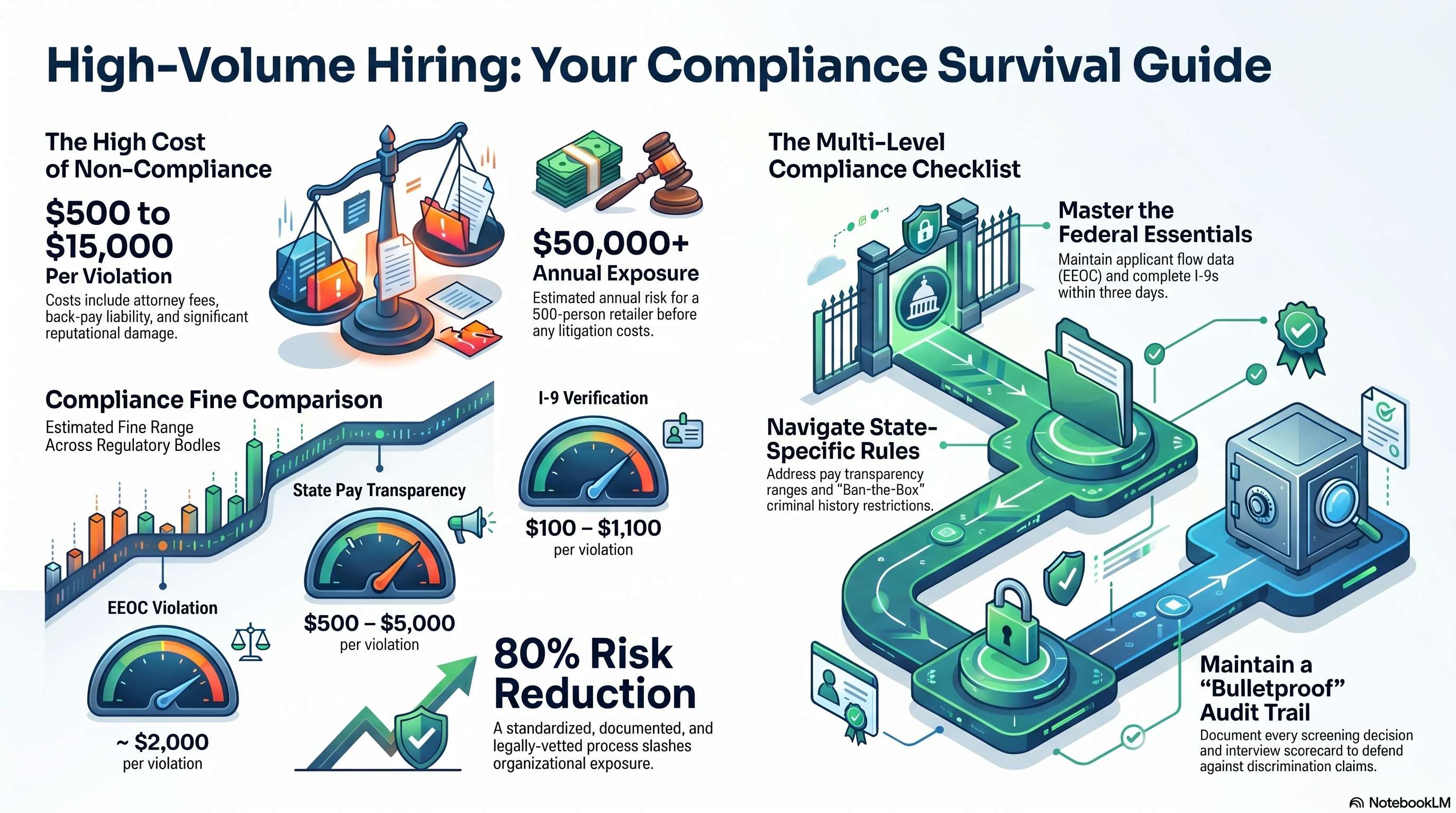
The Compliance Checklist for High-Volume Hiring[/caption]
Employers face overlapping regulations: Federal (EEOC, ADA, FCRA, I-9), State (pay transparency, ban-the-box, pay equity), Local (salary disclosure, hiring discrimination). Non-compliance costs: $500-$15,000 per violation, attorney fees, back-pay liability, reputational damage.
A 500-person retailer with 100 hires annually could face: (1) EEOC violation ($2,000 fine × multiple violations); (2) FCRA violation ($100-$1,000 per violation); (3) State pay transparency violation ($500-$5,000 per violation); (4) I-9 violation ($100-$1,000 per violation). Annual exposure: $10,000-$50,000+ before litigation.
Risk reduction: Standardized, documented, legally-vetted hiring process reduces exposure by 70-80%.
Federal Requirements Checklist
(1) EEOC Compliance: Title VII, ADA, ADEA apply to employers 15+ employees. (a) Post EEO poster in conspicuous location; (b) Maintain applicant flow data; (c) Structured, objective hiring to reduce disparate impact; (d) Document hiring decisions with justification; (e) No questions about disability, age, protected status.
(2) FCRA (Background Checks): (a) Obtain written disclosure and authorization before checking; (b) Conduct check through licensed agency; (c) Review results before adverse action; (d) Provide adverse action notice with opportunity to dispute; (e) No automatic disqualification based on criminal history (Ban-the-Box); (f) Wait period between offer and final hire.
(3) I-9 Verification: (a) Complete within 3 days of hire; (b) Request Documents establishing identity and work authorization; (c) Inspect documents in person; (d) Ensure no requests for unnecessary documents; (e) Retain I-9 for 3 years.
(4) FLSA (Wage/Hour): (a) Classify workers correctly (hourly vs. salaried); (b) Comply with minimum wage; (c) Track hours accurately; (d) Understand overtime rules by state.
State-Specific Requirements
Pay Transparency: California, New York, Colorado, Connecticut, Illinois, Maryland, Nevada, Texas, Washington require salary ranges in postings. Compliance: Post ranges for all positions in these states.
Ban-the-Box: 30+ states/cities prohibit asking about criminal history on application. Compliance: Don't ask about convictions pre-offer; explain opportunity for individualized assessment if you conduct background check.
Pay Equity: California, Illinois, others require pay equity analysis and reporting. Compliance: Audit compensation by role/demographics; document analysis; make corrections.
Right-to-Audit: Some states allow workers to audit hiring/promotion decisions. Compliance: Maintain documentation of all hiring decisions with justification.
Compliance Checklist for Hiring Managers
Pre-Hiring: (1) Define role and competencies; (2) Legal review of job description; (3) Post range if required by state; (4) Ensure posting to diverse channels.
Screening: (1) Use standardized rubric; (2) Apply same rubric to all candidates; (3) No questions about protected characteristics; (4) Document screening decisions.
Interviewing: (1) Structured questions applied to all candidates; (2) No questions about disability, age, marital status, childcare; (3) Document scoring; (4) Multiple interviewers if possible; (5) No salary history questions.
Background Check: (1) Obtain written authorization; (2) Use licensed agency; (3) Review results; (4) Provide adverse action notice if not hiring due to background.
I-9: (1) Complete on day 1; (2) Request identity documents; (3) Inspect in person; (4) No copies unless required; (5) Retain 3 years.
Offer: (1) Offer letter documents role, pay, benefits, start date; (2) Includes authorization to work statement; (3) No contingencies on reference check only (only on background check with notice/opportunity to dispute).
Onboarding: (1) Enroll in benefits within required timeline; (2) Provide required notices (wage/hour, safety, policies); (3) Training on compliance topics (anti-harassment, EEO, safety).
Documentation and Audit Trail
Every hiring decision must be documented: (1) Job posting and application materials; (2) All resumes/applications received; (3) Screening decision with reason (selected/rejected); (4) Interview scorecard with questions and ratings; (5) Background check authorization and results; (6) I-9 and documents; (7) Offer letter and acceptance; (8) Onboarding completion.
Audit trail answers: Who was selected? Why? Why not other candidates? This documentation is your defense in discrimination claims. Without it, you're relying on testimony.
Tool: ATS should maintain this documentation automatically. If not, create a hiring file for each position/candidate.
Compliance Training and Accountability
All hiring managers must: (1) Complete compliance training annually (2-3 hours) covering EEOC, ADA, FCRA, pay equity, ban-the-box; (2) Pass certification (test showing competency); (3) Participate in quarterly refreshers; (4) Have compliance audits of their hiring decisions.
Accountability: Manager compliance should be measured in performance reviews. A manager with compliance violations (even unintentional) doesn't receive high evaluation regardless of other performance.
Cost: Training $2,000-$5,000 annually for 25 managers. Value: Prevents $25,000-$50,000 in compliance fines and litigation.
Conclusion: Compliance as Risk Management
Compliance is not bureaucracy; it's risk management. A standardized, documented, legally-vetted hiring process costs minimal to maintain but saves massive downside in fines, litigation, and reputational damage. Invest in compliance discipline. Your organization will be stronger.
References and Further Reading
- EEOC: Employment Laws Guide (2024)
- FTC: FCRA Compliance Guide (2024)
- DOJ: I-9 Requirements (2024)
- State Attorneys General: Pay Transparency Laws (2024)
- SHRM: Compliance Checklist (2024)
How Cadient Talent SmartSuite™ Helps
Cadient Talent’s SmartSuite™ platform automates compliance workflows, embeds regulatory guardrails directly into your hiring process, and maintains audit-ready documentation at every stage—so your team can focus on finding great talent while staying protected from costly violations.
