
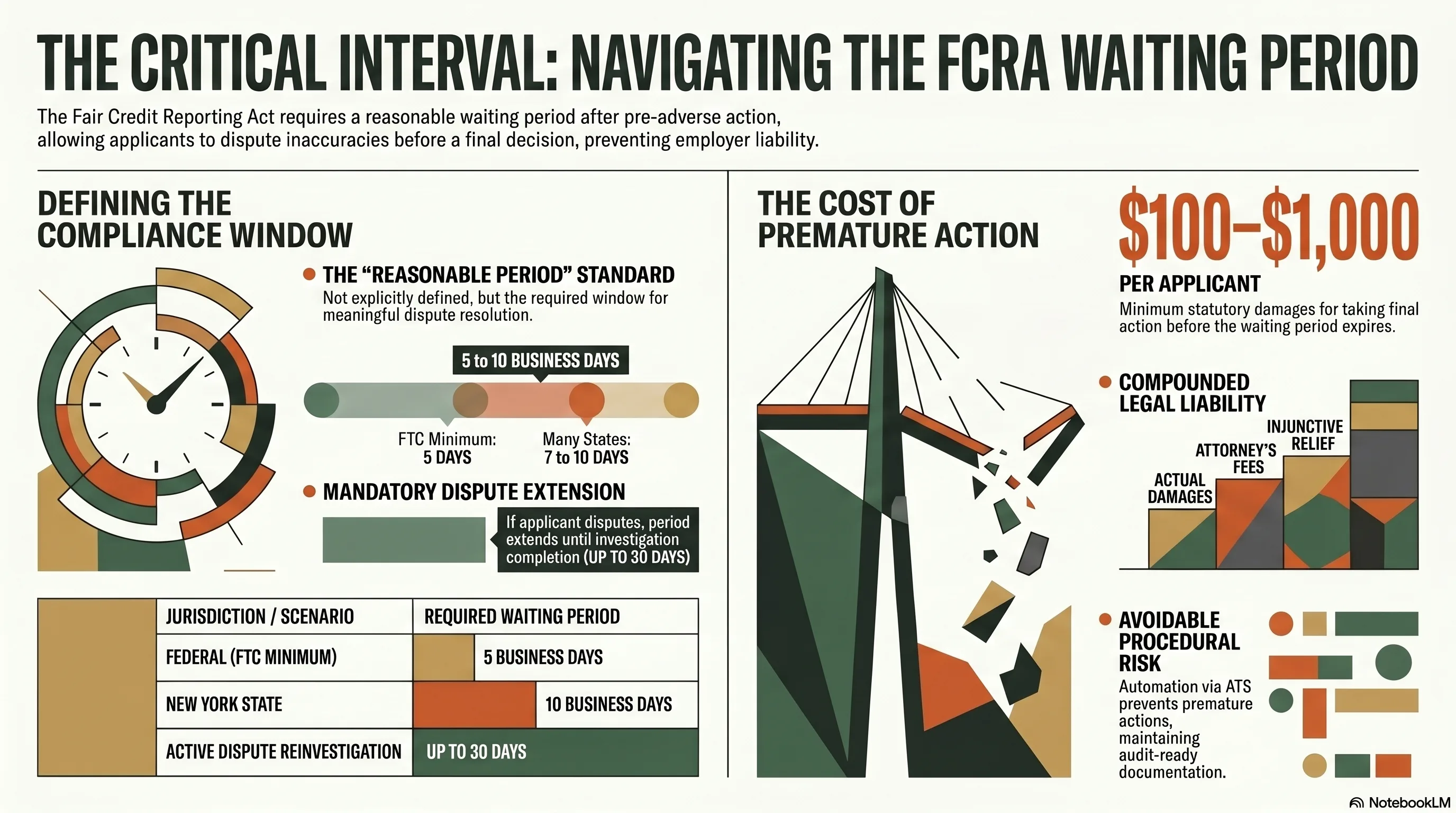
Premature adverse action during the dispute window can expose employers to statutory damages and injunctive relief preventing hiring decisions.
Executive Summary: The Waiting Period as a Foundational FCRA Right
The Fair Credit Reporting Act (FCRA) does not explicitly mandate a specific waiting period between providing an applicant with a pre-adverse action notice and finalizing an employment decision. However, 15 U.S.C. § 1681b(b)(3)(A) requires that applicants receive "disclosure of the consumer's right to dispute the accuracy or completeness of any information in a consumer report," implying a reasonable opportunity to exercise that right before a final decision is made.
This seemingly ambiguous statutory language has been interpreted by the Federal Trade Commission (FTC), courts, and state legislatures to require a "reasonable period"—commonly understood as 5 business days, with many states requiring 7-10 business days or longer if a dispute is pending. This waiting period is not merely a procedural formality; it is a fundamental substantive right that gives applicants a meaningful opportunity to prevent employment discrimination based on inaccurate information in their background report.
During the waiting period, several critical events may occur: (1) the applicant may dispute information with the consumer reporting agency, (2) the agency may investigate the disputed information, (3) the employer may receive new or corrected information, and (4) the applicant's eligibility for the position may change. Employers who prematurely take final adverse action before these events conclude expose themselves to statutory damages of $100 to $1,000 per applicant, plus actual damages, injunctive relief, and attorney's fees.
This article provides a comprehensive guide to FCRA waiting period compliance, including statutory framework, FTC guidance, dispute resolution mechanics, state-specific requirements, documentation protocols, and litigation risk analysis.
The Statutory and Regulatory Basis for a Reasonable Waiting Period
The FCRA's waiting period requirement is implied rather than explicit. 15 U.S.C. § 1681b(b)(3)(A) requires that before taking adverse action, an employer shall provide the applicant with "disclosure of the consumer's right to dispute the accuracy or completeness of any information in a consumer report furnished by the consumer reporting agency..."
The statutory language raises a threshold question: what is the purpose of disclosing a "right to dispute" if the employer takes final action before the applicant has a reasonable opportunity to exercise that right? Courts and the FTC have concluded that the statute implicitly requires a reasonable period to allow the applicant to pursue the disclosed rights.
FTC Guidance on the Reasonable Period:
The FTC has not issued a prescriptive regulation defining "reasonable period" with a specific number of days. However, FTC staff commentary (published on www.ftc.gov and in the Regulatory Section of the FCRA regulations) indicates that:
- A "reasonable period" should allow the applicant to contact the consumer reporting agency and submit a dispute regarding information in the report.
- The FTC has indicated that 5 business days is a reasonable minimum, as this allows sufficient time for an applicant to: receive and review the pre-adverse action notice, contact the consumer reporting agency, submit a dispute request, and allow the agency minimal time to log the dispute.
- If the applicant files a dispute, the reasonable period extends until the consumer reporting agency completes its reinvestigation (typically up to 30 days from the date of the dispute request) or until the dispute is otherwise resolved.
- The FTC has cautioned employers against setting artificial or short deadlines that effectively preclude meaningful dispute opportunities.
State Legislative Framework:
Many states have codified specific waiting periods in statute:
- New York requires at least 10 business days.
- California requires at least 5 business days, with extension if the applicant requests reinvestigation.
- Illinois does not specify a number of days but requires a "reasonable opportunity to respond."
- Massachusetts requires a "reasonable opportunity" without specifying days but mandates consideration of applicant responses.
- Colorado and Washington similarly require "reasonable opportunity" without numerical specificity.
For multi-state employers, the safest approach is to use the most stringent standard (10 business days, New York model) as a baseline for all applicants.
Judicial Interpretation:
Courts interpreting the waiting period requirement have emphasized:
- The waiting period is not discretionary; it is a mandatory procedural right that cannot be waived by applicants.
- The waiting period must be measured in business days (excluding weekends and federal holidays), not calendar days, giving applicants practical time to work with the consumer reporting agency during business hours.
- If an applicant files a dispute during the waiting period, the employer's obligation to wait extends until the dispute is resolved, even if this extends the period beyond the initial 5-10 business days.
- The waiting period cannot be shortened or eliminated based on operational pressures or urgent hiring needs. Courts have rejected employer arguments that waiting periods inconvenience the hiring timeline.
Consequence: Employers who take final adverse action before a reasonable waiting period expires, or who take adverse action while a pending dispute remains unresolved, violate the FCRA and expose themselves to statutory damages and potential injunctive relief preventing the adverse hiring decision.
When Does the Clock Start? Trigger Events and Calculation Methods
A frequent source of litigation is disagreement over when the waiting period begins. The FCRA does not specify, but guidance and case law establish these principles:
**Trigger Event 1: Receipt of Pre-Adverse Action Notice by Applicant**
The waiting period begins when the applicant receives the pre-adverse action notice, not when the employer sends it. This distinction matters significantly. If an employer sends a notice via email but the applicant does not check email for several days, does the waiting period begin on the date sent or the date opened?
Practical Standard: Most employers and courts use the following approach:
- If the notice is delivered by email: The waiting period begins on the date the email is sent (as evidenced by email timestamps), or alternatively, on the date the email is opened (if the employer uses read receipt confirmation). Using email with read receipt confirmation provides clear evidence of when the applicant received the notice.
- If the notice is delivered by certified mail: The waiting period begins on the date the certified mail is delivered (as shown by the delivery receipt), not on the date mailed.
- If the notice is delivered in person: The waiting period begins on the date of personal delivery (as evidenced by a signature or witness statement).
Best Practice: Employers should require applicants to acknowledge receipt of the pre-adverse action notice in writing (via email, checkbox, or signature), creating clear documentation of when the waiting period commenced. This eliminates future disputes about the start date.
**Trigger Event 2: Multiple Notice Delivery Methods**
Some employers deliver notices via multiple methods (email and certified mail simultaneously). In this case, the waiting period should begin on the earliest date of confirmed receipt, not the latest. This protects the applicant by starting the clock earlier.
Example: An email pre-adverse action notice is sent on Monday and opened by the applicant on Tuesday. Certified mail is sent on Monday but received by the applicant on Friday. The waiting period should begin on Tuesday (email open date), not Friday (certified mail receipt date).
**Trigger Event 3: Partial Notice or Multiple Notices**
If an employer sends a pre-adverse action notice but later discovers that key information was missing (such as the consumer reporting agency's contact information), the question arises: does the applicant have a reasonable period from the incomplete notice, or only from the corrected notice?
Judicial Approach: Courts generally hold that if the initial notice is materially deficient, the waiting period begins from the date of the corrected notice, not the deficient one. This prevents employers from sending incomplete notices and claiming compliance with the waiting period on the basis of inadequate disclosures.
**Calculation in Business Days**
The waiting period is measured in business days (Monday-Friday), excluding federal holidays and certain state holidays. The calculation typically follows this method:
Example: Pre-adverse action notice delivered on Monday, April 15.
Business Day Count:
- Tuesday, April 16 = Day 1
- Wednesday, April 17 = Day 2
- Thursday, April 18 = Day 3
- Friday, April 19 = Day 4
- Monday, April 22 = Day 5 (waiting period expires)
The final adverse action notice may be sent on Tuesday, April 23 (the first business day after the waiting period expires).
If a federal holiday (such as Memorial Day) falls during the waiting period, it is excluded from the count:
Example: Pre-adverse action notice delivered on Thursday, May 23 (day before Memorial Day).
Business Day Count (excluding Memorial Day on Monday, May 27):
- Friday, May 24 = Day 1
- Tuesday, May 28 = Day 2 (Monday excluded for holiday)
- Wednesday, May 29 = Day 3
- Thursday, May 30 = Day 4
- Friday, May 31 = Day 5
Final adverse action may be sent on Monday, June 3.
**Automation and Tracking**
High-volume ATS platforms should include automated waiting period calculation that:
- Records the exact date and time the pre-adverse action notice is delivered.
- Automatically calculates the expiration date of the waiting period based on business day rules.
- Flags the application on the expiration date for manager follow-up.
- Prevents the system from allowing entry of a final adverse action before the waiting period expires (or provides a warning if attempted).
- Tracks any disputes filed during the waiting period and extends the period accordingly.
Consumer Dispute Rights During the Waiting Period
During the waiting period, applicants have substantive legal rights to dispute information in the consumer report. Understanding these rights and the employer's corresponding obligations is essential to compliant waiting period management.
**Right 1: Direct Dispute with Consumer Reporting Agency**
The applicant may contact the consumer reporting agency (such as LexisNexis, Checkr, Sterling, or GoodHire) and challenge the accuracy of any information in the report. This is called a "dispute request" or "reinvestigation request."
The consumer reporting agency then has specific obligations:
- Investigate the disputed information: The agency must contact the source of the information (e.g., the court where a criminal record is maintained, the employer who provided employment history, or the financial institution that reported credit information) and verify its accuracy.
- Reinvestigation timeline: The agency has 30 calendar days (some states require 45 days) to complete the reinvestigation, unless the applicant requests expedited investigation (which must be completed within a shorter timeframe).
- Results notification: Once the investigation is complete, the agency must notify the applicant (and may notify the employer) of the results: the information was accurate and remains in the report, the information was inaccurate and has been corrected or removed, or the investigation was inconclusive and the item remains pending.
Consumer Reporting Agency Investigation Procedure:
When a dispute is filed, the consumer reporting agency's investigation typically follows this sequence:
- Day 1-2: Agency receives dispute request from applicant.
- Day 3-7: Agency contacts the source of the disputed information requesting verification.
- Day 8-25: Source responds with verification documents or indicates it cannot verify the information.
- Day 26-30: Agency notifies applicant and any relevant third parties (including the employer) of the outcome.
This 30-day process extends beyond the employer's typical 5-business-day waiting period. The critical question then becomes: must the employer wait for the full 30-day investigation to conclude before taking final adverse action?
**Right 2: Direct Dispute with Employer**
The applicant may also directly contact the employer and provide an explanation or challenge regarding information in the report. For example:
- "The reported criminal conviction is from 1995 and was expunged in 2010; enclosed is the expungement order."
- "The reported delinquent account was paid in full in 2022; enclosed is the payment confirmation."
- "The employment termination was wrongful and I am pursuing litigation; enclosed is the lawsuit filing."
Employer Obligations When Receiving Applicant Disputes:
When an applicant disputes information or provides additional information during the waiting period, the employer must:
- Acknowledge receipt: Confirm that the dispute or additional information was received and will be considered.
- Consider the dispute: Review the information provided by the applicant and evaluate whether it changes the disqualifying nature of the report information.
- Delay adverse action: Do not take final adverse action while the dispute is pending and unresolved.
- Escalate to Legal/HR: Transfer the dispute to legal or HR personnel for formal consideration, rather than allowing the hiring manager to proceed with adverse action.
- Document the dispute: Maintain a record of the dispute, the information provided by the applicant, and the resolution.
**Right 3: Extended Waiting Period if Dispute is Filed**
A critical protection: If the applicant files a dispute with the consumer reporting agency during the initial waiting period (5-10 business days), the employer's obligation to wait extends beyond the initial period until the dispute is resolved.
This extended period serves a vital function: it prevents employers from ignoring or circumventing applicants' reinvestigation requests by simply waiting out the initial notice period and taking final adverse action before the agency investigation is complete.
State-Specific Extensions:
- California: Explicitly requires that employers wait for reinvestigation to be completed before taking final adverse action if the applicant disputes the information.
- New York: Requires at least 10 business days initially, with extension if a dispute is pending.
- Massachusetts: Requires that employers not take adverse action based on information that is the subject of a pending dispute.
Example Timeline With Dispute:
Monday, April 15: Pre-adverse action notice sent; waiting period begins.
Wednesday, April 17: Applicant files dispute with consumer reporting agency, claiming criminal record was expunged.
Thursday, April 18: Applicant emails employer evidence of expungement order and requests consideration before adverse action.
Friday, April 19: Waiting period expires (5 business days), but dispute is pending.
April 20-May 9: Consumer reporting agency investigates; applicant's dispute is pending.
May 10: Agency confirms expungement and removes criminal record from report.
May 10-11: Employer receives updated report; reassesses candidate and determines that without the now-removed criminal record, the candidate qualifies for the position.
May 12: Employer issues offer of employment.
Consequence: Had the employer taken final adverse action on April 20 (the day after the initial waiting period expired), it would have denied employment based on information that was subsequently found to be inaccurate. This would constitute an FCRA violation.
This scenario illustrates the waiting period's critical function: ensuring that employment decisions are made based on accurate information, not outdated or inaccurate data.
Employer Obligations During the Waiting Period
While the applicant has rights during the waiting period, the employer also has corresponding affirmative obligations:
**Obligation 1: Maintain Application Status and Access to Information**
During the waiting period, the employer must not:
- Remove the application from the hiring pipeline or candidate pool.
- Take any action that irreversibly denies the applicant's opportunity for employment.
- Communicate to third parties (references, other employers, professional licensing boards) that the applicant was rejected.
The applicant's employment status must remain in limbo during the waiting period. This creates operational complexity for employers managing large application volumes, but FCRA compliance requires it.
**Obligation 2: Provide Clear Communication of Waiting Period and Dispute Mechanism**
The pre-adverse action notice must clearly explain to the applicant how to dispute information and must provide specific instructions:
- Name and contact information for the consumer reporting agency
- Website where disputes can be filed (typically the agency's website)
- Phone number and mailing address for disputes
- Explicit statement of how long the applicant has to dispute (5-10 business days)
- Statement that the employer will not take final action until the waiting period expires
Many applicants do not understand how to file a dispute with a consumer reporting agency. Best practice is to provide step-by-step instructions or a link to the agency's dispute process.
**Obligation 3: Respond Promptly to Applicant Disputes**
If the applicant files a dispute with the employer (rather than directly with the consumer reporting agency), the employer must:
- Acknowledge receipt within 2-3 business days.
- Review the information provided by the applicant.
- If the applicant's information is relevant, request an updated report from the consumer reporting agency or conduct internal verification.
- Respond to the applicant within 7-10 business days with a determination of whether the dispute changes the employment decision.
**Obligation 4: Manage Multiple Disqualifying Factors**
Sometimes, the consumer report contains multiple disqualifying factors. If the applicant disputes one factor, the employer must determine whether the other factors alone are sufficient to justify adverse action.
Example: An applicant's report shows: (1) criminal conviction in 2015, (2) credit score of 580 (below the employer's threshold), and (3) employment gap unexplained. The applicant disputes the criminal conviction, submitting evidence of expungement.
The employer's obligation: Determine whether, even with the criminal conviction removed, the credit score and employment gap alone justify adverse action. If the credit score and gap are independently sufficient grounds, the employer may take adverse action. If not, the employer must wait for the criminal conviction dispute to be resolved.
This multi-factor analysis requires documented decision-making that clearly articulates which factors are disqualifying and whether any single factor alone would justify rejection.
**Obligation 5: Document All Disputes and Responses**
The employer must maintain comprehensive records of:
- Any disputes filed by the applicant (whether with the employer or with the consumer reporting agency).
- The date the dispute was filed and received.
- What information the applicant provided in support of the dispute.
- How the employer responded to the dispute.
- When the dispute was resolved and what the resolution was.
- Whether the resolution changed the employer's adverse action decision.
This documentation is critical in litigation. If an applicant sues claiming the employer took adverse action while a dispute was pending, the documentation demonstrates whether the employer complied with waiting period obligations.
Penalties for Premature Adverse Action and Dispute Mishandling
Violations of FCRA waiting period requirements carry significant penalties:
**Statutory Damages**
The FCRA provides for statutory damages of $100 to $1,000 per violation. Each applicant who is subject to adverse action taken in violation of waiting period requirements constitutes a separate violation. For a company that processes 1,000 applications per month and takes adverse action on 200 applicants, a systematic waiting period violation affects 200 applicants and creates potential liability of $20,000,000 to $200,000,000 in statutory damages alone.
**Actual Damages**
In addition to statutory damages, applicants may recover:
- Lost wages from the position they were denied.
- Benefits (health insurance, retirement contributions) they would have received.
- Emotional distress damages (if awarded under state law).
- Credit card interest on disputed items if the applicant's credit was damaged.
In employment contexts, actual damages are often substantial. An applicant denied a $75,000/year position and forced to accept a $50,000/year job elsewhere may claim $25,000/year in actual damages, multiplied across several years of continuing consequences.
**Attorney's Fees and Costs**
The FCRA allows prevailing applicants to recover attorney's fees and litigation costs. In complex litigation spanning 2-3 years, attorney's fees commonly reach $500,000 to $3,000,000, particularly in class action settings.
**Injunctive Relief**
Courts may issue injunctive orders requiring employers to:
- Reinstate or hire the applicant who was wrongfully denied employment.
- Refrain from using defective adverse action processes.
- Implement new policies and procedures subject to court approval.
- Submit to independent auditing of FCRA compliance.
Reinstatement or hiring injunctions are particularly damaging as they may require a company to hire an applicant years after the initial rejection, disrupting workplace dynamics and creating potential performance issues.
**Class Action Exposure**
Because waiting period violations typically affect all applicants receiving adverse action over a period of time (weeks, months, or years), class action litigation is common. A single class action can encompass 500-5,000+ applicants, multiplying damages exposure accordingly.
Example Calculations:
Scenario 1 (Small Company):
- Company receives 3,000 applications per year.
- 15% (450) undergo background checks.
- 20% of those (90) receive adverse action notices.
- All adverse action notices fail to provide an adequate waiting period.
- Statutory damages exposure: 90 applicants × 2 violations (inadequate notice + premature action) × $100-$1,000 = $18,000 to $180,000.
- Attorney's fees: $150,000 to $400,000.
- Actual damages: $5,000 to $50,000 per applicant = $450,000 to $4,500,000.
- Total exposure: $618,000 to $5,080,000 per year.
Scenario 2 (Large Company):
- Company receives 50,000 applications per year.
- 30% (15,000) undergo background checks.
- 10% of those (1,500) receive adverse action notices.
- All adverse action notices contain waiting period violations.
- Statutory damages exposure: 1,500 applicants × 2-3 violations × $100-$1,000 = $300,000 to $4,500,000.
- Attorney's fees: $2,000,000 to $7,000,000.
- Actual damages: $300,000,000 to $3,000,000,000 (if each applicant claims $200,000 to $2,000,000 in actual damages).
- Total exposure: $302,300,000 to $3,011,500,000.
Recent litigation demonstrates that large companies face exposure in the billions of dollars range if systematic FCRA violations are discovered.
**Regulatory Enforcement**
In addition to private litigation, the FTC may bring enforcement actions against employers for systematic FCRA violations. The FTC has authority to:
- Issue cease-and-desist orders requiring employers to stop the violations.
- Impose civil penalties (up to $5,000 per violation under the FTC Act).
- Require refunds or restitution to affected applicants.
- Implement corrective advertising or public disclosure of violations.
The FTC has increased its focus on FCRA enforcement in recent years, with particular attention to background check practices in high-volume hiring contexts.
Documentation Requirements and Audit Protocols
Compliant waiting period management requires detailed documentation:
**Documentation 1: Pre-Adverse Action Notice Delivery**
Retain:
- Copy of the pre-adverse action notice sent (including all required elements).
- Email timestamp or certified mail receipt showing date and time of delivery.
- Confirmation of receipt (read receipt, delivery confirmation, signature).
- The exact date the waiting period commenced.
- The calculated expiration date of the waiting period.
**Documentation 2: Dispute Log**
For each applicant, maintain a log of:
- Whether a dispute was filed (date, method).
- What information the applicant disputed.
- Evidence provided by the applicant (documents, letters, etc.).
- How the employer responded (date, method).
- When the dispute was resolved.
- What the resolution was (dispute sustained, overruled, etc.).
- How the resolution affected the adverse action decision.
**Documentation 3: Final Adverse Action Notice**
Retain:
- Copy of the final adverse action notice sent.
- Confirmation of delivery (email timestamp, certified mail receipt).
- Date the final notice was sent (should be after waiting period expiration).
- Verification that any pending disputes were resolved before the final notice was sent.
**Documentation 4: Timeline Verification**
Create a timeline document for each applicant demonstrating:
- Date pre-adverse action notice was delivered.
- Date waiting period commenced.
- Date waiting period was to expire (without disputes).
- Dates of any disputes filed and received.
- Dates of dispute investigation or resolution.
- Date final adverse action notice was sent.
- Verification that final notice was not sent until after waiting period (and dispute resolution) was complete.
**Audit Protocol**
Annual Compliance Audit:
- Sample 50-100 adverse action decisions made over the prior 12 months.
- For each decision, verify:
- Pre-adverse action notice was sent (retained in file).
- Notice was sent before final adverse action was taken.
- Waiting period was calculated correctly (5-10+ business days depending on state).
- Waiting period actually elapsed before final action was taken.
- Any disputes filed during waiting period are documented.
- Final adverse action notice was sent only after waiting period expired and disputes were resolved.
- All required elements were included in both notices (report copy, summary of rights, consumer reporting agency contact, etc.).
- If deficiencies are found in more than 5% of sampled decisions, escalate to legal counsel and conduct broader review of entire applicant population.
- If deficiencies are found, determine whether they constitute violations for which statutory damages may apply and assess potential liability.
- Implement corrective measures to address identified gaps.
**ATS System Configuration for Waiting Period Compliance**
Modern ATS platforms should be configured to:
- Require entry of the date pre-adverse action notice is sent, and automatically log it in the application record.
- Automatically calculate the waiting period expiration date based on business days (configurable for state-specific requirements).
- Display the waiting period expiration date prominently in the hiring manager's dashboard.
- Prevent or warn against entry of final adverse action before waiting period expiration (i.e., the system should not allow a hiring manager to mark a candidate as "rejected" before the waiting period ends).
- Provide a flag or alert on the waiting period expiration date reminding the manager to follow up and determine whether to send final adverse action.
- Log all disputes filed (internal or with consumer reporting agency) and escalate disputes to HR/Legal.
- Extend the waiting period automatically if a dispute is flagged, with clear notification of the new expiration date.
- Generate final adverse action notice templates with pre-filled information (applicant name, position, reason for decision) that can be reviewed and sent by HR.
- Archive all documentation (pre-adverse notice, consumer report, disputes, final notice) in the applicant's permanent record for audit and litigation support.
State-Specific Waiting Period Variations and Extended Protections
Waiting period requirements vary significantly by state:
**California: Shortest Waiting Period with Dispute Extension**
California law requires:
- Minimum 5 business days' notice before adverse action.
- If applicant disputes and requests reinvestigation, employer must wait for reinvestigation to complete (up to 30 days) before taking final adverse action.
- Explicit acknowledgment of applicant's right to dispute and reinvestigation is required in pre-adverse action notice.
Californians have experienced significant expansion of FCRA protections through legislation (AB 701, AB 375) restricting use of criminal history. Pre-adverse action notices in California must include explicit notice of these restrictions.
**New York: 10-Business-Day Minimum**
New York law requires:
- Minimum 10 business days' notice before adverse action.
- Explicit statement of applicant's right to respond or refute information in the background report.
- If applicant provides rebuttal or additional information, employer must consider it before taking final adverse action.
- Extended timeline for dispute resolution if applicant indicates intent to challenge information.
**Illinois: Reasonable Opportunity Standard**
Illinois requires:
- "Reasonable opportunity" to respond to background information (no specific number of days).
- Courts have interpreted this as 5-7 business days in practice.
- Detailed record-keeping requirements; employers must document when notices were provided and when responses were received.
**Massachusetts: Criminal History Restrictions**
Massachusetts requires:
- "Reasonable opportunity" to respond before adverse action based on criminal history.
- Explicit notice that criminal record cannot be considered unless conviction determination rendered or substantial business necessity shown.
- If applicant indicates intent to challenge criminal record or provide context (e.g., rehabilitation evidence), employer must wait for applicant's response.
- Extended protections for youthful offender records and misdemeanor convictions.
**Colorado: Reinvestigation Protection**
Colorado requires:
- Reasonable waiting period (typically 5-7 business days).
- If applicant files dispute, employer must allow full reinvestigation by consumer reporting agency (up to 30 days).
- Employer must also allow applicant to submit written statement explaining or contextualizing information in the report.
**Washington: Criminal History Priority**
Washington requires:
- Reasonable waiting period before adverse action based on criminal history.
- Explicit notice that employer cannot consider certain classes of criminal records (e.g., records that have been sealed, expunged, or are subject to protection).
- If applicant disputes classification of record (e.g., contends it was expunged), employer must obtain clarification before taking adverse action.
**Multi-State Compliance Strategy**
For employers recruiting across multiple states, implement the most protective standard:
- Use 10 business days as the minimum waiting period (New York standard).
- Automatically extend the period if any dispute is filed, until the dispute is resolved (California standard).
- Include explicit notice of state-specific criminal history protections (Massachusetts/Washington standard).
- Maintain detailed documentation of all communications, disputes, and timeline calculations.
- Train HR and hiring managers on state-specific variations so they understand why the waiting period may extend beyond the initial notification in certain cases.
- Consult employment counsel in each state to verify compliance with local requirements.
Practical Waiting Period Management: Timing, Dispute Resolution, and Best Practices
Managing the waiting period effectively requires coordination among multiple functions within the employer organization:
**Phase 1: Pre-Adverse Action Notice Issuance**
Date: Day 0
Responsible Party: HR/Recruiting
Actions:
- Background check report received showing disqualifying information.
- Hiring manager flags application for adverse action decision.
- HR generates pre-adverse action notice including all required elements.
- Notice is sent via email (with read receipt) and certified mail simultaneously.
- ATS system records the date and time of notice delivery.
- HR confirms receipt with applicant and calculates waiting period expiration date.
**Phase 2: Waiting Period (Dispute Opportunity)**
Dates: Day 1-5 (or Day 1-10 depending on state)
Responsible Party: HR and Applicant
During this period:
- Applicant reviews the notice and consumer report.
- Applicant may contact consumer reporting agency to dispute information.
- Applicant may contact employer directly to provide explanation or additional information.
- Consumer reporting agency may initiate reinvestigation (30-day timeline).
- HR monitors for any disputes filed and escalates to legal if needed.
Employer Actions During Waiting Period:
- Do not communicate final rejection to applicant.
- Maintain application status as "pending final decision."
- Log any dispute communications from applicant.
- If applicant provides information challenging the disqualifying factor, escalate to legal for evaluation of whether the decision must be modified.
- Do not proceed with final hire of other candidate for the same position (if possible); keep option open that disqualifying applicant may ultimately qualify.
**Phase 3: Dispute Resolution (if applicable)**
Dates: Day 6-35 (if dispute filed; disputes may take up to 30 days to resolve)
Responsible Party: HR/Legal, Applicant, Consumer Reporting Agency
If no dispute is filed during Phase 2:
- Proceed directly to Phase 4 (Final Adverse Action Notice).
If dispute is filed:
- Applicant's dispute with consumer reporting agency is logged and tracked.
- Consumer reporting agency investigates the disputed information.
- Applicant may provide supporting documents to employer (e.g., expungement order, proof of payment, corrected credit report).
- HR evaluates whether applicant's information changes the adverse action decision.
- Consumer reporting agency issues results of investigation (approximately 30 days from dispute filing).
- Employer receives updated consumer report (if information was corrected or removed).
- Employer reassesses applicant's qualification and makes determination: proceed with adverse action, or withdraw adverse action and make offer if the applicant now qualifies.
**Phase 4: Final Adverse Action Notice**
Date: Day 6+ (minimum Day 6; later if disputes are pending)
Responsible Party: HR/Legal
Actions:
- Only after waiting period expires (and disputes are resolved) can final adverse action notice be sent.
- Final notice includes: clear statement of adverse action, specific information from report that triggered decision, consumer reporting agency contact information, right to challenge the decision, and FTC contact information.
- Final notice is sent via email and/or certified mail with proof of receipt.
- ATS system records final notice delivery.
- Application is marked "rejected" or "not selected."
- Applicant may now be notified that the position is no longer available or has been filled.
**Timeline Example: No Dispute**
Monday, April 15: Background report received; disqualifying criminal conviction identified.
Monday, April 15, 2:00 PM: Pre-adverse action notice sent via email and certified mail.
Tuesday, April 16: Email read receipt confirmed.
April 16-20: Waiting period (5 business days).
Friday, April 20: Waiting period expires; no disputes filed by applicant.
Monday, April 23: Final adverse action notice sent.
Tuesday, April 24: Applicant receives notice via certified mail.
**Timeline Example: Dispute Filed**
Monday, April 15: Background report received; disqualifying criminal conviction identified.
Monday, April 15, 2:00 PM: Pre-adverse action notice sent via email and certified mail.
Tuesday, April 16: Email read receipt confirmed; waiting period begins.
Thursday, April 18: Applicant emails employer claiming criminal record was expunged; includes copy of expungement order. Dispute triggers extended waiting period.
Thursday, April 18: HR escalates to Legal; Legal reviews expungement order.
Thursday, April 18: HR contacts consumer reporting agency to verify whether expungement is reflected in their records.
Friday, April 19: Consumer reporting agency confirms they will investigate the expungement claim.
April 20-May 9: Agency investigation period (30 days from dispute filing).
May 10: Consumer reporting agency confirms expungement and removes criminal conviction from applicant's report.
May 10: HR receives updated report; Legal reassesses applicant's qualification.
May 11: Legal notifies HR that applicant now qualifies; adverse action decision withdrawn.
May 12: Employer issues offer of employment.
May 13: Applicant accepts offer.
In this scenario, the extended waiting period allowed the applicant's dispute to be resolved, resulting in withdrawal of the adverse action and extension of an offer.
**Best Practices Summary**
- Use 10 business days minimum as waiting period (rather than the federal 5-day minimum).
- Require written acknowledgment of receipt of pre-adverse action notice.
- Provide clear, step-by-step instructions for filing disputes.
- Monitor for disputes during waiting period and escalate immediately to HR/Legal.
- Document all communications and timeline tracking.
- Extend waiting period automatically if disputes are pending.
- Reassess qualification if applicant disputes disqualifying information.
- Do not take final adverse action unless and until waiting period expires and disputes are resolved.
- Train hiring managers on waiting period protocols and why adverse action cannot be expedited.
- Use ATS automation to track timelines and prevent premature adverse action.
References and Further Reading
- 15 U.S.C. § 1681b(b)(3)(A) - FCRA Adverse Action Requirement and Reasonable Period
- 15 U.S.C. § 1681i - FCRA Consumer Dispute Procedures
- FTC Guidance on Reasonable Period for Dispute Resolution - www.ftc.gov/FCRA
- 16 CFR Part 600.8 - FTC Regulations on Adverse Action Procedures
- FTC Regulatory Section Comment on Reasonable Period (FCRA Commentary)
- New York General Business Law Section 380-l - 10-Business-Day Requirement
- California Labor Code Section 432.7 and Assembly Bill 701 - Criminal History Protections
- California Code of Civil Procedure Section 1050 - Dispute Rights in Background Checks
- Illinois FCRA, 50 Ill. Adm. Code 907 - State Adverse Action Requirements
- Massachusetts Consumer Report Law, Mass. Gen. Laws c. 149, § 24L
- Colorado Consumer Reporting Agencies Act, Colo. Rev. Stat. § 12-14.3-101 et seq.
- Washington Consumer Report Law, Rev. Code § 19.255.010 - Criminal History Restrictions
- FTC Staff Commentary on Consumer Report Reinvestigation Procedures
- EEOC Guidance on Background Checks and Hiring Decisions - eeoc.gov
- Ramirez v. TransUnion LLC, 141 S. Ct. 2190 (2021) - Standing to Sue for Statutory Violations
- Spokeo, Inc. v. Robins, 578 U.S. 330 (2016) - Concrete Injury Requirement in FCRA Claims
How Cadient Talent SmartSuite™ Helps
Cadient Talent’s SmartSuite™ platform automates compliance workflows, embeds regulatory guardrails directly into your hiring process, and maintains audit-ready documentation at every stage—so your team can focus on finding great talent while staying protected from costly violations.