Structure the critical first quarter to prevent 30% of new hires from quitting.
Why the First 90 Days Matter More Than Recruitment
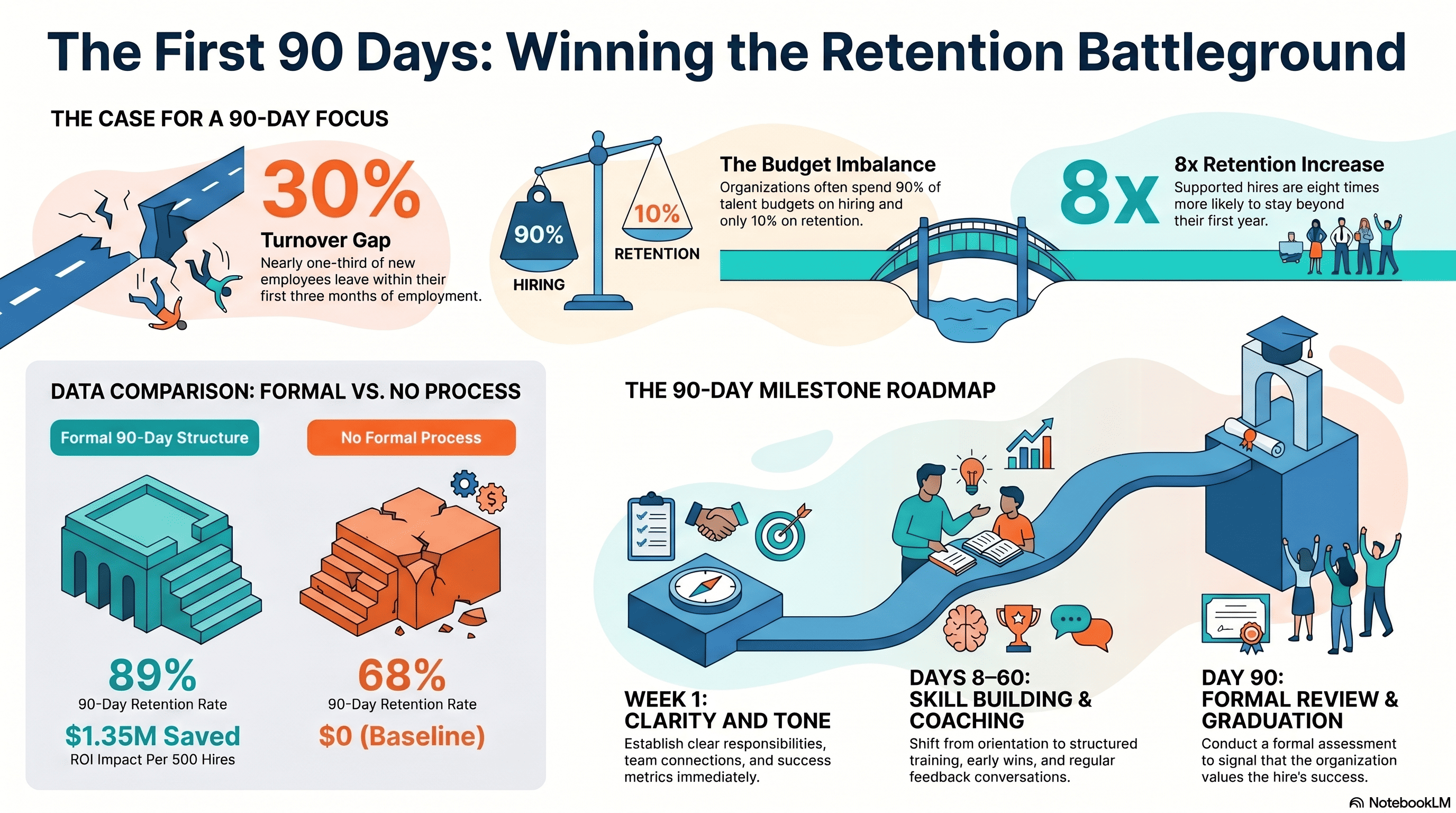
Nearly 30% of new employees leave in their first 90 days. This figure is consistent across retail, hospitality, logistics, and healthcare. If you hire 100 people, 30 will be gone within three months. You've paid recruiting costs, conducted training, and invested manager time—all for hires who don't stick.
Yet most organizations focus all their energy on recruiting better and onboarding faster. They spend 90% of talent budget on the hiring process (sourcing, screening, interviewing) and 10% on the first three months after hire. The allocation is backwards.
Research from the Center for American Progress shows that the first 90 days are the critical period where new hires form lasting opinions about the organization, their job fit, and their commitment. Hires who feel supported, clear on expectations, and connected to the team in the first 90 days are 8x more likely to stay beyond year one.
The inverse: hires who have confusing onboarding, unclear expectations, or poor manager interaction in the first 90 days are primed to leave. When a recruiter from a competitor calls in month four, they're receptive.
The 90-Day Framework: Milestone-Based Progression
Week 1: Orientation and Role Clarity
Day one and the first week set the emotional tone. The hire should understand: what their primary responsibilities are, who their immediate team is, where their tools and resources are, and how success is measured. This clarity should be documented and signed off by the manager. Many organizations fail here—the new hire's first week is a blur of meetings without clear takeaways.
Days 8-30: Skill Building and Integration
The first month should include structured training (if needed), early wins (small tasks the hire can accomplish successfully), and structured team integration. Manager should have 2-3 one-on-one check-ins focused on questions like: 'What's confusing?' 'What's going well?' 'What support do you need?' Not all about task completion—also about belonging.
Days 31-60: Increased Autonomy and Feedback
By day 31, the hire should be demonstrating baseline competency in core job functions. The second month should include a structured feedback conversation: what's the hire doing well? where does improvement need? how are they feeling? This is not a formal review; it's a coaching conversation. Hires report that managerial feedback in this period dramatically impacts their sense of progress.
Days 61-90: Performance Assessment and Onboarding Completion
The final 30 days should include a formal 90-day review: is the hire meeting role expectations? are there training gaps? what's the plan for quarter two? This signals that the organization takes new-hire success seriously. Hires who complete a structured 90-day review are 3x more likely to be retained beyond year one, even if the review identifies gaps (because it shows structure and support, not judgment).
Early Warning Indicators: Spotting Flight Risk
Some hires are exit-bound by week 2. Organizations miss the signals because they're not tracking early indicators.
Warning signs include:
Disengagement: The hire who was enthusiastic on day one is quiet by week two. They're not asking questions, not proposing ideas, not socializing. This suggests they're already mentally left.
Repeated schedule conflicts: The hire who misses early training sessions, calls out sick often, or shows up late to early shifts. Frontline research shows this pattern often precedes resignation.
Manager disconnect: The hire rarely interacts with their manager, doesn't receive clear feedback, and is left to figure things out alone. Many managers assume 'leave them alone unless there's a problem.' This creates flight risk.
Unresolved onboarding friction: The hire is unclear on basic processes (how to submit time, where to find information, who to ask for help) into week three. This sustained confusion drives departure.
Managers should track these signals and have a coaching conversation if any pattern emerges. The goal isn't to confront; it's to surface and resolve blockers: 'I noticed you seemed unsure about the scheduling system. Let me walk you through it.'
Structured Check-In Cadence
A formal check-in schedule prevents information gaps and ensures early interventions. Here's a minimalist cadence:
Day 3: Quick pulse check (15 min, manager + hire): How's day one and two been? Any immediate blockers?
Day 10: First real one-on-one (30 min): Role clarity, questions, team fit, support needs.
Day 30: Month-one reflection (30 min): What's going well? What's hard? Feedback on both sides.
Day 60: Mid-quarter review (30 min): Performance against expectations, skill development, any issues?
Day 90: Formal 90-day review (45 min): Overall assessment, quarter-two expectations, retention conversation.
All check-ins should be documented in a simple template (ATS or HRIS). This creates accountability and ensures nothing falls through cracks.
For high-volume operations, managers often resist structured check-ins ('I don't have time to meet with every new hire every week'). Frame it differently: structured check-ins take 2 hours per quarter per new hire. Turnover due to poor onboarding costs 20+ hours of recruiting, training, and coverage per lost hire. The check-ins are a time investment that prevents larger time loss.
Use technology to scale: A brief check-in template in your HRIS or ATS ensures consistency and reduces documentation time. Pulse surveys (2-minute, automated) between manager conversations provide real-time signals.
Connecting Onboarding Quality to Retention Metrics
Organizations often silo onboarding and retention as separate functions. In reality, they're directly linked.
Track this correlation: segment your new-hire cohorts by onboarding quality (or use binary: formal 90-day process vs. no process). Then measure 30-day, 60-day, and 90-day retention rates for each cohort.
Example data from a 500-hire cohort:
- Cohort with formal 90-day structure: 89% retained at 90 days
- Cohort without formal process: 68% retained at 90 days
- Difference: 21 percentage points = 105 additional hires retained
This 21-point difference translates directly to dollars: 105 hires × $12,876 turnover cost = $1.35M impact. Compare that to the cost of structured 90-day onboarding (manager time, systems, documentation) and the ROI becomes obvious.
Report this correlation quarterly to leadership. Show that 'improving our 90-day onboarding process will retain an additional 100+ hires per year, worth $1.3M+ in avoided turnover.' This frames onboarding as a business initiative, not a back-office HR task.
Role-Specific Onboarding Tracks
A generic 90-day process doesn't work across all roles. Customize tracks:
Hourly frontline roles (retail associate, warehouse worker, kitchen staff): Focus on operational clarity, quick competency, team integration. 90 days is realistic for full productivity.
Supervisory roles: Extend to 120 days. Add mentorship components, involve their manager's manager, include cross-functional introductions.
Seasonal hires (peak hiring period): Compress to 30 days if temporary. Focus on immediate competency. If converting to permanent, extend to full 90-day process.
Remote/distributed hires: Add structured virtual team building, more frequent manager check-ins (asynchronous + synchronous), video introductions to team.
Each track shares the core framework (day 1 clarity, day 30 feedback, day 90 review) but adjusts depth and focus.
Manager Training on First 90 Days
The first 90 days live or die with managers. Yet most organizations don't train managers on the framework.
Minimal manager training should cover:
Goal: what you're trying to achieve with structured 90-day onboarding (retention, faster productivity, belonging)
Framework: what the four phases look like, what happens in each
Check-in skills: how to conduct productive one-on-ones (ask questions, listen, offer support)
Documentation: what needs to be recorded and where
Red flags: what warning signs suggest a hire is at risk
Escalation: when and how to involve HR or senior leadership if issues emerge
Delivery: 60-minute virtual training, repeated quarterly (for new managers). Include a worksheet or template that managers can reference. Make it practical, not theoretical.
Tractable: once trained, a manager can run the 90-day process with minimal HR overhead.
Technology Enablement for 90-Day Tracking
Manual 90-day processes collapse at scale. Use technology to systematize:
HRIS onboarding workflow: Auto-schedule check-in reminders for managers
Check-in template: Manager clicks a link, fills in a 5-minute form, submits. Triggers next phase.
Pulse surveys: Automated 2-minute surveys sent to new hires at days 10, 30, 60, 90. Questions: 'How clear are your role expectations?' 'How connected do you feel to your team?' Responses flag flight risk.
Manager dashboard: Aggregated view of all new hires and their 90-day status. Green = on track, Yellow = at risk, Red = intervention needed.
Retention prediction: Using early signals (check-in feedback, pulse survey responses), model which hires are at risk of leaving. Flag for proactive manager outreach.
SmartSuite includes all of these; alternative HRIS systems have onboarding modules with similar capabilities.
How Cadient Talent SmartSuite Helps
SmartSuite's onboarding module includes the complete 90-day framework: templated check-in guides, automated scheduling of milestones, pulse survey integration, manager dashboards, and flight-risk prediction. Managers see a single view of all new hires and their progress. Documentation is automatic. Integration with your HRIS ensures seamless data flow.
References and Further Reading
- Center for American Progress, 'The True Cost of Employee Turnover' (2023)
- BambooHR, 'The State of Onboarding' (2024)
- SHRM, 'Onboarding and Retention Research' (2023)
- Gallup, 'How Onboarding Impacts Retention' (2024)
How Cadient Talent SmartSuite™ Helps
Cadient Talent’s SmartSuite™ platform automates compliance workflows, embeds regulatory guardrails directly into your hiring process, and maintains audit-ready documentation at every stage—so your team can focus on finding great talent while staying protected from costly violations.
