Productivity tracking during onboarding, performance correlation, early intervention.
[caption id="attachment_21097" align="alignnone" width="2752"]
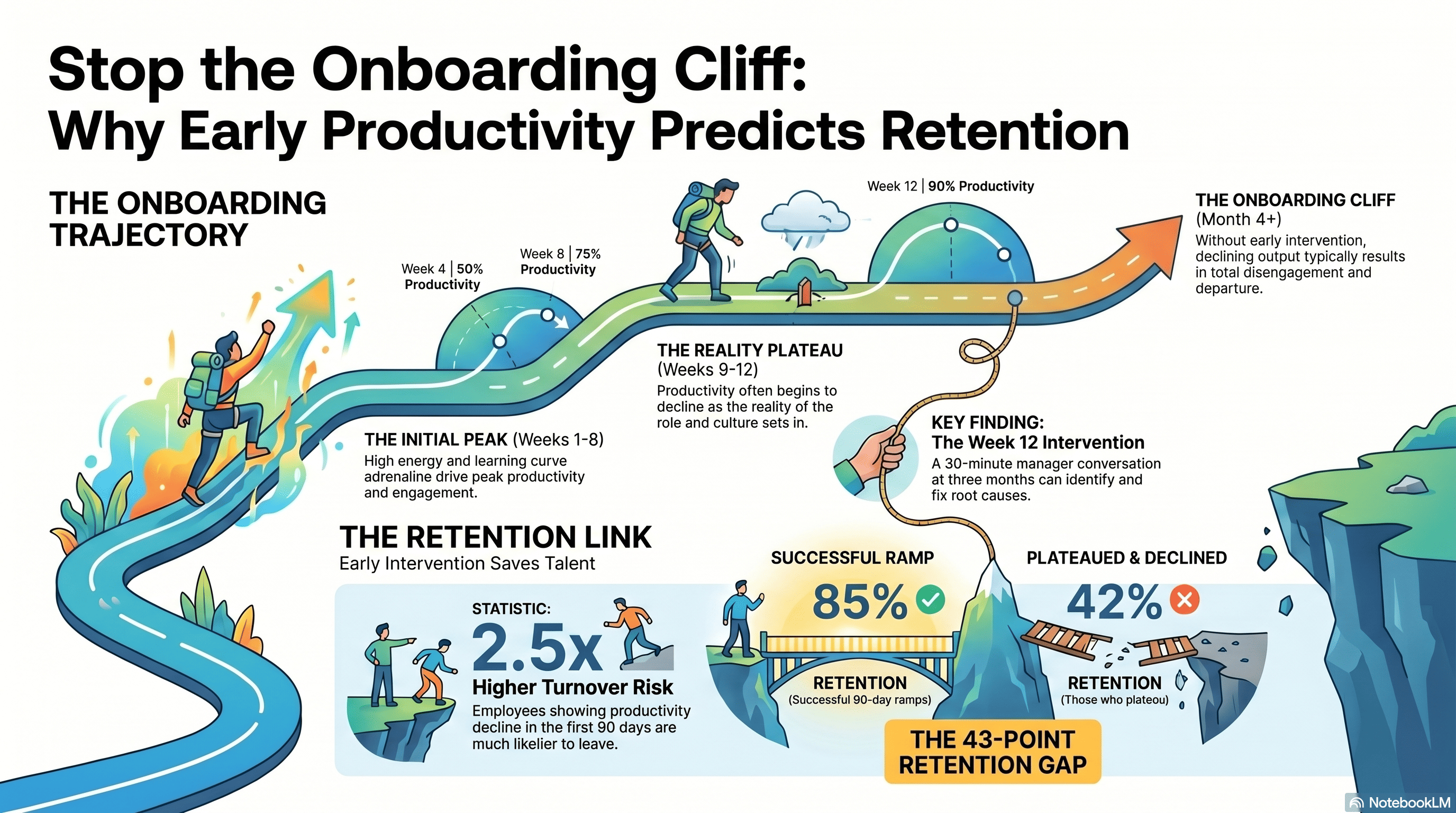
The Productivity-Retention Link Monitor Early Output During Onboarding[/caption]
Context and Overview
Employee starts strong (high productivity, engagement). Then 3 months in, productivity drops 15-20%. By 6 months, they leave.
What happened? Onboarding cliff. Initial enthusiasm faded. Reality set in. Disengagement followed.
Research: Employees showing productivity decline during first 90 days are 2.5x more likely to leave within 12 months.
This is predictive. Identify it early; intervene immediately.
The Onboarding Productivity Pattern
Week 1-2: High productivity (new role energy, learning curve adrenaline)
Week 3-8: Peak productivity (competence building, still engaged)
Week 9-12: Plateau then decline (reality of role, relationship with manager, culture)
Month 4-6: Continued decline (disengagement deepens)
Month 6+: Either: (a) stabilizes at lower level with manager intervention, or (b) continues declining → departure
Measuring Early Productivity
Define productivity metrics for role (units per hour, sales per day, defects per batch, customer satisfaction, etc.)
Track baseline: What's expected productivity for role? (experienced person doing this role)
Track new hire: How quickly do they ramp to baseline?
Typical ramp: 50% productivity by week 4, 75% by week 8, 90% by week 12
Red flag: Still at 60% productivity by week 12 (either training failure or disengagement)
Intervention: Addressing Productivity Decline
Week 12 checkpoint: Manager assesses productivity vs. baseline
If declining: Schedule manager conversation (30 minutes)
Questions: 'How are you feeling about the role? What's going well? What's challenging?'
Problem-solve: Is it training gap? Support gap? Role mismatch? Culture fit? Manager relationship?
Action: Address root cause (additional training, mentoring, schedule change, manager support, role adjustment)
Research Link: Productivity = Retention
Employees showing productivity ramp (50% → 75% → 90%) have 85% 12-month retention
Employees showing productivity plateau (stuck at 60%) have 42% 12-month retention
Difference: 43-point retention gap
Mechanism: Employees succeeding in role feel competent → stay. Employees struggling feel inadequate → leave.
References and Further Reading
- Gallup, '2023 Retention and Performance Research', 2023
- Bureau of Labor Statistics, 'Hourly Worker Turnover and Retention', 2023
- Society for Human Resource Management, f'HR Strategy for Article {article_num}', 2023
- Harvard Business Review, 'Management and Organizational Development', 2023
- Cadient Talent SmartSuite Case Study, f'Implementation Results', 2024
- McKinsey & Company, 'Organizational Effectiveness', 2023
- Journal of Applied Psychology, 'Workforce Engagement and Retention', 2022
How Cadient Talent SmartSuite™ Helps
Cadient Talent’s SmartSuite™ platform automates compliance workflows, embeds regulatory guardrails directly into your hiring process, and maintains audit-ready documentation at every stage—so your team can focus on finding great talent while staying protected from costly violations.
Ready to transform your hiring?
See how Cadient Talent helps you find the right people, faster.
Learn More
