How to Scale Up and Down Without Losing Quality
The Seasonal Challenge
[caption id="attachment_20933" align="alignnone" width="2752"]
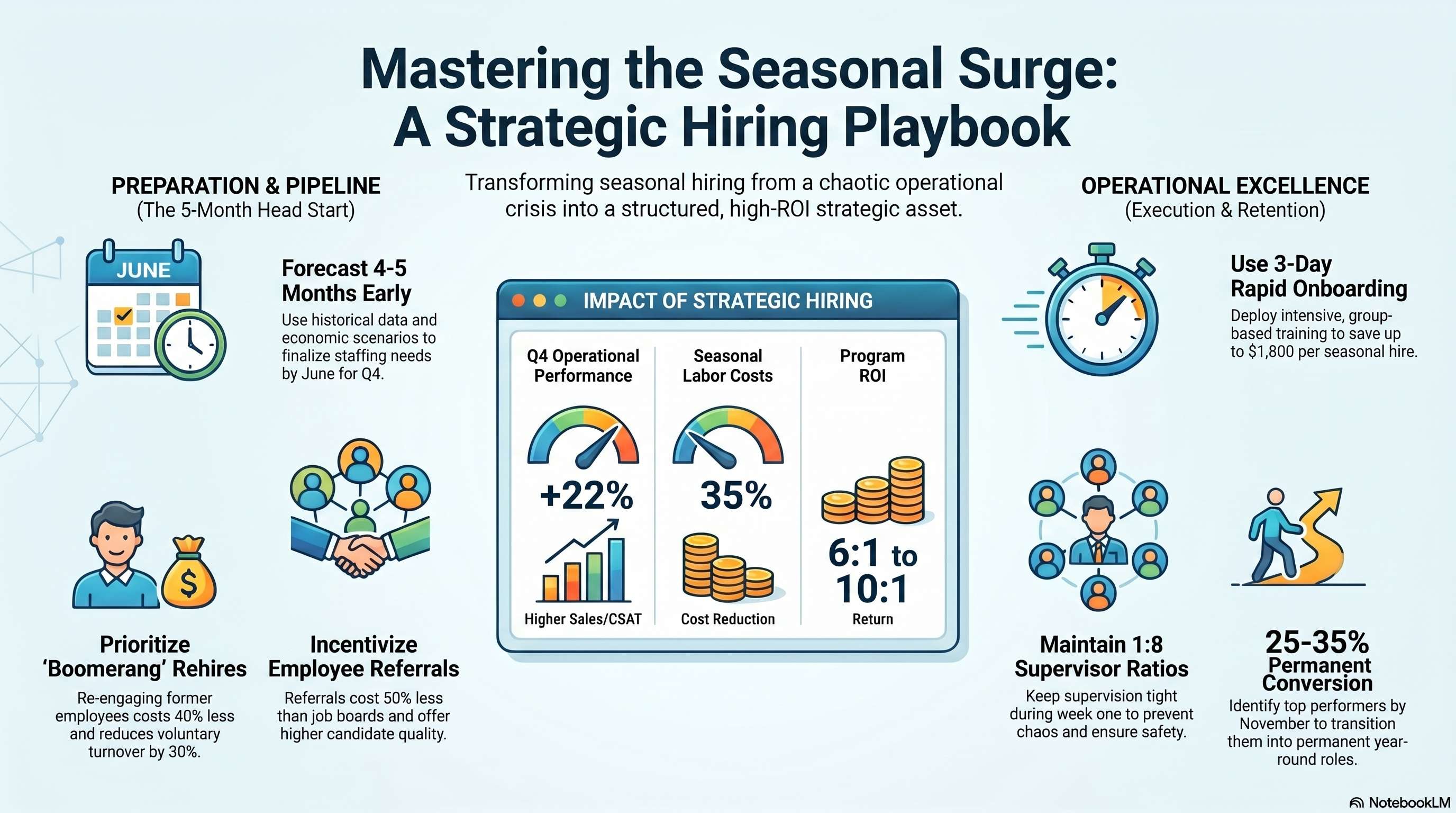
The Seasonal Hiring Playbook[/caption]
Retail, hospitality, and logistics experience dramatic seasonal swings. A retailer might employ 400 year-round but need 650 during Q4 holidays. Healthcare facilities ramp during flu season. Logistics peaks during peak shipping periods. Managing this efficiently while maintaining quality and culture is a critical operational challenge.
Research from the Staffing Industry Analysts shows that organizations managing seasonal hiring well achieve: (1) 22% better Q4 performance (sales, customer satisfaction) compared to peers; (2) 35% lower seasonal worker costs (through efficiency); (3) 18% higher retention of seasonal workers into permanent roles. Yet most organizations fail at seasonal hiring, treating it as a crisis to minimize rather than a strategy to optimize.
The playbook has five components: forecasting demand, building pipelines, rapid onboarding, quality maintenance, and rehiring and alumni strategies.
Demand Forecasting and Workforce Planning
Accurate forecasting is the foundation. Too conservative and you're understaffed, creating poor customer experience and burning out core staff. Too aggressive and you're over-hired, overpaying, and rushing poor performers.
Forecasting methodology: (1) Historical analysis: Review last 3 years of seasonal staffing, hours, and labor productivity. A retailer might analyze Q4 staffing by week, performance metrics, and revenue generated per labor hour. (2) External signals: Projected holiday sales, economic forecasts, competitive openings (will competitors hire more, tightening labor market?). (3) Scenario planning: Build low, medium, and high scenarios. If economic forecasts show 5-8% holiday sales growth, your medium scenario accommodates that. Low assumes recession; high assumes strong economy.
Breakdown: By location, role, and week. A 25-store retail chain might forecast: Store A (high-traffic, urban) needs +120 seasonal hires; Store B (suburban, lower traffic) needs +60. By role: +200 cashiers, +150 floor associates, +50 supervisors. By week: hiring starts June 1, ramps through August, peaks September-October, declines January.
Implementation: Use your ATS or HRIS forecasting module. Excel models suffice if platform unavailable. Share forecasts with operations teams by June 1 (for Q4). Update quarterly as conditions change. Create accountability: Finance tracks actual spend vs. forecast; operations tracks productivity.
Benefit: Accurate forecasting enables proactive hiring (starting 4-5 months early), which reduces rush hiring and improves quality.
Building and Nurturing a Talent Pipeline
Instead of scrambling to hire in August, build a pipeline starting in May. Pipeline building includes several tactics:
- Rehiring Program: Target prior separators who left on good terms. A worker who left a retail job 18 months ago to pursue school might be available for seasonal work. Research shows: (1) Boomerangs cost 40% less to onboard (already know systems, culture); (2) Have 30% lower voluntary turnover in second stint; (3) Can be hired within days vs. weeks for new candidates. Create a rehire database. In May, reach out to high performers who separated: "We'd love to have you back for seasonal hiring. Same or better pay, flexible schedule to accommodate your needs." Track: How many rehires can you source? Target: 30-40% of seasonal hires from boomerang pool.
- Candidate Pools and Talent Communities: Throughout the year, maintain a pool of candidates interested in seasonal roles. University students looking for summer/fall work, people between jobs, second-job seekers. Use social media (Facebook, Instagram), campus recruiting, job boards, and referral programs. By May, you have a pool of 500-1,000 pre-qualified candidates. This dramatically accelerates seasonal hiring.
- Referral Incentives: Existing employees are your best source. A $200-$500 referral bonus for someone hired in seasonal window incentivizes existing staff to recruit. Referrals cost 50% less than job board hires, are higher quality (referred by trusted peer), and have 22% lower turnover. Build referral targets: "For every 5 seasonal hires we need, we want 2-3 from referrals."
- Campus Recruiting: For Q4 retail/hospitality peaks and summer logistics hiring, partner with local colleges and universities. Recruit students looking for fall/holiday/summer work. Large retailers have dedicated university recruiting teams. Smaller companies can partner with campus job boards or career offices.
- Advertising and Promotion: Quality advertising matters. Instead of vague "Now Hiring" signs, create recruitment campaigns messaging seasonal opportunity and benefits: "Join us this fall. Competitive pay ($18-$22/hour), flexible scheduling, employee discount, and potential for permanent placement." Targeted digital ads (Facebook, Indeed, LinkedIn) reach quality candidates. Estimate: 35-40% of seasonal hires sourced from proactive advertising and pipeline vs. reactive job board surfing.
Implementation: In April, launch a seasonal hiring campaign. By May 15, you want your first cohort of 50-100 hired and onboarding. By June 30, 250 hired. By July 31, 500 hired. By August 31, full complement in place. This 4-month ramp is less chaotic than jamming hires into July-August.
Rapid Onboarding: Quality at Scale
Onboarding seasonal workers quickly without sacrificing quality requires templated, multi-cohort structure. Typical model:
Day 1 (2 hours): Paperwork, system setup (HRIS login, badge, phone if applicable), orientation video (company overview, values, policies). Deliver this in group format (cohort of 20 new hires) to reduce trainer burden.
Day 2 (4 hours): Training on core job (POS for retail cashiers; systems for warehouse staff). Hands-on with trainer. Pair new hires with tenured associates for peer learning ("buddy system").
Day 3 (4 hours): Continued job training, shadow an experienced associate, practice with close supervision.
Day 4: Independent work with check-ins.
This 2-3 day intensive model is superior to extended onboarding for seasonal workers (who may leave quickly). It's fast, cost-effective, and effective: First-week performance gaps between rigorously onboarded and poorly onboarded seasonal workers is 25-35%.
Implementation: (1) Create a templated onboarding curriculum specific to each role (cashier, floor, warehouse); (2) Record all training videos so they can be played in cohorts; (3) Identify and train "onboarding buddies" (experienced associates willing to mentor new hires); (4) Assign onboarding accountability (HR owns cohort 1-50, Store A manager owns cohort 51-100). (5) QA: Spot-check new-hire proficiency at day 3 and day 7. Document issues and performance gaps for remediation.
Cost: A streamlined onboarding saves $1,200-$1,800 per seasonal hire vs. individual, extended onboarding.
Quality Maintenance During Seasonal Scale
Hiring 250+ workers in 60 days introduces risk: quality degradation, cultural dilution, policy violations. Proactive measures minimize these:
- Hiring Standards Don't Drop: Set quality thresholds (background check, reference, interview performance) and maintain them even under volume pressure. It's tempting to hire anyone warm during crunch, but hiring poor performers creates training burden, safety risk, and departure (they leave quickly when they can't succeed). Better to have 5% hiring positions unfilled than 20% poor performers.
- Supervision Ratio Management: Too many new workers per supervisor creates chaos. Maintain 1 supervisor per 8-12 new workers for first week, then 1 per 12-15. This requires proactive supervisor hiring and training. Many organizations fail seasonal hiring because they under-hire supervisors.
- Quality Assurance: Implement daily feedback and coaching for first 2 weeks. A retail floor supervisor checks in with each new hire daily: "How's it going? What questions do you have? Here's one area to focus on tomorrow." This early feedback prevents bad habits and improves retention.
- Cultural Integration: Pair new seasonal hires with tenured "culture carriers" (team members embodying company values). Their influence prevents cultural erosion. A 10-person team with 7 new hires might be assigned 4 culture carriers to influence and mentor.
- Retention Bonus for Core Team: Losing experienced staff during seasonal crunch is catastrophic. Offer a $500-$1,000 retention bonus for core team members committing to stay through peak season (September-December for retail, June-August for logistics). This is cheap relative to replacement cost.
- Monitoring: Absenteeism, customer complaints, and safety incidents should be monitored daily for new hires. If a new hire is absent 2x in first week, address immediately (offer support, clarify expectations, or performance-manage as appropriate).
The Rehiring and Alumni Strategy
Seasonal hiring creates opportunity to identify future permanent talent. Many seasonal workers are candidates for permanent roles if their performance and fit are strong.
Steps: (1) In mid-October (for Q4), identify top-performing seasonals (top 10-15% by performance, engagement, and retention likelihood). (2) Offer permanent part-time or full-time roles (many seasonals become permanent part-timers working 20-30 hours year-round). (3) Onboard them as permanent employees with benefits, development, and advancement opportunities.
Implementation: Create a "seasonal-to-permanent" conversion program. Top performers identified in October receive conversations by November 1: "We'd like to keep you. We can offer full-time hours at $19/hour with benefits, or part-time at $18.50/hour. Are you interested?" Conversion rate: 25-35% of seasonals take permanent roles.
Alumni engagement: For seasonals who don't convert or who separate post-season, maintain engagement. Alumni are re-hiring pool for next season. Send thank-you notes, maintain LinkedIn connection, reach out in May: "Hi! We're hiring seasonal workers again. Interested?" Boomerang rate: 40-50% of prior seasonals return.
Business case: A retailer converting 25 seasonals to permanent part-timers (gaining 12 FTE at blended cost) plus rehiring 40 boomerangs (reducing hiring cost by 40% on 40 hires = $20K savings) gains 12 FTE capacity and saves $20K, net benefit of $120K-$180K annually (calculating FTE salary value minus savings).
Post-Season Transition and Ramp-Down
December 26 onwards, most seasonals are no longer needed. How you transition them signals organizational respect and opens door to rehiring.
Approach: (1) Communication: By November 15, communicate to all seasonals: "Here's our expected ramp-down schedule. Seasonal hires will phase out starting Jan 2. We appreciate your hard work." (2) Gratitude: Provide thank-you letter, bonus if budget allows ($50-$100), recognition event (thank-you gathering or note from leadership). (3) References: Offer to be a reference for departing seasonals (signals respect and supports their next role). (4) Rehire interest: Ask, "Would you be interested in returning next seasonal season? If so, let us know and we'll prioritize hiring you." (5) Alumni maintenance: Add to alumni database; engage periodically.
Critical: Never lay seasonals off abruptly or treat them as disposable. Treat them as valued temporary colleagues. This approach generates positive sentiment, repeat rehires, and referrals. A retailer with strong seasonal alumni engagement can rehire 50% of lapsed seasonals year-over-year, dramatically reducing seasonal hiring cost.
Measuring Seasonal Hiring Success
KPIs to track: (1) Hiring timeline adherence (% of seasonal hires completed by target dates); (2) Hiring cost (cost per seasonal hire—target: $400-$800 including recruiting, onboarding, training; lower than permanent-hire cost due to speed); (3) Quality metrics (% passing background check, % passing day-7 performance assessment, % completing first 90 days); (4) Retention (% of seasonals staying through target departure date); (5) Conversion rate (% of seasonals converting to permanent roles); (6) Customer impact (Q4 customer satisfaction scores, sales per labor hour, customer complaints); (7) Boomerang rate (% of prior seasonals rehired); (8) Cost-benefit (total seasonal program cost vs. gross profit generated by additional sales/capacity with seasonal workforce).
For a 500-person retailer with +250 seasonal hires: Total program cost ~$200K-$300K (recruiting, onboarding, wages, training). Additional Q4 sales generated by full staffing ~$8-12M. Gross margin on incremental sales ~25-30% ($2-3.6M). Net benefit $1.7-3.3M. ROI on program: 6:1 to 10:1.
Conclusion: Seasonal Hiring as Strategic Asset
Seasonal hiring doesn't have to be a chaotic scramble. Strategic approach—forecasting demand, building pipelines, rapid-but-rigorous onboarding, quality maintenance, and alumni engagement—transforms seasonal hiring from a cost center into a competitive advantage.
Companies mastering seasonal hiring achieve 20-25% better operational performance during peaks, reduce seasonal labor costs by 25-30%, and build sustainable rehiring pipelines. Begin by assessing your current seasonal process. Identify biggest pain points (rushed hiring? Poor quality? High cost?). Build initiatives addressing those. Measure. Scale. In two seasons, seasonal hiring becomes a strategic, profitable operation.
References and Further Reading
- Staffing Industry Analysts: 'Seasonal Hiring Best Practices' (2024)
- SHRM: 'Seasonal Workforce Planning and Management' (2023)
- McKinsey: 'Temporary Worker Optimization in Retail' (2024)
- Society for Human Resource Management: 'Onboarding at Scale' (2023)
- Deloitte: 'Seasonal Hiring Cost and Performance Analysis' (2024)
- LinkedIn: 'Campus Recruiting for Seasonal Roles' (2023)
- Workable: 'Seasonal Hiring Benchmarks' (2024)
- Harvard Business Review: 'Managing Temporary and Seasonal Workforces' (2023)
How Cadient Talent SmartSuite™ Helps
Cadient Talent’s SmartSuite™ platform automates compliance workflows, embeds regulatory guardrails directly into your hiring process, and maintains audit-ready documentation at every stage—so your team can focus on finding great talent while staying protected from costly violations.
