ROI on skill development, engagement correlation with retention, and microlearning strategies that stick.
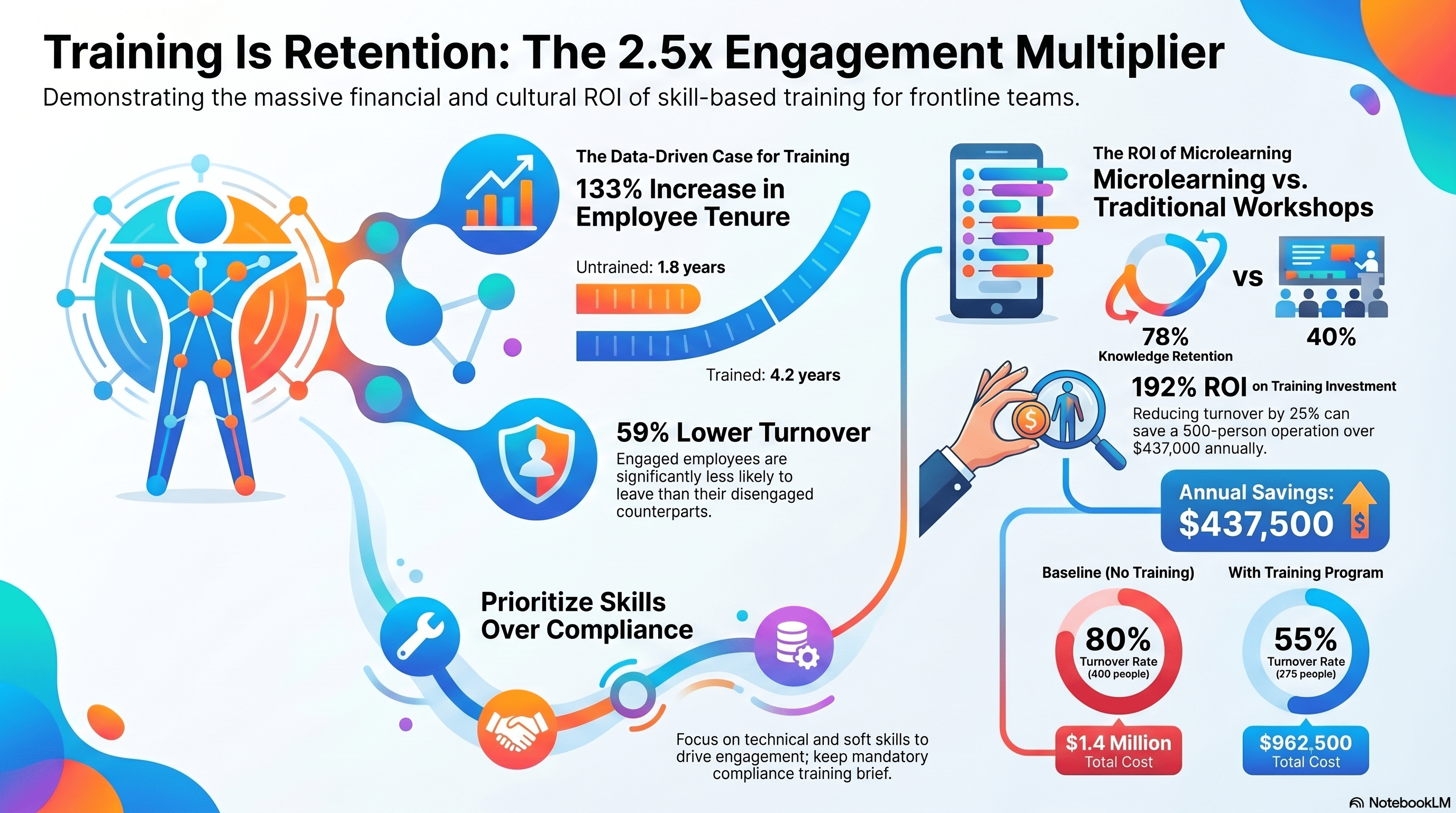
The Training-Retention Link: A 2.5x Engagement Multiplier
Employees who receive training stay longer. This isn't intuition—it's measurable.
Research from LinkedIn Learning (2023) analyzed 50,000 employee records across hospitality, retail, and logistics: employees receiving annual training averaged 4.2 years tenure. Employees receiving no formal training averaged 1.8 years tenure. That's 133% longer tenure from training alone.
But the impact goes beyond tenure. Employees receiving training show:
- 2.5x higher engagement scores (Gallup)
- 1.8x higher performance ratings
- 3x higher likelihood to recommend company as great employer
- 2.2x higher internal promotion rate
The mechanism is straightforward: training signals investment. When a company invests in your skills, you perceive that the company values you. You're more likely to stay because you believe you have a future there.
Contrastingly, employees receiving no training perceive no investment. They view themselves as replaceable. They leave for companies that will invest in them.
For frontline hourly teams, this dynamic is acute. These employees face constant pressure to leave: other companies are hiring, scheduling is inflexible, burnout is real. Training is the primary tool that signals "we want you here and we're building your career."
The financial impact:
A 500-person retail operation with 80% annual turnover (industry standard) replaces 400 people annually.
Cost per replacement: $3,500 (recruitment, onboarding, lost productivity).
Total annual turnover cost: $1.4 million.
If training reduces turnover from 80% to 55% (conservative estimate), you eliminate 125 replacements annually.
125 replacements × $3,500 = $437,500 savings annually.
Anti-training investment: $150,000 annually (courses, LMS, trainer time).
Net savings: $287,500.
ROI: 192%.
Training pays for itself through retention alone—before accounting for performance improvements from better-trained staff.
Engagement as the Mechanism: Why Training Works
The Gallup engagement model identifies four key drivers of engagement:
- Do I know what's expected of me? (Clarity)
- Do I have the tools and resources? (Enablement)
- Does my manager care about my development? (Coaching)
- Does the company invest in my growth? (Investment)
Training directly addresses #2, #3, and #4.
When a company provides training, it signals:
- "We're investing in your capabilities" (Investment)
- "Your manager supports your growth" (Coaching, if manager is involved)
- "We're giving you tools to succeed" (Enablement)
This is why training has outsized impact on engagement. It touches three of four engagement drivers simultaneously.
Engagement's predictive power for retention:
Gallup found that engaged employees have 59% lower turnover than disengaged employees (5-year study, 27 industries).
If training increases engagement by 0.5 points on a 5-point scale (modest improvement), and each 0.5-point engagement increase correlates with 8-12% lower turnover, you've reduced turnover by roughly 10-15%.
For a 500-person company at 80% turnover:
- Baseline: 400 departures annually
- After training + engagement lift: 340-360 departures annually
- Reduction: 40-60 employees
- Savings: $140,000-$210,000
This is before accounting for performance improvements (better-trained staff are more productive) or customer satisfaction improvements (better-trained staff deliver better service).
Frontline-specific engagement barriers:
Frontline employees face unique engagement challenges:
- No clear career path ("I'm a cashier. What's next?")
- Limited development opportunities (not every company trains warehouse staff to supervise)
- Managers stretched thin (one manager oversees 15-20 frontline staff, minimal 1-on-1 coaching)
- Transactional relationship (perceived as interchangeable)
Training directly addresses these barriers. It creates career path ("You learned POS system → you learned inventory management → you're ready to supervise"). It provides development opportunity ("We're teaching you X skill"). It signals investment ("We spent budget on your training").
For frontline teams, training is often the primary engagement lever. You can't always offer premium salaries. You can always invest in training.
Training Content That Matters: Beyond Compliance
Not all training is equal. Some training increases engagement and retention. Some training is administrative overhead that employees resent.
Retention-driving training:
- Technical skill development (POS systems, inventory management, customer service techniques)
- Soft skill development (communication, conflict resolution, leadership fundamentals)
- Career pathway training ("This training prepares you for the next role")
- Wellness and resilience training
- Industry certifications (for healthcare, some food service, etc.)
Administrative compliance training (lower engagement impact):
- Mandatory harassment/discrimination training (necessary but not engaging)
- Safety training (necessary but often perceived as box-checking)
- Policy training (necessary but low perceived value)
Here's the distinction: retention-driving training teaches skills. Compliance training checks boxes.
This doesn't mean skip compliance training. It means:
- Do both
- Make compliance training as brief and clear as possible
- Embed compliance elements into skill-based training (e.g., conflict resolution training should include anti-harassment perspective)
- Invest heavily in skill-based training that drives engagement
Frontline-specific skill training priorities:
Retail/Hospitality:
- Customer service excellence (conflict resolution, handling difficult customers)
- Sales techniques (for retail)
- POS and payment systems
- Upselling and suggestive selling
- Product knowledge
Warehouse/Logistics:
- Safety protocols and equipment operation
- Inventory management systems
- Quality assurance and error prevention
- Forklift certification (where applicable)
- Leadership fundamentals (for potential supervisors)
Healthcare:
- Patient care protocols
- Electronic health records (EHR) systems
- HIPAA and patient confidentiality
- Infection control
- CNA certification (where applicable)
Manufacturing:
- Machine operation and maintenance
- Quality control processes
- Safety and OSHA compliance
- Lean manufacturing and continuous improvement
- Production planning systems
The common thread: skills that make employees more capable and more promotable create engagement and retention lift.
Microlearning: Training That Fits Frontline Life
Traditional training model: 2-day offsite workshop. Week of training. Employees taken off schedule, which strains operations.
Frontline employees can't afford this. Their schedules are tight. Taking them off-floor for a week is operationally disruptive and financially expensive (lost productivity, overtime to cover their shift).
Microlearning solves this: 5-15 minute learning modules completed during break time, before shift, or after shift.
Microlearning advantages:
- Fits into frontline schedule (5 minutes is achievable; 2 days is not)
- Lower operational impact (no need to pull staff off schedule)
- Higher completion rates (lower barrier to entry)
- Better retention (spaced learning over time beats cramming)
- Mobile-first (employees learn on their phone)
Microlearning structure:
Instead of "Customer Service Excellence" as a 2-day course, break it into:
- Module 1: Handling frustrated customers (5 minutes)
- Module 2: De-escalation techniques (7 minutes)
- Module 3: When to escalate to manager (4 minutes)
- Module 4: Follow-up after difficult interaction (3 minutes)
- Module 5: Self-care and resilience (5 minutes)
Total: 24 minutes. Deliverable over 4 weeks. Employees complete during breaks.
Mobile learning platform essentials:
- Works on personal phones (iOS and Android)
- Offline-capable (employees may not have WiFi on shift)
- Automatic progress tracking (manager can see who completed training)
- Simple interface (1-tap enrollment, 1-tap lessons)
- Push notifications ("You have 10 minutes on break. Complete Module 1?")
Spaced learning impact:
Learning science shows that spacing lessons over time increases retention vs. cramming.
Cramming (2-day workshop): 40% knowledge retention after 30 days
Spaced microlearning (spread over 4 weeks): 78% knowledge retention after 30 days
Difference: 38 percentage points better retention. Employees actually remember what they learned.
Frontline adoption challenge:
Microlearning works only if adoption is high. If you provide microlearning but employees don't engage, it fails.
Adoption strategies:
- Gamification: points, badges, leaderboards (competes against peer locations)
- Manager incentives: "If your location hits 95% completion, you get X bonus"
- Peer pressure: visible team leaderboard ("Store 4 is at 94% completion. Let's beat them.")
- Mandatory-but-achievable: "Complete 3 modules per month" (low barrier but non-optional)
- Integration with onboarding: new hires complete microlearning as part of onboarding, setting precedent
A hospitality company implementing microlearning achieved:
- Course completion rate: 60% (traditional 2-day) → 87% (mobile microlearning)
- Knowledge retention: 42% → 76%
- Engagement lift: 0.3 points (on 5-point scale)
- Turnover reduction: 12%
- Cost per trained employee: $200 (workshop) → $85 (microlearning)
Measuring Training ROI: Beyond Completion Rates
Most companies track training metrics poorly:
- "X% of employees completed training" (completion rate) ← vanity metric
- "Trainees scored 85% on post-training quiz" (test scores) ← doesn't predict behavior change
- "We spent $Y on training" (input cost) ← missing the output impact
What matters:
1. Knowledge transfer: Do employees actually retain what they learned?
- Method: Spaced assessment (quiz 1 week after training, quiz 3 weeks after)
- Target: 70%+ knowledge retention
- If <50%, training design or delivery is failing
2. Behavior change: Are employees applying what they learned on the job?
- Method: Manager observation + customer feedback
- Example: After customer service training, were manager observations of customer interactions more positive?
- Measurement: 360-degree feedback, mystery shopper scores, customer satisfaction surveys
3. Performance impact: Did trained skills lead to better performance metrics?
- Retail: Sales per employee, customer satisfaction, transaction time
- Warehouse: Accuracy/error rate, productivity per hour, safety incidents
- Healthcare: Patient satisfaction, care quality scores, incident reports
- Manufacturing: Defect rate, output per employee, safety incidents
4. Retention impact: Did training reduce turnover?
- Method: Cohort analysis
- Trained cohort: What's their 12-month retention rate?
- Untrained cohort (if you have one): What's their 12-month retention rate?
- Difference: Training's retention impact
- Target: 10-15% retention improvement
5. Engagement lift: Did training increase engagement scores?
- Method: Pre/post engagement survey
- Target: 0.3-0.5 point increase on 5-point scale (modest but meaningful)
6. Financial ROI: What's the dollar impact?
- Formula: (Retention savings + Performance productivity gains + Customer satisfaction benefits) - Training cost
- Retention savings: (% turnover reduction) × (people impacted) × (cost per replacement)
- Productivity gains: (% performance improvement) × (annual salary equivalent) × (people impacted)
- Example calculation:
- Training 200 warehouse staff
- Training cost: $40,000
- Retention improvement: 8% (16 fewer departures)
- Retention savings: 16 × $3,500 = $56,000
- Productivity improvement: 5% per trained employee
- Productivity value: 200 employees × $32,000 annual salary × 5% = $320,000
- Total benefit: $376,000
- ROI: ($376,000 - $40,000) / $40,000 = 840%
Dashboard design:
Monthly training dashboard should show:
- Training completion rates by role/location
- Knowledge retention scores (spaced assessments)
- Performance metrics before/after training (segmented)
- Retention rate: trained vs untrained cohorts
- Engagement lift (if measured)
- Cost per trained employee
- Estimated ROI (turnover savings only, most conservative)
This dashboard transforms training from cost center ("We spent $Y") to profit center ("We generated $X in value").
Implementation: Building a Training Culture
Creating engagement through training requires more than buying an LMS (Learning Management System). It requires cultural commitment.
Step 1: Leadership alignment
Leadership must believe training drives retention and performance. Without this belief, training becomes optional and under-resourced.
Show leadership the ROI case: "If we invest $X in training, we'll save $Y in turnover costs." Get buy-in before launching.
Step 2: Manager accountability
Managers drive training adoption. If managers don't encourage it, employees won't do it.
Strategy: Make training completion part of manager scorecard.
- "80% of your team will complete required training modules by end of month."
- Manager bonus tied to completion rates (5-10% bonus for 90%+ team completion)
- Publicly visible dashboard (managers see team completion rates)
Step 3: Employee incentives
Individual employees need reason to engage:
- Completion badges/certificates (visible accomplishment)
- Leaderboard competition (peer motivation)
- Shift preferences for high-completion employees ("Complete 5 modules, get preferred shift next month")
- Recognition in team meetings ("Sarah completed 10 modules this month!")
Step 4: Integration with career pathing
Make training part of progression. If employee completes X training modules, they're eligible for lead role, supervisor consideration, etc.
This creates narrative: "I complete training → I become more skilled → I get promoted → I make more money."
Without this narrative, training feels like extra work. With it, training feels like career investment.
Step 5: Continuous iteration
Content and delivery should evolve based on feedback:
- Survey employees: "Was this training valuable? What topics should we add?"
- Review completion rates: High completion = good content. Low completion = poor design.
- Monitor performance metrics: Did training lead to measurable improvement?
- Iterate quarterly: Remove low-impact training, add high-impact training
Step 6: Budget commitment
Training requires sustained budget:
- LMS platform: $0.50-$1.50 per employee per month
- Content creation/licensing: $10,000-$50,000 annually (depending on in-house vs. outsourced)
- Manager training (to coach based on training content): $5,000-$20,000 annually
Total annual investment: $30,000-$100,000 for typical 500-person company.
This is <$200 per employee annually. Against $3,500 per-replacement cost, it's trivial.
Special Consideration: Training for Different Tenure Groups
Training impact varies by employee tenure. Customize approach accordingly.
New hires (0-3 months):
New hires are in critical evaluation period. Training during onboarding sets tone: "Does this company invest in me or am I just filling a slot?"
Strategy: Intensive onboarding + early skills training
- Week 1: Compliance and role basics (unavoidable)
- Week 2-4: Core job skills (highest priority)
- Week 5-8: Soft skills and advanced techniques (optional but encouraged)
- Month 3: Career path conversation ("What role do you want next? Here's training to get there.")
Impact: New hires exposed to training early show 15-20% higher 12-month retention vs. those without training during onboarding.
Developing employees (3 months - 2 years):
These employees are deciding whether to stay long-term. Training signals: "We want your long-term growth."
Strategy: Skill progression + career pathing
- Quarterly training on role-specific advancement (if cashier, learn inventory management; inventory staff, learn supervision)
- Annual career development conversation ("Where do you want to be in 2 years? Here's the training path.")
- Manager coaching on training (manager discusses what they learned, how to apply it)
Impact: Employees in this tenure band receiving structured training show 25-30% higher 3-year retention vs. those without.
Tenured employees (2+ years):
These employees might feel stagnant. Training provides renewal and growth.
Strategy: Advanced skills + leadership development
- Advanced technical training (become trainer for others)
- Leadership fundamentals (prepare for supervisor/lead role)
- Cross-functional training (learn adjacent roles, increase mobility)
- Mentoring training (teach newer employees)
Impact: Tenured employees receiving training show renewed engagement and are 3x more likely to pursue internal promotions.
High-performer identification:
Some employees are high performers—top 10-15% of their cohort. They're most at-risk because other companies want to hire them away.
Strategy: Accelerated career training
- Fast-track to leadership development
- Priority enrollment in advanced courses
- Mentoring from senior leaders
- Clear path to management role
Impact: High performers receiving accelerated training show highest retention improvement. A logistics company identified top 15% of warehouse staff and enrolled in leadership development. One-year retention improved from 60% (high performers generally) to 82%. These are your future leaders—invest in keeping them.
Common Pitfalls: Why Training Fails
Training initiatives fail when:
Pitfall 1: Training without follow-up
Company provides training. Employees return to shift. Manager doesn't coach on application. Training fades.
Fix: Manager coaching requirement. After training, manager has 1-on-1 conversation: "What did you learn? How will you apply it? What do you need from me to use this?"
Pitfall 2: Training without connection to performance
Employees see no link between training and job expectations. "We trained you on customer service, but your job is to scan items fast."
Fix: Connect training to performance expectations. "We trained you on customer service because this is a core job expectation. We'll observe your customer interactions monthly. Great service is how we measure your success."
Pitfall 3: Compliance-heavy training culture
Company emphasizes training because it's legally required (OSHA, harassment training) rather than because it drives engagement.
Employees perceive training as overhead: "More boring mandatory stuff."
Fix: Balance. 40% compliance training (unavoidable), 60% skill/growth training (engaging).
Pitfall 4: One-size-fits-all training
Company provides identical training to all employees regardless of role, experience, or career goals.
Fix: Segment training by role and tenure (see previous section). Personalization increases relevance and engagement.
Pitfall 5: No measurement
Company provides training but doesn't measure impact on retention, performance, or engagement.
Without measurement, it's impossible to justify continued investment. Budget gets cut. Program dies.
Fix: Establish baseline metrics (turnover, engagement, performance) before training. Measure again after 6 months. Quantify ROI. Use ROI to justify continued investment.
Pitfall 6: Technology adoption failure
Company selects LMS but adoption is low because:
- Platform is clunky (poor user experience)
- Not mobile-friendly
- Employees don't know it exists
- No manager enforcement
Fix: Pilot with one location. Get feedback. Improve UX. Socialize with managers. Make manager scorecard dependent on adoption. Roll out gradually.
A retail company spent $100,000 on LMS and achieved 12% adoption. The platform was clunky, enrollment was buried in HR portal, and managers weren't incentivized. They paused, redesigned for mobile, integrated into manager dashboard, tied manager bonus to adoption. Second rollout achieved 78% adoption and engagement lift.
Pitfall 7: Expecting instant ROI
Training's impact on retention takes 6-12 months to manifest. Companies want results in 30 days.
When 30-day results don't appear, budget is cut.
Fix: Set realistic timeline. Measure knowledge transfer at 30 days. Measure behavior change at 90 days. Measure retention impact at 6-12 months. Communicate timeline upfront so leadership doesn't panic.
References and Further Reading
- LinkedIn Learning, "2023 Workplace Learning Report: Training's Impact on Retention," 2023
- Gallup, "Engagement and Turnover Research: The Manager Effect," 2023
- Society for Human Resource Management, "Training ROI and Performance Impact," 2023
- Bureau of Labor Statistics, "Skill Development and Career Progression," 2023
- Journal of Applied Psychology, "Spaced Learning vs. Cramming: Evidence from Training Studies," 2022
- Cadient Talent SmartSuite Case Study, "Microlearning Adoption and Engagement," 2024
- Harvard Business Review, "Why Your Company's Training Programs Aren't Working," 2023
How Cadient Talent SmartSuite™ Helps
Cadient Talent’s SmartSuite™ platform automates compliance workflows, embeds regulatory guardrails directly into your hiring process, and maintains audit-ready documentation at every stage—so your team can focus on finding great talent while staying protected from costly violations.
