The Underrated Retention Tool in High-Volume Environments
Why Hourly Workers Leave: The Communication Void
[caption id="attachment_20946" align="alignnone" width="2752"]
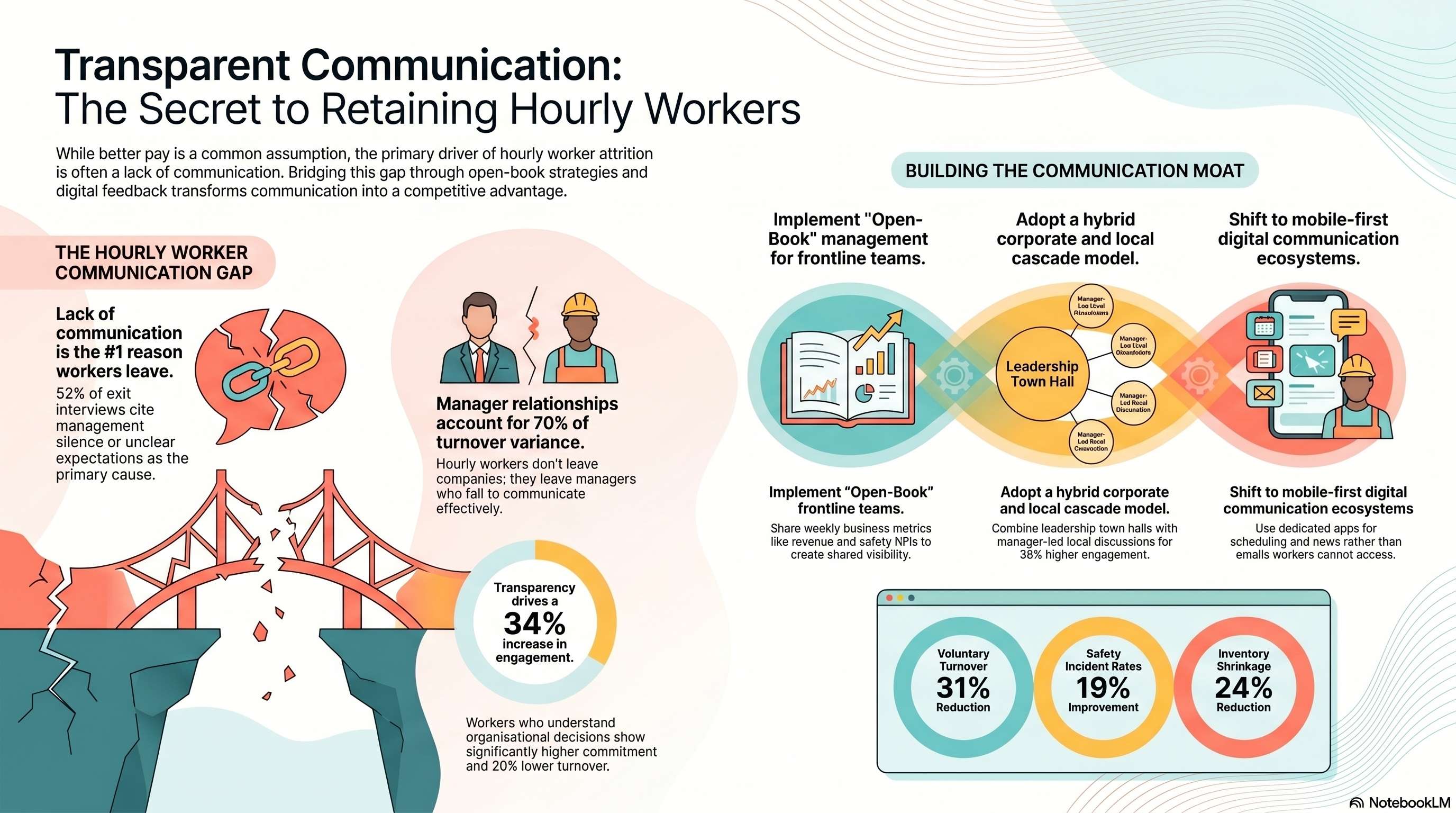
Transparent Communication[/caption]
Exit interview data from RetailMeNot, Indeed, and Glassdoor reveal a consistent pattern: the most commonly cited reason hourly workers leave is not low pay (ranked 3rd) but rather "no communication from management" or "didn't know what was expected" (ranked 1st, cited in 52% of exit interviews). This data contradicts traditional HR assumptions. Compensation, benefits, and career advancement are important, but they're not the primary drivers of attrition.
The core issue: Hourly workers in high-volume environments often feel treated as operational units rather than team members. They receive directives but not context. They see scheduling changes but not the reasoning. They experience policy enforcement but not the strategic intent behind it. This information asymmetry creates psychological distance and erodes engagement.
Research from the University of Michigan's organizational psychology lab found that workers receiving transparent communication about organizational decisions show 34% higher engagement and 26% lower voluntary turnover compared to workers in command-and-control environments where information flows only downward and minimally.
Open-Book Management for Frontline Operations
Open-book management—the practice of sharing key business metrics, financials, and strategic priorities with all employees—originated in manufacturing but has profound applications for hourly workforces. The concept: when workers understand the business fundamentals (revenue, costs, margin, customer feedback), they make better decisions and feel more connected to organizational success.
A distribution center that shares weekly order volume, inventory accuracy metrics, and safety KPIs with all associates creates shared visibility into what drives profitability and job security. When a new safety protocol is implemented, associates understand not just the rule but the financial and human cost of accidents. When staffing is reduced, associates understand the business context rather than perceiving it as arbitrary.
Companies implementing open-book management in hourly operations report: (1) 31% reduction in voluntary turnover; (2) 19% improvement in safety incident rates; (3) 24% reduction in shrink and inventory discrepancies; (4) 18% increase in suggestion submissions from frontline workers. The mechanism is straightforward: when workers have context, they make choices aligned to business outcomes, and they feel trusted and valued.
Implementation requires translating business metrics into accessible language, sharing them frequently (weekly or biweekly), and creating forums for questions and dialogue. A retail store manager might share: "Last week our shrink was 2.1% (above target of 1.8%). That costs us about $3,000 in lost margin. When we solve this, those savings support bonuses for our team and hiring for open shifts." This narrative connects individual behavior (careful merchandising, loss prevention) to collective outcomes.
Town Halls and Cascading Information for Multi-Location Operations
Large retail and hospitality chains with 50+ locations face a challenge: how do you ensure frontline workers hear strategic information from leadership in a credible, contextual way? The best solution is a hybrid model combining corporate town halls with local manager cascades.
Corporate town halls (quarterly or semi-annually) connect workers across locations to CEO and senior leadership messages. These should be recorded, subtitled, available on-demand, and kept to 20-30 minutes maximum. A typical structure: (1) CEO overview of quarter results, 3-minute maximum; (2) Key strategic priorities explained in plain language (not jargon); (3) Customer or employee stories illustrating values; (4) Q&A (prerecorded or live).
Critically, within 48-72 hours, local managers must hold brief team meetings to contextualize the corporate message for their location. "Here's what the CEO shared. Here's what it means for our store. Here are the three things we're going to focus on this month to contribute to the company goal."
Research from Gallup found that organizations with cascading communication (corporate + manager-led local discussions) show 38% higher engagement than those relying on corporate communication alone. The reason: local context and manager reinforcement are essential for information to translate into behavior change. A worker needs to hear the strategic priority from corporate but then understand from their manager how it applies to their daily work.
Digital Channels for Shift-Based Communication
Traditional communication methods (email, intranet, printed postings) fail for shift-based hourly workers without regular desk access. Companies like Target, Amazon, and Chipotle have implemented mobile-first communication ecosystems specifically designed for hourly workforces.
Key requirements for effective digital communication: (1) Mobile app accessible to all associates with phone numbers issued by the company; (2) Push notifications for time-sensitive information (schedule changes, policy alerts, recognition, company announcements); (3) One-way channels (company announcements) and two-way channels (manager messaging, Q&A); (4) Offline functionality (employees can read messages without active connection); (5) Privacy controls (separation of work and personal phone numbers).
Best practices observed at high-performing retailers: News is posted in a dedicated app channel, not email (associates don't check email during shifts). Scheduling changes trigger immediate notifications with 24-48 hour notice where possible. Manager messages are personalized and informal, creating relationship building. Company updates are accompanied by specific details relevant to that location (how the store is performing, local recognition, upcoming events).
Companies implementing mobile-first communication report 27% higher awareness of company news among hourly workers and 31% higher engagement. Critically, the app must not be a surveillance tool or a performance-management device; it must be perceived as a tool for information and connection, or adoption fails.
Building Trust Through Honest Communication in Crisis Situations
Organizational transparency is tested most severely during crises: economic downturns, restructuring, leadership changes, or operational failures. How companies communicate during these moments determines whether workers perceive them as trustworthy or manipulative.
A case study: A major retail chain facing declining foot traffic needed to reduce labor costs by 15%. Rather than hiding this and making cuts without explanation, the CEO sent a 10-minute video directly to all workers explaining: (1) The business challenge (foot traffic down 18%, margins compressed); (2) The analysis conducted (three cost-reduction scenarios explored); (3) Why staffing reduction was necessary over other options; (4) What this means for individual workers (no full-time hour guarantees, severance packages offered, retention bonuses for core team); (5) What comes next (quarterly updates on progress, commitment to rehire when business improves).
This transparent approach produced better outcomes than competitors who made similar cuts quietly: (1) Voluntary attrition decreased during the crisis (competitors' attrition spiked 35%); (2) Workers eligible for severance took it but remained positive about the company; (3) When business improved 18 months later, the company successfully rehired former associates. (4) Public reputation as an employer remained intact (Glassdoor ratings stayed above 3.5 stars while competitors dropped to 2.8).
Research from the Center for Organizational Dynamics at University of Pennsylvania shows that transparent crisis communication increases worker retention during downturns by 22% compared to opaque communication. The mechanism: workers understand the situation, feel respected, and perceive the company as dealing with reality rather than hiding failure.
One-on-One Manager Communication: The Retention Multiplier
Corporate communication and digital channels set the tone, but individual manager-employee communication is where retention decisions are made. Workers don't leave companies; they leave managers. Research from the Association of American Colleges and Universities (AACE) found that the quality of the manager-employee relationship accounts for 70% of variance in voluntary turnover among hourly workers.
Effective manager communication includes: (1) Regular check-ins (at least biweekly, 10-15 minutes); (2) Clear feedback on performance (what's going well, what needs improvement, tied to observable behavior); (3) Development conversations (what skills do you want to build, what roles interest you); (4) Context provision (why we're doing this, how your work connects to company goals); (5) Active listening (manager asks questions, genuinely listens rather than monologues).
Companies implementing structured manager communication protocols (e.g., biweekly check-in template, monthly development conversations) report: (1) 28% reduction in voluntary turnover; (2) 34% higher engagement scores on manager relationship questions; (3) 41% increase in internal promotions (workers want to advance when they have good managers).
The training requirement is critical. Many store managers and shift supervisors were never trained in effective communication. They default to transactional interactions (assignments, corrections, scheduling). Providing structured templates, training, and accountability (tracking manager communication frequency in their performance reviews) transforms manager communication from an afterthought into a retention lever.
Feedback Loops: Making Communication Two-Way
Transparent communication is not a one-way broadcast. The most powerful communication systems include regular feedback mechanisms allowing workers to respond, ask questions, and shape decisions.
This includes: (1) Anonymous surveys (engagement pulse checks, exit interviews); (2) Focus groups (20-30 workers discussing specific topics with HR); (3) Suggestion systems (employees submit ideas for operational improvements, get feedback on status); (4) Town hall Q&A (workers pose questions to leadership); (5) Manager listening tours (leader visits location, sits down with small groups of workers, listens without judgment).
Whole Foods pioneered a "open book" listening culture where regional leaders hold listening sessions monthly, and employee feedback directly influences store policies. This two-way communication has contributed to Whole Foods' retention rate (72% after 3 years, vs. retail average of 42%) and employee engagement (8.2/10 vs. retail average of 6.1/10).
Critically, feedback must close loops. If workers submit suggestions and hear nothing, it signals that feedback doesn't matter. Best practices: (1) Every suggestion gets a response within 2-3 weeks; (2) Accepted suggestions are shared company-wide with attribution; (3) Rejected suggestions include explanation of why; (4) Suggestion acceptance rate is published (transparency about how many ideas are implemented).
Measuring Communication Effectiveness
Communication programs should be measured like any operational initiative. Key metrics include:
Awareness Metrics: Do workers know company strategy, financial performance, and upcoming changes? Pulse surveys (quarterly, 5-10 questions) asking: "Do you understand the company's key priorities?" "Do you know how your work contributes to company goals?" Target: 70%+ awareness.
Engagement Metrics: Do workers feel informed and valued? Net Promoter Score (NPS) questions: "Would you recommend this company as a great place to work?" "Does management communicate openly with you?" Track trending over time.
Business Outcome Metrics: Does communication correlate with retention, safety, quality, and financial performance? Analyze cohorts: workers in locations with high communication frequencies vs. low frequencies. Control for demographics, tenure, role. Measure impact on turnover, safety incident rates, and shrink.
Adoption Metrics (for digital platforms): What percentage of workers are actively using communication channels? For a mobile app: daily active users, message open rates, engagement with different content types. Target: 65%+ daily active usage.
Cost-Benefit Analysis: What's the program cost (platforms, training, manager time) vs. the benefit (turnover reduction, productivity improvement, safety gains)? A communication program that costs $15,000 annually and reduces turnover by 8 workers (saving $120,000 in replacement costs) has an ROI of 8:1.
Conclusion: Communication as a Competitive Moat
In high-volume industries with thin margins and high competition, transparent communication is a competitive advantage. Workers who understand the business, feel trusted with information, and have voice in decisions are significantly more likely to stay, perform at higher levels, and support the organization's mission.
The investment is modest relative to the returns: A communication program with quarterly town halls, manager training, digital infrastructure, and feedback systems costs $1.5-$3 per employee per month but generates 18-26% reductions in voluntary turnover and 12-15% improvements in engagement—translating to millions in savings and revenue uplift for large organizations.
Begin with assessment: Where are you today? What information do workers have? How clear is company strategy at the frontline? Then build incrementally: Start with manager communication training and biweekly check-ins. Add digital communication channels. Layer in town halls and open-book metrics. Implement feedback loops. Measure, adjust, and scale.
Transparent communication is not a one-time initiative; it's a cultural practice that requires sustained leadership commitment. Companies that maintain it outcompete those that don't.
References and Further Reading
- Gallup: 'Engagement Through Communication: Manager and Corporate Cascading Effects' (2023)
- University of Michigan: 'Information Asymmetry and Frontline Worker Engagement' (2024)
- SHRM: 'Exit Interview Analysis: Hourly Worker Attrition Root Causes' (2023)
- Association of American Colleges and Universities: 'Manager-Employee Relationship Quality and Voluntary Turnover' (2023)
- Center for Organizational Dynamics, University of Pennsylvania: 'Crisis Communication and Worker Retention' (2024)
- Whole Foods Market: 'Listening Culture and Retention Outcomes' (2023)
- Society for Human Resource Management: 'Open-Book Management in High-Volume Operations' (2023)
- McKinsey: 'Digital-First Communication for Distributed Hourly Workforces' (2024)
How Cadient Talent SmartSuite™ Helps
Cadient Talent’s SmartSuite™ platform automates compliance workflows, embeds regulatory guardrails directly into your hiring process, and maintains audit-ready documentation at every stage—so your team can focus on finding great talent while staying protected from costly violations.
