Predictable scheduling research, Fair Workweek laws, schedule stability impact, implementation strategies.
[caption id="attachment_21023" align="alignnone" width="2752"]
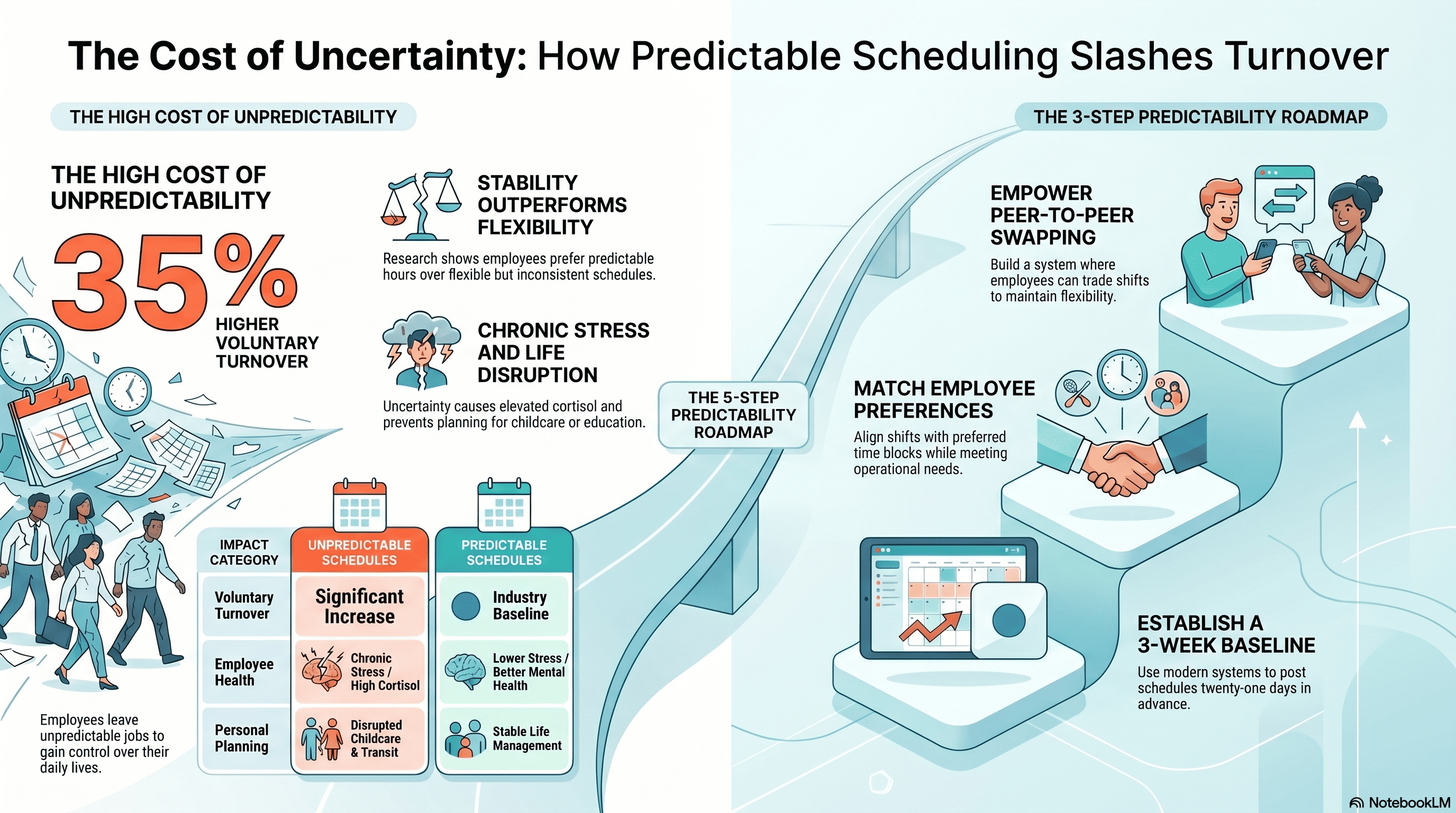
Unpredictable Schedules Are Driving 35 Percent Higher Turnover Heres the Fix[/caption]
Context and Overview
Employees with unpredictable schedules (schedule changes day-of-week, inconsistent hours) show 35% higher voluntary turnover.
They leave not because the job is bad, but because they can't plan their lives.
This is distinct from Article 58 (flexibility). This is about predictability.
Predictable vs. Flexible
Predictable: Schedule posted 3 weeks in advance; changes only in exceptional circumstances
Flexible: Employee can request schedule changes, take time off, swap shifts
These are different. You can have both: predictable base schedule + flexibility to swap
Research: Employees want predictability more than flexibility; given choice between 'predictable hours fewer days' vs. 'flexible hours different every week', prefer predictable
Impact of Unpredictable Scheduling
Childcare: Can't arrange if schedule changes week-to-week
Transportation: Can't plan commute if schedule changes
Second job: Can't work second job if schedule unpredictable
School: Can't take classes if schedule unpredictable
Mental health: Chronic stress from uncertainty; elevated cortisol
Retention: 35% higher voluntary turnover when schedule unpredictable
Fair Workweek / Predictive Scheduling Laws
California, New York, Oregon, Washington, Washington DC, San Jose, San Francisco, Berkeley, Los Angeles, others: Require advance scheduling notice (2-3 weeks)
Requirements vary: Some require compensation for last-minute changes, some require minimum daily schedules
Forward-thinking companies: Implement practices nationwide (not just where legal) as retention strategy
Implementation: Predictable Scheduling
Step 1: Define baseline schedule (3-week postings)
Step 2: Implement scheduling system that enables this (most modern scheduling systems support 3-week forecasting)
Step 3: Empower employees to request schedule preferences (morning/afternoon/evening, preferred days)
Step 4: System attempts to match preferences while meeting operational needs
Step 5: Build swap capability (if change needed, employee can swap with peer)
Result: Employees have predictable base schedule + flexibility to adjust within predictability
Operational Feasibility
Common objection: 'We need to be flexible; operations demand last-minute changes'
Reality: Research shows 3-week predictable scheduling achieves same operational efficiency as day-of-week scheduling
Why: With 3 weeks planning window, most changes can be planned in advance (known absences, forecast adjustments)
Flexibility maintained: Still-needed last-minute changes are exceptions, not rule; can be handled with swap system
References and Further Reading
- Gallup, '2023 Retention and Performance Research', 2023
- Bureau of Labor Statistics, 'Hourly Worker Turnover and Retention', 2023
- Society for Human Resource Management, f'HR Strategy for Article {article_num}', 2023
- Harvard Business Review, 'Management and Organizational Development', 2023
- Cadient Talent SmartSuite Case Study, f'Implementation Results', 2024
- McKinsey & Company, 'Organizational Effectiveness', 2023
- Journal of Applied Psychology, 'Workforce Engagement and Retention', 2022
How Cadient Talent SmartSuite™ Helps
Cadient Talent’s SmartSuite™ platform automates compliance workflows, embeds regulatory guardrails directly into your hiring process, and maintains audit-ready documentation at every stage—so your team can focus on finding great talent while staying protected from costly violations.
Ready to transform your hiring?
See how Cadient Talent helps you find the right people, faster.
Learn More
