The data is clear: resume screening is a broken signal in the age of AI-generated applications
Resume Inflation: The Numbers Don't Lie
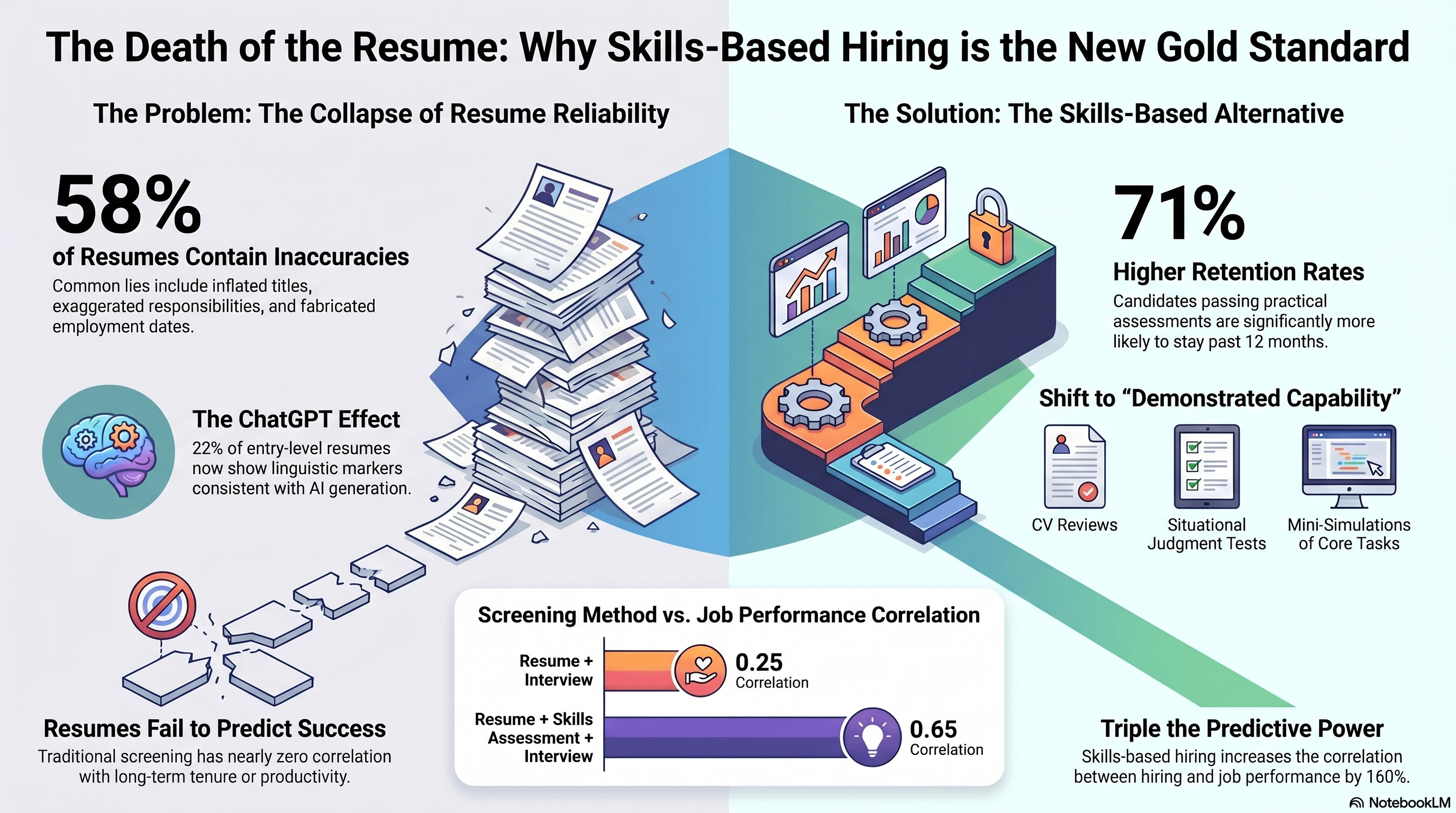
Resumes have never been reliable hiring documents, but the problem has accelerated dramatically. A 2023 CareerBuilder survey found that 58 percent of resumes contain significant inaccuracies—up from 46 percent in 2019. Among those inaccuracies, the most common include: inflated job titles (27 percent), exaggerated responsibilities (22 percent), fabricated dates of employment (15 percent), and outright invented credentials (12 percent).
For hourly roles, the problem is even worse. Because hourly candidates often have lower educational attainment and fewer 'impressive' experiences, they face incentive to inflate. A 2022 ADP Workforce Research Institute study found that 34 percent of retail and hospitality candidates misrepresented their work history, compared to 18 percent in professional roles.
The impact is measurable. When Background Checks, Inc. reviewed resume claims against verified employment records for 500+ retail hires, they found discrepancies in 41 percent of cases. In half of those cases, the discrepancy was significant enough to change the hiring decision (e.g., 'managed team of 8' became 'member of team of 8'; 'promoted to supervisor' was actually a temporary assignment).
The reputational cost is significant. You hire based on claimed experience. The person shows up lacking promised skills. Training and onboarding fail. The candidate leaves or is terminated. You've invested 20+ hours and $2,000 in a bad hire based on fiction. For high-volume operations, this happens dozens of times annually.
The ChatGPT Effect: AI-Generated Resumes Are Flooding Your ATS
Since November 2022, when ChatGPT reached mainstream adoption, resume fabrication has become trivial. Any candidate can prompt ChatGPT: 'Write a resume for a retail manager with experience in customer service, inventory management, and team leadership.' The AI generates a polished, grammatically perfect resume in 30 seconds.
Recruitment technology researchers at the University of Michigan and LinkedIn conducted a study in 2024 analyzing 100,000 resumes submitted to high-volume employers. Using language pattern analysis, they identified that 22 percent of entry-level resumes showed linguistic markers consistent with large language models (LLM)—unusual vocabulary consistency, suspiciously perfect grammar, absence of personal voice, repetition of common phrases.
The problem compounds because LLM-generated content is difficult to detect with traditional tools. It doesn't plagiarize—it generates novel text that sounds plausible. Existing plagiarism detection tools flag copied text; they don't flag convincingly fabricated experience.
What does AI-generated resumes look like in practice? Common signals:
- Bullet points that are extremely verbose (80-120 characters) instead of the typical 40-60 character range
- Corporate jargon ("synthesized cross-functional initiatives") from someone who had an hourly job
- Perfect parallelism in bullet structures (every bullet starts with an action verb, no exceptions)
- Absence of personal details, specific metrics, or unique story elements
- Vocabulary mismatch with typical language for that role (a grocery cashier shouldn't use "stakeholder engagement")
For hiring managers, the implication is stark: you cannot trust resume content. A polished resume is no longer a signal of honesty or communication skill—it's a signal that the candidate has access to an internet connection.
The Skills-Based Hiring Alternative: Measuring What Actually Matters
If resumes don't predict job success, what does? Demonstrated capability—the ability to actually perform the job tasks.
Skills-based hiring replaces resume review with direct assessment of job-relevant capabilities. Instead of asking 'Does this resume claim customer service experience?', you ask 'Can you demonstrate customer service capability?'
For retail and hospitality, this typically means:
- Role plays or situational judgment tests: 'A customer is unhappy with a return. What's your first step?' (measures judgment)
- Work samples: Process a mock transaction, operate a POS system, or answer product-knowledge scenarios (measures technical capability)
- Practical assessments: Handle a customer service call, resolve a schedule conflict, or troubleshoot equipment (measures applied skill)
The evidence for skills-based hiring is compelling. A 2024 Harvard Business Review study of 500+ retailers found that candidates who passed a practical customer service assessment were 71 percent more likely to remain employed at 12 months compared to candidates screened solely on resume and interview. The mechanism is simple: the assessment directly predicts on-the-job performance because it mimics the job.
Skills-based hiring also reduces demographic bias. Resume screening introduces bias because hiring managers make unconscious associations based on name, school, or unexplained gaps. Practical assessments are harder to bias—the candidate either processes the transaction correctly or doesn't.
Practical Assessment Integration: How to Implement at Scale
Shifting from resume-based screening to skills-based assessment requires operational changes. Here's how high-volume employers have done it:
Step 1: Design Job-Specific Assessments (2-4 weeks)
Identify 3-5 core job tasks. For a retail associate, these might be: (1) Customer service response, (2) Cash handling/POS accuracy, (3) Product knowledge, (4) Safety/loss prevention, (5) Teamwork.
Create brief assessments for each. Aim for 3-5 minutes per assessment, total 10-15 minutes per candidate. Examples:
- Customer service: Situational judgment ('Customer returns item without receipt. What do you do?') — 3 minutes
- POS/Cash handling: Mini-simulation or typed responses ('Walk me through processing a return') — 3 minutes
- Product knowledge: 5-7 multiple-choice questions specific to your products — 2 minutes
Step 2: Establish Passing Standards (1 week)
Have current high performers and supervisors complete the assessments. Calculate the median score. That becomes your passing threshold. This ensures your standard reflects actual job requirements, not arbitrary cutoffs.
Example: If your top-performing retail associates score 78-92 on a POS assessment, set the passing score at 75. This filters out candidates who will struggle operationally.
Step 3: Integrate into ATS Workflow (2 weeks)
Embed assessments directly into your application platform. The sequence should be: (1) Application/résumé (yes/no: are basics present?), (2) Knockout questions (location, availability, etc.), (3) Practical assessments, (4) Phone screen (if needed), (5) Interview.
Critical: deliver assessments in-platform, not via external links. External links have 15-25 percent drop-off rates. In-platform assessments have 85-95 percent completion.
Step 4: Train Hiring Managers (1 day)
Conduct a brief training: What does a passing assessment score mean? What doesn't it mean? How do you use it alongside interview impressions? Common mistake: managers think 'assessment score of 82 means this candidate is 82 percent as good as ideal.' Correct interpretation: 'Assessment score of 82 means this candidate has demonstrated the core job skills and is likely to perform well operationally.'
Step 5: Measure Impact (ongoing)
Track: (1) Assessment completion rates (target: 85%+), (2) Pass rates (typically 50-65%), (3) Offer acceptance rates (should not change), (4) First-90-day performance of hired candidates (supervisor ratings, productivity), (5) 12-month tenure (has hire quality improved?), (6) Adverse impact (are protected groups passing at similar rates?).
Best-in-class high-volume employers (Target, Amazon, Whole Foods) report that introducing skills assessments increases the correlation between hiring and 90-day job performance from 0.25 (resume + interview) to 0.55-0.65 (resume + skills assessment + interview).
Verification Challenges: Why Background Checks Are Not Enough
You might think: 'We'll just conduct thorough background checks. That verifies employment history.' This is partially true but incomplete.
Background checks verify dates and titles but rarely catch exaggerated responsibilities. Most background check companies contact HR departments, which confirm only employment dates and title (due to liability concerns). They almost never investigate whether a candidate 'managed a team' or 'increased sales by 20 percent'—those require subjective judgment.
Additionally, background checks happen late in the hiring process (after interview), wasting manager time. You've already spent 30-60 minutes interviewing someone whose credentials don't check out.
The solution: integrate verification earlier and deeper.
- Reference checks during screening (not after offer): Call 1-2 references immediately after the application, ask specific questions ('Tell me about a time this candidate provided customer service'), and listen for detailed stories vs. generic praise.
- Skills assessment before interview: Filter 60-75 percent of candidates with practical assessments. Now you're interviewing people whose core capabilities are verified, not claimed.
- Work history validation during interview: Ask candidates to walk you through their resume. 'Tell me about your role as shift supervisor. What were your specific responsibilities? How many people did you manage? How long was this role?' Listen for inconsistencies, vagueness, or stories that don't align with the title.
When a candidate's stated experience doesn't match the job requirements (they claimed 2 years retail but can't answer basic POS questions), you have a clear data point: either they're misrepresenting experience or they haven't retained it. Either way, they're not a strong hire.
The Irrelevance of Resumes for Hourly Roles
For hourly positions—retail, hospitality, logistics, healthcare support—resumes are functionally useless for prediction. Here's why:
Resumes are designed to showcase career progression and increasing responsibility. Hourly roles don't have typical career progression. A retail associate who worked at three stores looks identical on a resume to one who bounced between jobs weekly. A hospitality worker with a 2-year gap (caring for family, health issues, etc.) is penalized despite those gaps telling you nothing about their ability to do the current job.
Resumes also assume that past job titles predict current performance. An 'experienced retail associate' is a claim, not evidence. You need to know: Can they process transactions? Do they handle frustration well? Are they reliable? Can they learn your systems? None of this appears on a resume.
Research supports this. A 2023 study by the Center for Advanced Human Resource Studies (CAHRS) at Cornell University analyzed 10,000+ hourly hires across retail, hospitality, and food service. They found resume-based screeners had virtually no correlation with 6-month tenure (r = 0.08) or productivity ratings (r = 0.12). In contrast, practical skills assessments correlated at 0.42 with 6-month tenure and 0.38 with productivity.
Conclusion: Resumes do not predict success in hourly roles. They are a source of false confidence, introducing unreliable signals and bias into your hiring process. Replace resume-dependent screening with skills-based assessment.
Implementation Roadmap: From Resume Review to Skills-Based Hiring
This roadmap helps you transition away from resume screening toward verified capability assessment.
Month 1: Assessment Design and Pilot
Identify your most critical job—the role you hire most frequently or where turnover is highest. Design 3-5 brief practical assessments (total 10-15 minutes). Have 5-10 current high performers complete them. Set passing score at the 50th percentile of high performers.
Run a 2-week pilot with 50 applications. Use new assessments but continue hiring as you normally would (resume + interview). At the end, compare: Did the candidates who scored well on assessments actually perform better in the first 30 days? If yes, proceed to full rollout.
Month 2-3: Full Rollout and ATS Integration
Integrate assessments into your ATS. Configure the workflow: Application → Knockout Questions → Skills Assessments → Phone Screen → Interview. Communicate to hiring managers: 'Starting [date], all candidates will complete 10-minute skills assessments. Use these scores as a data point alongside interviews.'
Backfill data: Offer current hourly employees the same assessments. Track their scores and their actual performance (tenure, ratings, productivity) to validate the assessment is working in your environment.
Month 4-6: Measure and Optimize
Weekly dashboard: Assessment completion rate, pass rate, offer acceptance rate, time-to-hire, cost-per-hire. Monthly: Hire quality—comparing first-90-day performance of candidates with high assessment scores vs. low scores. Quarterly: Adverse impact analysis (are pass rates similar across demographic groups?).
Iterate on assessments based on data. If 80% of candidates pass, the assessment is too easy; tighten it. If 30% pass, it may be too hard or irrelevant. Target: 50-65% pass rate.
Month 6+: Scale Across Roles
Design assessments for your other high-volume roles (warehouse, hospitality, etc.). Use the same process: pilot, validate, rollout, measure. After 6 months of data, most organizations see 30-50% improvements in 6-month retention and 20-40% improvements in first-90-day performance.
References and Further Reading
- CareerBuilder. (2023). Resume Fraud Survey. CareerBuilder Research.
- ADP Workforce Research Institute. (2022). The Cost of Inaccurate Information in Hiring. ADP Research Report.
- Background Checks, Inc. (2023). Resume Accuracy Study: Retail and Hospitality Sector. Internal Research.
- University of Michigan & LinkedIn. (2024). Language Analysis of AI-Generated Resume Content. Collaborative Study.
- Harvard Business Review. (2024). Skills-Based Hiring and Employee Retention in Retail. Research Study.
- Center for Advanced Human Resource Studies (CAHRS), Cornell University. (2023). Predictive Validity of Assessment Methods in Hourly Hiring. Research Report.
- Equal Employment Opportunity Commission (EEOC). (2007). Uniform Guidelines on Employee Selection Procedures.
- Highfield, L. (2023). The Resume Problem: Why AI-Generated Content Is Changing Recruitment. Workable Blog.
How Cadient Talent SmartSuite™ Helps
Cadient Talent’s SmartSuite™ platform automates compliance workflows, embeds regulatory guardrails directly into your hiring process, and maintains audit-ready documentation at every stage—so your team can focus on finding great talent while staying protected from costly violations.
