Meta-analysis proves: consistent questions and rating scales predict job performance far better than intuition
The Gut-Feel Problem: Why Intuition Is Systematically Biased
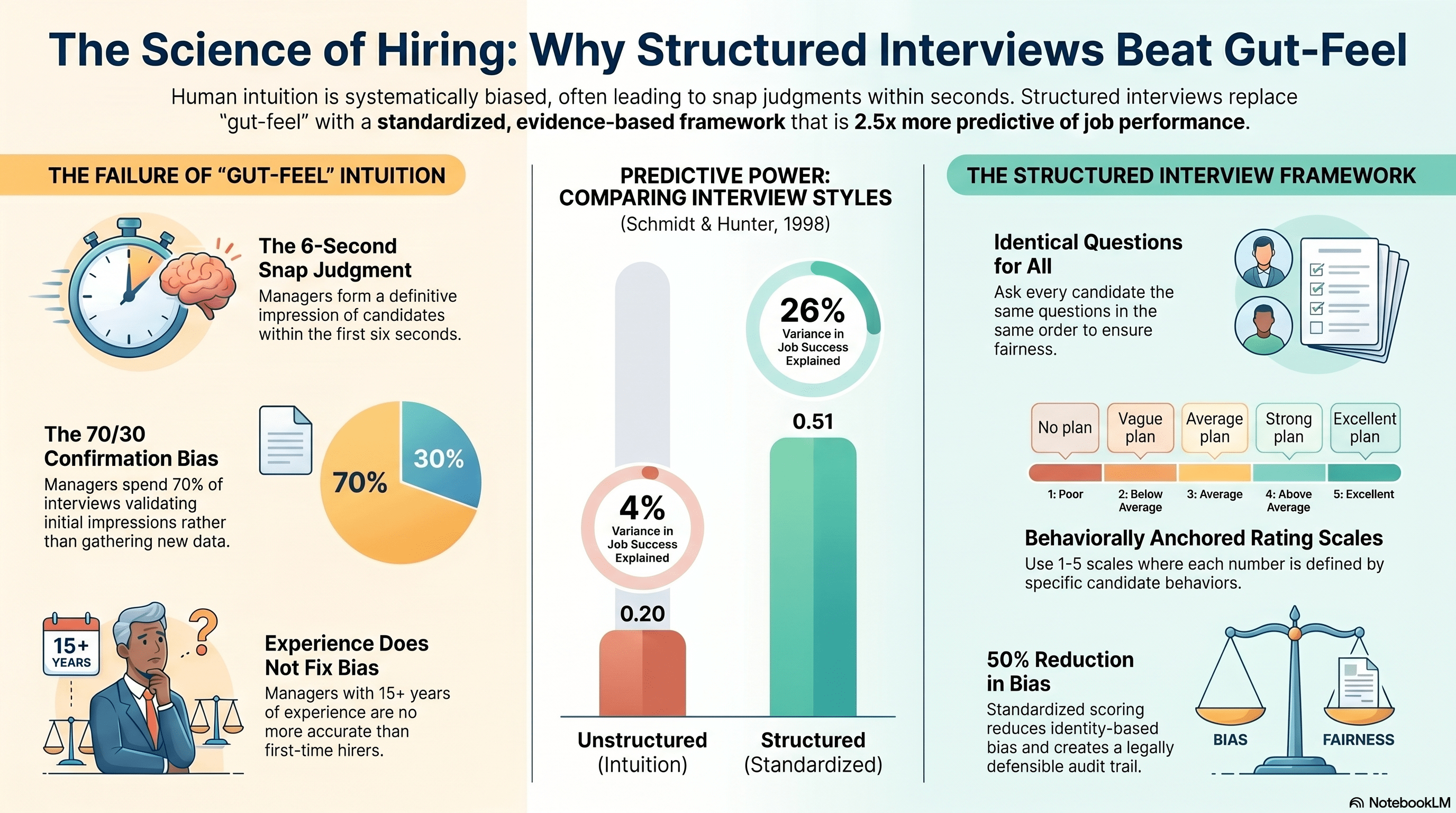
Hiring managers rely on intuition. A candidate sits across the table. The manager forms an impression in the first 30 seconds (research shows this happens by second 6, actually). The interview is theater—manager is confirming their snap judgment, not gathering new data.
This is not a character flaw; it's a cognitive limitation. The human brain makes rapid, unconscious judgments and then seeks confirming evidence (confirmation bias). Studies show hiring managers spend 70% of interview time validating their initial impression and only 30% gathering new information.
The consequences are predictable: hiring managers hire people similar to themselves (affinity bias), people they like personally (likability bias), people who performed well in the interview but not necessarily on the job (interview performance ≠ job performance).
Quantifying the problem: Unstructured interviews—different questions asked to different candidates, subjective evaluation—correlate at 0.20 with job performance (Schmidt & Hunter, 1998). This means unstructured interviews explain only 4% of variance in job success. A coin flip would be almost as predictive.
Senior hiring managers think they're better than this. Research disagrees. A 2022 study in the Journal of Applied Psychology found that interview experience level (15+ years of hiring experience vs. first time) had nearly zero relationship with interview predictive validity. Even experienced managers use the same biased heuristics.
The Structured Interview Framework: Evidence-Based Approach
Structured interviews are systematically different from unstructured. They share three elements: (1) identical questions asked to all candidates, (2) predetermined rating scales, (3) documented evaluation.
Element 1: Standardized Questions Based on Job Analysis
Start with a formal job analysis: What tasks does the job require? What knowledge, skills, and abilities are necessary? From this, develop 6-8 interview questions that directly assess job-relevant competencies.
Example for a retail supervisor role:
Job Analysis: Must manage a team of 5-8, schedule staff, handle conflicts, drive sales targets, enforce loss prevention.
Structured Interview Questions:
- 'Describe a time you had to manage a conflict between team members. How did you handle it?' (Assesses conflict management)
- 'Tell me about your experience with scheduling and workload management. What's your approach?' (Assesses planning/organization)
- 'Have you worked with sales targets or performance metrics? How do you motivate your team to meet them?' (Assesses performance management)
- 'Describe an instance where you identified a loss prevention or safety issue. What did you do?' (Assesses vigilance and adherence to policy)
Critical: All candidates answer the same questions in the same order. No deviations. No 'let me ask a follow-up I didn't ask the last candidate.'
Element 2: Predetermined Rating Scales (Behaviorally Anchored)
For each question, create a 1-5 scale with behavioral anchors. Don't just score 'good' or 'bad'—define what each level looks like.
Example (Conflict Management Question):
5 = Excellent: 'Described a specific conflict, identified root cause, facilitated discussion between parties, reached resolution, followed up to ensure effectiveness.' (Evidence: manager took structured approach, documented resolution, checked outcome)
4 = Good: 'Described a conflict and how they addressed it; resolution was reached.' (Evidence: identified issue and took action; outcome was positive)
3 = Satisfactory: 'Described a conflict; response was reactive or vague.' (Evidence: acknowledged issue but approach lacked structure or clarity)
2 = Below expectations: 'Conflict mentioned but candidate didn't clearly describe their role or outcome was negative.' (Evidence: deflected responsibility or conflict escalated)
1 = Unacceptable: 'Candidate avoided the question, gave irrelevant example, or described mishandling.' (Evidence: poor judgment or evasion)
Rater uses this scale to evaluate each response. '5' vs '4' is clear because behavioral anchors define the difference.
Element 3: Documented Evaluation and Scoring
Immediately after interview, hiring manager documents: The candidate's actual response to each question (verbatim or detailed notes), the rating on the 1-5 scale, the reasoning (which behavioral anchor matched?). This creates accountability and consistency.
Total interview score = Sum of ratings across 6-8 questions. Score range: 6-40 (or however many questions you use). Establish a passing threshold based on current high performers (typically, 20th-30th percentile of high performers' scores).
Example: Your top 10 retail supervisors complete the structured interview and score an average of 32/40. Set hiring threshold at 25—candidates scoring below 25 are unlikely to perform as well.
The Research Evidence: Meta-Analysis of Structured vs. Unstructured
The gold standard study is Schmidt & Hunter (1998), a meta-analysis of 136 years of selection research involving 500,000+ job placements. Key findings:
Unstructured interview validity: r = 0.20 (explains 4% of variance in job performance)
Structured interview validity: r = 0.51 (explains 26% of variance in job performance)
Structured interviews are 2.5x more predictive than unstructured.
A more recent meta-analysis by Levashina et al. (2014) in the Journal of Applied Psychology, examining 336 studies and 150,000+ hires, confirmed: Structured interviews (standardized questions, rating scales) correlate at 0.44-0.51 with job performance. Unstructured interviews correlate at 0.18-0.25.
Why does structure matter so much?
- Reduced Bias: Identical questions eliminate opportunities for bias to influence what candidates are asked. You can't ask women different questions than men if everyone answers the same questions.
- Reduced Subjective Judgment: Rating scales with behavioral anchors eliminate 'I have a good feeling about this person.' Judgment is constrained to the scale. If the candidate's response matches a '3,' the score is 3, regardless of whether the manager likes them.
- Comparable Data: When all candidates answer identical questions and are rated on identical scales, you can directly compare scores. Candidate A scored 32, Candidate B scored 28. This is meaningful. With unstructured interviews ('I vibed with A more than B'), comparison is meaningless.
- Reduced Recency/Likeability Bias: In unstructured interviews, candidates who are likeable or who speak well get higher ratings (they're better at interviews, not better at the job). In structured interviews, specific job-relevant competencies are being measured. Likeable candidates who lack relevant skills score lower.
The evidence is unequivocal: Structured interviews significantly outperform unstructured.
Implementation for Frontline Hiring Managers: Making It Practical
Many organizations say 'We'll do structured interviews' and then don't, because hiring managers resist ('I'll just ask questions that feel natural'), or the organization fails to enforce consistency. Here's how to implement successfully:
Step 1: Formal Job Analysis (2 weeks)
Conduct interviews with 3-5 current high performers and 2-3 supervisors. Ask: What does this job require? What are the biggest challenges? What separates good performers from mediocre? Document the critical competencies (e.g., conflict management, reliability, sales drive, customer empathy).
Step 2: Develop Structured Interview Guide (2 weeks)
For each critical competency, write 1-2 interview questions. Questions should be behavioral ('Tell me about a time...') or situational ('How would you handle a situation where...'). Examples:
- Behavioral: 'Tell me about a time you had to learn a new system or process. How did you approach it?'
- Situational: 'How would you respond to a customer complaint about a pricing error in our system?'
Create the rating scale (1-5 with behavioral anchors) for each question. Have supervisors and high performers review and refine. This ensures questions and scales reflect actual job requirements.
Step 3: Manager Training (1 day)
Declare 4 hours of mandatory training for all hiring managers. Content:
- Why structured interviews work (show research)
- How to administer the interview (read questions verbatim, ask follow-ups only to clarify, no tangents)
- How to score using the rating scale (match candidate's response to behavioral anchors)
- Common mistakes (asking different questions, being influenced by likability, making hiring decisions before the interview is finished)
- Practice: Conduct a mock interview, score it, compare with trained rater
Step 4: Implement with Accountability
Make the structured interview mandatory. Configure your ATS or paper process to include the interview guide and rating scale. Require managers to document scores before making hiring decisions. The score plus documented reasoning becomes the hiring record.
Step 5: Monitor Compliance (ongoing)
Audit interview documentation monthly. Are managers using the rating scale, or writing 'Good candidate'? Are they asking the standardized questions, or making up their own? Provide feedback and retraining as needed.
Common resistance: 'This feels robotic. I want to have a natural conversation.' Response: You can have a natural conversation—after the structured questions. Use the first 20 minutes for structured questions and ratings. Use the final 10 minutes for whatever you want ('Any questions for me?'). Managers who implement this way find they become much better interviewers because they're focused on data, not gut feel.
Bias Reduction: How Structure Eliminates Affinity, Gender, and Racial Bias
One of the most powerful benefits of structured interviews is bias reduction. This isn't theoretical—it's measurable.
A landmark study by Powell (1991) examined hiring decisions for identical resumes with different names. One version had a stereotypically white male name, another a stereotypically female name, others Black or Latino names. Results: identical qualifications, different names, led to 25-40% differences in interview evaluations and hiring recommendations.
However, when the same decisions were made using structured interviews (identical questions, rating scales), the name-based differences largely disappeared. Why? Because interview time is spent gathering data about competence, not forming impressions based on identity.
A 2023 study by the Center for Talent Innovation found:
- Unstructured interviews: 63% of managers made hiring decisions within the first 5 minutes, often unconsciously influenced by identity
- Structured interviews: Only 12% of managers made early decisions; the majority changed their initial impression based on structured questions
This has legal and moral implications. Structured interviews are also more legally defensible. If a candidate sues claiming discrimination, you can produce: (1) Job analysis documenting job-relevant competencies, (2) Interview questions linked to those competencies, (3) Rating scales with behavioral anchors, (4) Documented scores and reasoning. This creates an audit trail showing you made decisions based on job-related factors, not protected characteristics.
Companies like Google, Amazon, and Target mandate structured interviews specifically for bias reduction. Google's research showed that unstructured interviews had hiring bias consistent with the general population's biases; structured interviews reduced bias by 50%+ while improving hire quality.
Question Libraries: Building and Maintaining Question Banks
To ensure consistency and efficiency, develop a library of pre-vetted structured interview questions for your most common roles. This prevents managers from 'reinventing' questions and introducing inconsistency.
Structure the library by competency:
Competency: Customer Service
- Q1: 'Tell me about a time a customer was upset. How did you respond?'
- Q2: 'Describe a situation where you had to go above and beyond for a customer.'
Competency: Reliability/Attendance
- Q1: 'Tell me about a situation where you had to manage multiple priorities. How did you ensure reliability?'
- Q2: 'Describe a time you had to push through a challenge to get to work or complete a responsibility.'
Competency: Teamwork
- Q1: 'Tell me about a time you worked with someone difficult. What happened?'
- Q2: 'Describe a time you helped a coworker with a task or challenge.'
For each question, include rating anchors (1-5 scale). This library becomes the standard for all interviews for that role. Managers choose 6-8 questions from the library to cover the critical competencies, but they ask the same questions to all candidates for that role.
Update the library annually based on: (1) Changes to job requirements, (2) Manager feedback (which questions are most predictive?), (3) Adverse impact analysis (are any questions biased against protected groups?).
Maintain the library in a document or ATS accessible to all managers. Store example responses (strong, medium, weak) so managers can calibrate their scoring.
Training Requirements: Getting Managers to Actually Use Structured Interviews
The biggest implementation risk is not the design of the structured interview—it's manager adoption. Managers revert to unstructured interviews without ongoing training and accountability.
Initial Training (4 hours, annual refresher 1 hour)
Core training must cover: (1) Why it matters (research evidence), (2) How to administer (verbatim reading of questions, consistency), (3) How to score (matching to behavioral anchors, avoiding influence of likability), (4) Mock interview with scoring and calibration, (5) Hands-on practice with feedback.
Calibration Sessions (Quarterly, 30 min)
Bring hiring managers together (in person or virtual). Present a candidate interview response. All managers independently score it using the rating scale. Compare scores. Discuss: 'Why did manager A score this a 4 and manager B a 3? Which behavioral anchor does this response match?' This calibration prevents rating drift.
Performance Feedback (Monthly)
Review hiring manager interview documentation. Provide feedback: 'You asked this candidate question 2 but didn't ask candidate B question 2. Ensure all candidates are asked all questions.' 'You wrote 'good response' but didn't score it. Score every response 1-5.'
Manager Resistance: Common Pushback and How to Respond
'This feels robotic and takes away from natural conversation.' Response: The structure takes 20 minutes. You can have natural conversation after. More importantly, your job is to predict job performance, not make friends. Structure helps you do that better.
'I've been hiring for 15 years; I know talent when I see it.' Response: Research shows that interview experience has zero relationship with interview accuracy. Even experienced managers have biases. The structure isn't an insult to your experience—it's a tool that makes you better.
'My candidates are offended by the formal questions.' Response: Have you asked them? Pilot research shows candidates actually prefer structured interviews (they feel fair). If a candidate is offended by job-relevant questions, that's data about their attitude.
Combining Structured Interviews with Other Data: Multi-Method Prediction
Structured interviews are powerful alone (r = 0.51), but they're even more powerful combined with other predictors.
The strongest hiring decisions combine multiple data sources:
- Cognitive ability test (r = 0.51)
- Structured interview (r = 0.51)
- Work sample test (r = 0.54)
- Personality assessment (r = 0.35-0.40)
When combined (each weighted equally), the combined validity is r = 0.65-0.70. This means you're explaining 42-49% of variance in job success—a 10x improvement over gut-feel hiring.
For practical implementation, the workflow is:
- Knockout questions: Location, availability, certifications (eliminates 40-50%)
- Cognitive ability or skills assessment: Practical job-relevant capability (eliminates another 25-35%, keeping top 50-60%)
- Structured interview: Job-relevant competencies (results in 10-20% hired)
- Reference checks: Verify claims and get additional perspective (rare to find new information, but fills gaps)
Each layer is data-driven and reduces subjectivity. By the time you're making an offer, you have 4-5 independent data points suggesting the candidate will succeed.
References and Further Reading
- Schmidt, F. L., & Hunter, J. E. (1998). The validity and utility of selection methods in personnel psychology: Practical and theoretical implications of 85 years of research findings. Psychological Bulletin, 124(2), 262-274.
- Levashina, J., Hartwell, C. J., Morgeson, F. P., & Campion, M. A. (2014). The structured employment interview: Narrative and quantitative review of the research literature. Personnel Psychology, 67(1), 241-293.
- Powell, G. N. (1991). Applicant reactions to the initial employment interview. Journal of Vocational Behavior, 28(1), 12-25.
- Center for Talent Innovation. (2023). Structured Interviews and Unconscious Bias. CTI Research Report.
- Rynes, S. L., & Gerhart, B. (1990). Interviewer assessments of applicant fit: An exploratory investigation. Personnel Psychology, 43(1), 13-35.
- DeCarlo, T. E. (2005). The effects of sales message and suspicion of ulterior motives on salesperson evaluation. Journal of Consumer Psychology, 15(3), 238-249.
- Huffcutt, A. I., & Arthur, W. (1994). Hunter and Hunter (1984) revisited: Interview validity for entry-level jobs. Journal of Applied Psychology, 79(2), 184-190.
How Cadient Talent SmartSuite™ Helps
Cadient Talent’s SmartSuite™ platform automates compliance workflows, embeds regulatory guardrails directly into your hiring process, and maintains audit-ready documentation at every stage—so your team can focus on finding great talent while staying protected from costly violations.
