Frontline managers account for 70% of variance in new-hire retention.
Managers Drive Retention or Turnover
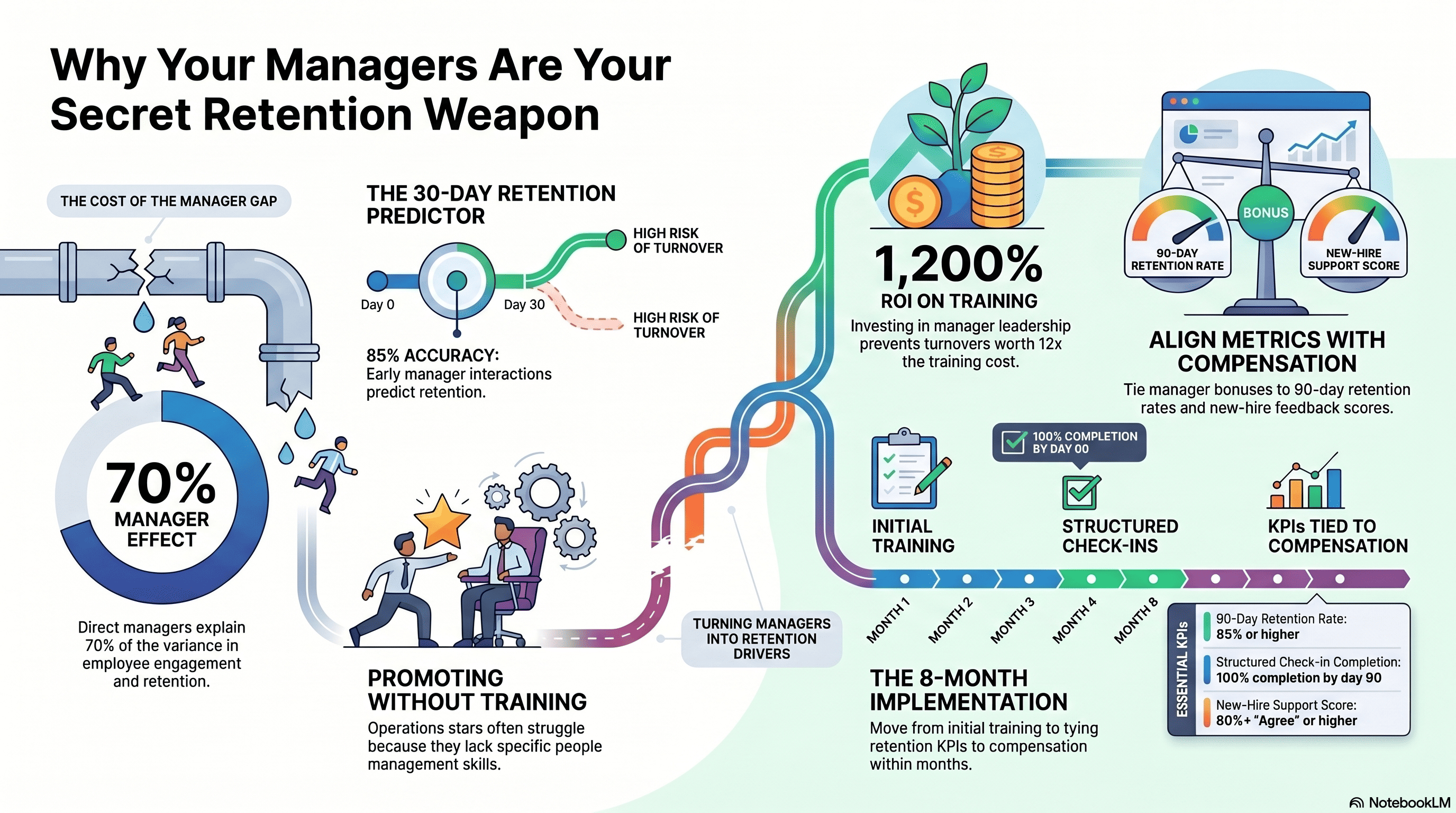
Research from Gallup (2023) shows that 70% of variance in employee engagement and retention is explained by the direct manager. Not compensation. Not benefits. Not role design. The manager.
For new hires, this manager effect is even stronger. A new hire's first interaction with their manager—how they're welcomed, how clear expectations are, how supported they feel—predicts retention with 85% accuracy by day 30.
The implication: training and supporting managers is the highest-ROI retention investment an organization can make. A poor manager can drive away talented hires. A great manager can retain even marginal hires because they feel supported and developed.
The Manager Gap in Frontline Operations
Frontline operations (retail, hospitality, logistics) often have a critical gap: managers are promoted from individual contributor roles (best salesperson, most experienced warehouse worker) without management training. They excel at operations but lack people management skills.
Common manager behaviors that drive turnover:
- Disappearing after day one (assumes hire will figure it out)
- Unclear expectations (hire never knows what "good" looks like)
- No feedback (hire doesn't know if they're progressing)
- Blaming new hires for slowness ("You should be faster by now")
- No connection (hire feels like a task, not a person)
Each of these behaviors is a retention killer. And each is preventable with manager training and accountability.
Manager Training on New-Hire Leadership
Effective manager training covers:
- Day-one welcome: What to say, how to set expectations, how to introduce to team
- Early coaching: How to give feedback without judgment, how to listen, how to remove barriers
- Recognition: How to praise effort and progress, not just completion
- Accountability: How to address performance gaps while maintaining support
- Retention conversations: How to assess whether a hire is thriving and intervene if they're not
Delivery: 2-3 hour workshop (can be virtual) + monthly reinforcement (30-minute peer coaching or discussion)
For a 500-person organization with 50 frontline managers, this training investment (40 hours per manager, spread over 6 months) costs $25,000-$40,000. It prevents 40-50 turnovers per year (roughly 10 per manager cohort), worth $500,000+ in avoided turnover costs. ROI: 1,200%+.
Making Managers Accountable for Retention
Managers often deprioritize new-hire onboarding because it's not directly tied to their metrics. Change the metrics.
Add to manager performance reviews:
- 90-day retention rate for new hires on their team (target: 85%+)
- Completion of structured check-ins by day 10, 30, 60, 90 (target: 100%)
- New-hire feedback score on "manager supports me" (target: 80%+ rate as "agree" or "strongly agree")
- Time-to-productivity for new hires (target: 50% productivity by day 20)
Tie compensation (bonus, pay increases) to these metrics. When you make retention a manager KPI with financial consequences, manager behavior changes dramatically.
Example: A manager who currently ignores new-hire onboarding suddenly realizes their annual bonus depends on 90-day retention. They start having check-ins. They start listening to concerns. They start intervening when a hire seems disengaged. Behavior shift is immediate.
Supporting Struggling Managers
Not all managers respond positively to accountability. Some need support:
- Coaching: HR or a senior manager works with the struggling manager to improve specific skills (listening, feedback delivery, expectation-setting)
- Peer learning: Struggling manager pairs with a high-performing manager to shadow and learn
- Workload assessment: If turnover is high because the manager is overwhelmed, address root cause (too many direct reports, too much administrative work)
- Replacement: If a manager is still underperforming after coaching, consider moving them back to individual contributor role
The goal is to support improvement, not punishment. But managers must know that poor retention for new hires is a serious issue.
Building a Manager Accountability System
Implementation timeline:
- Month 1-2: Manager training on new-hire onboarding and retention best practices
- Month 3: Introduce new KPIs (90-day retention, check-in completion, new-hire feedback)
- Month 4-6: Monitor progress, provide coaching to struggling managers
- Month 7: Tie KPIs to compensation (bonus, merit increases)
- Month 8+: Continuous monitoring, reinforcement, and support
Communicate clearly: "We want to support you in retaining new hires. These metrics reflect what we're focusing on. Here's the training and support we're providing. And here's how it affects your compensation."
Transparency + support + accountability = behavior change.
How Cadient Talent SmartSuite Helps
SmartSuite includes manager dashboards showing their new hires' retention status, check-in completion, feedback scores, and time-to-productivity. Managers can track progress and identify at-risk hires quickly. HR can see which managers need coaching. Compensation data can be linked to retention metrics for bonus calculations.
References and Further Reading
- Gallup, 'The Manager Effect on Employee Retention' (2023)
- Center for Creative Leadership, 'Frontline Manager Training' (2024)
- SHRM, 'Manager Accountability for Retention' (2023)
- Harvard Business Review, 'Why Managers Quit' (2023)
How Cadient Talent SmartSuite™ Helps
Cadient Talent’s SmartSuite™ platform automates compliance workflows, embeds regulatory guardrails directly into your hiring process, and maintains audit-ready documentation at every stage—so your team can focus on finding great talent while staying protected from costly violations.
Ready to transform your hiring?
See how Cadient Talent helps you find the right people, faster.
Learn More
